
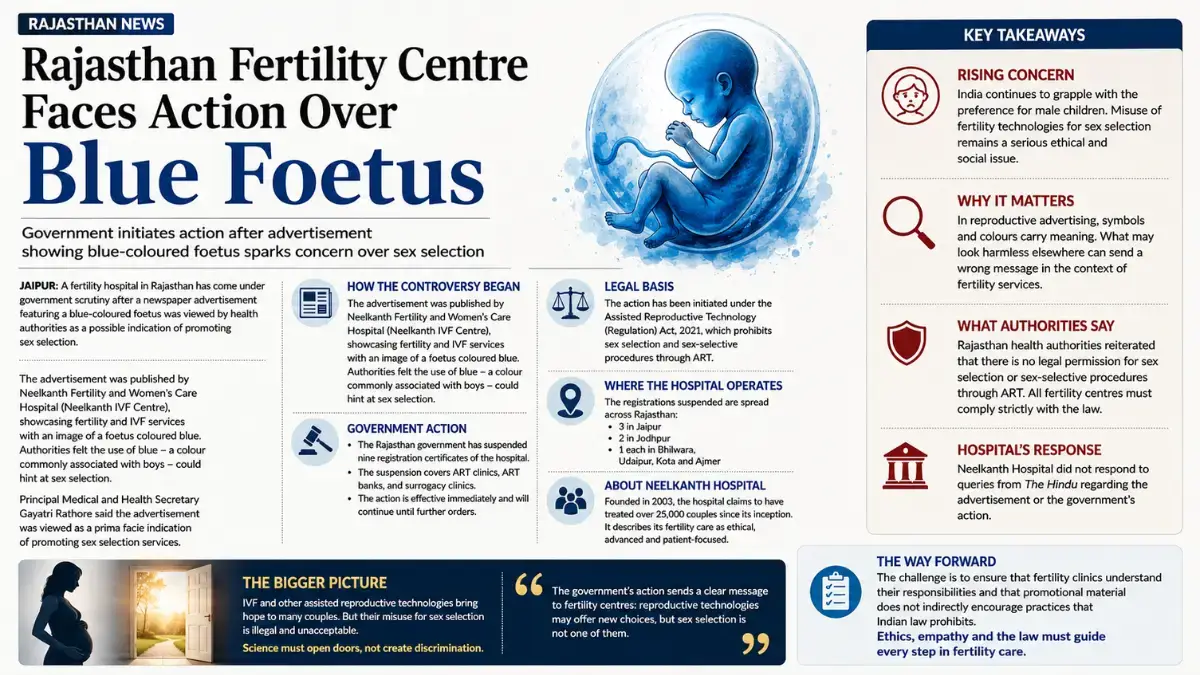
Recently a fertility hospital in the Rajasthan’s Jaipur district has come under the government scrutiny infamously after a newspaper advertisement having a blue-coloured foetus was viewed by health authorities as a possible indication of promoting sex selection. This advertisement was published by Neelkanth Fertility and Women’s Care Hospital, also known as Neelkanth IVF Centre, following the publication of which, the State health department initiated action against the hospital and warned that the sex selection before the birth of the child is strictly prohibited under Indian law.
The controversy centres on the use of blue colour in the advertisement. While blue is widely used in advertising and popular culture to represent boys or male children, officials felt that its use in an advertisement for fertility and assisted reproductive services could send a different and potentially problematic message. Rajasthan Principal Medical and Health Secretary Gayatri Rathore said the department considered the advertisement a preliminary indication that the hospital might be attempting to promote sex-selection services.
According to the official, the hospital had advertised its IVF, fertility and assisted reproductive services using an image of a foetus coloured blue. Since blue is commonly associated with male children, the authorities viewed the advertisement with concern.The government has subsequently suspended nine registration certificates connected with assisted reproductive technology (ART) clinics, ART banks and surrogacy clinics operated by the hospital. The suspension has taken immediate effect and will remain in place until further orders.
The registrations affected by the action are spread across several cities in Rajasthan. Three are in Jaipur, two in Jodhpur, and one each in Bhilwara, Udaipur, Kota and Ajmer. The action has been initiated under the Assisted Reproductive Technology (Regulation) Act, 2021. The legislation places strict restrictions on practices that could facilitate sex selection through assisted reproductive technology.
Rajasthan health authorities have reiterated that there is no legal permission for sex selection or sex-selective procedures through ART. The government has also indicated that fertility clinics operating in the State will be expected to follow the law strictly. The controversy highlights a larger concern surrounding India’s continuing battle against sex selection and the preference for male children. Although modern fertility technologies have provided new possibilities for people struggling with infertility, the same technologies can raise serious ethical concerns when they are misused for selecting the sex of a child. The use of symbols, colours or imagery in advertising therefore becomes particularly important in this sector. An advertisement that may appear harmless in another context can acquire a completely different meaning when it is associated with reproductive services.
Neelkanth Hospital was established in 2003. According to information available on its website, the hospital has provided fertility treatment to more than 25,000 couples since its establishment. It describes its approach to fertility care as ethical, advanced and focused on patients. The incident once again brings the question of ethical boundaries in fertility treatment and reproductive advertising into focus. IVF and other assisted reproductive technologies can be life-changing for couples hoping to have children, but their use must remain within the boundaries laid down by law.
For regulators, the challenge is not simply to act after a questionable advertisement appears. It is also to ensure that fertility clinics understand their responsibilities and that promotional material does not indirectly encourage practices that Indian law prohibits. In this case, the Rajasthan government’s action sends a clear message to fertility centres that the reproductive technologies may offer new choices, but sex selection is not one of them.