
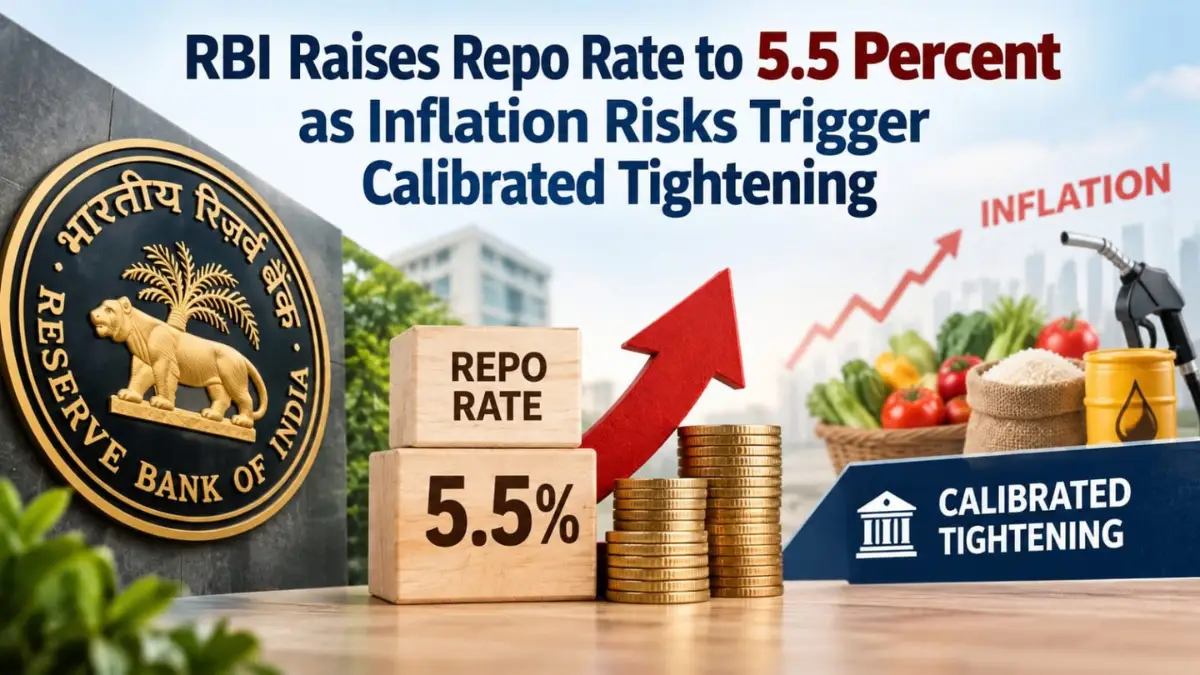
The Monetary Policy Committee (MPC) has held its recent meeting from October 5 to October 7, 2026 and has changed its policy stance from the neutral to the “calibrated tightening,” with the Reserve Bank of India (RBI) raising its policy repo rate by 25 basis point from 5.25 % to 5.50%. Since the February 2023, it is the first increase in the repo rate. This decision taken by the Monetary Policy Committee of the RBI is crucial in the event of the rising fuel and food prices, the growing uncertainties in the global geopolitical conditions, especially the sudden re-escalation of the West Asian conflict in the month of September, and the increasing volatility in the financial markets due to the rise in the bond yields in the the advanced economies and an appreciating US Dollar, as told by the RBI Governor, Mr. Sanjay Malhotra. He also stressed that the uncertainty surrounding the valuations of the artificial intelligence-related stocks could also pose significant downside risks to the global economic outlook.
This recent move by RBI marks a significant change after a long period of monetary easing. The repo rate had been reduced to 5.25% in December 2025 and was subsequently kept unchanged at the next four MPC meetings. During the earlier easing cycle, the MPC had cut the policy rate by a total of 125 basis points, bringing it down from 6.50 % to 5.25%.
The RBI has also made it clear that the rate cuts are not possible in the near term, and that the repo rate could either be increased or remain unchanged, depending upon the economic and the geopolitical conditions. However, the duration of this hike in the repo rate would depend on the actual growth and the trend of inflation. The RBI is particularly watching the broadening of price pressures and the possibility of second- round effects arising from the supply shocks.
The policy repo rate is the rate at which the RBI lends the short-term funds to the commercial banks, and with the increase in the repo rate, the cost of funds for the banks also increase, that can eventually make the borrowing of loans more expensive for the banks. Some of the examples include the home loans, the vehicle loans and the personal loans.
Further, the RBI has kept the Standing Deposit Facility (SDF) at 5.25% and the Marginal Standing Facility (MSF) at 5.75%. The Standing Deposit Facility (SDF) is a facility through which the banks are given the option of parking their excess or surplus funds with the RBI and they can earn interest in return without providing the collateral, thereby helping the central bank in the absorption of the excess liquidity from the banking system. The Marginal Standing Facility, however, works differently as it allows the eligible banks to borrow the short-term funds from the RBI against the specified securities if they face a temporary shortage of funds. Therefore, it acts as an emergency or marginal source of overnight liquidity for the banks. By keeping the SDF at 5.25% and the MSF at 5.75%, the RBI has tried to maintain the operating corridor around the repo rate while tightening the overall monetary conditions.
The RBI is expecting the headline Consumer Price Index (CPI) inflation to average almost 5.8 % over the next three quarters, while the core inflation is projected at around 4.4 percent for this financial year. Therefore, inflation is likely to remain at the centre of the policy decisions of the RBI.
The central bank also highlighted the difficulty in distinguishing between the second- round effects of the supply-side pressures and their indirect impact on inflation. While the monetary policy can influence demand and the inflation expectations, the supply-side shocks such as the higher food and energy prices can create inflationary pressures that are more difficult to control through the interest-rate changes alone.
However, irrespective of the challenging global backdrop, the RBI has maintained that the Indian economy remains strong. The economic momentum continues to be broad-based, while the overall economic structure is expected to remain resilient. The latest hike in the policy repo rate, therefore, reflects a cautious approach that is aimed at containing the inflationary risks while maintaining the financial stability. Also, the shift from neutral to the calibrated tightening by the RBI sends a clear message to the financial markets, the businesses and the borrowers that the period of declining interest rates may have ended for now and the future decisions will depend heavily on the trends of inflation, the economic growth, the global commodity prices, the geopolitical developments and the financial market conditions. Finally, to talk about the impact of this rate hike on the borrowers, they will have to deal with the higher borrowing costs, while the savers may benefit from the improved returns on some deposits as the financial institutions adjust their interest rates.