
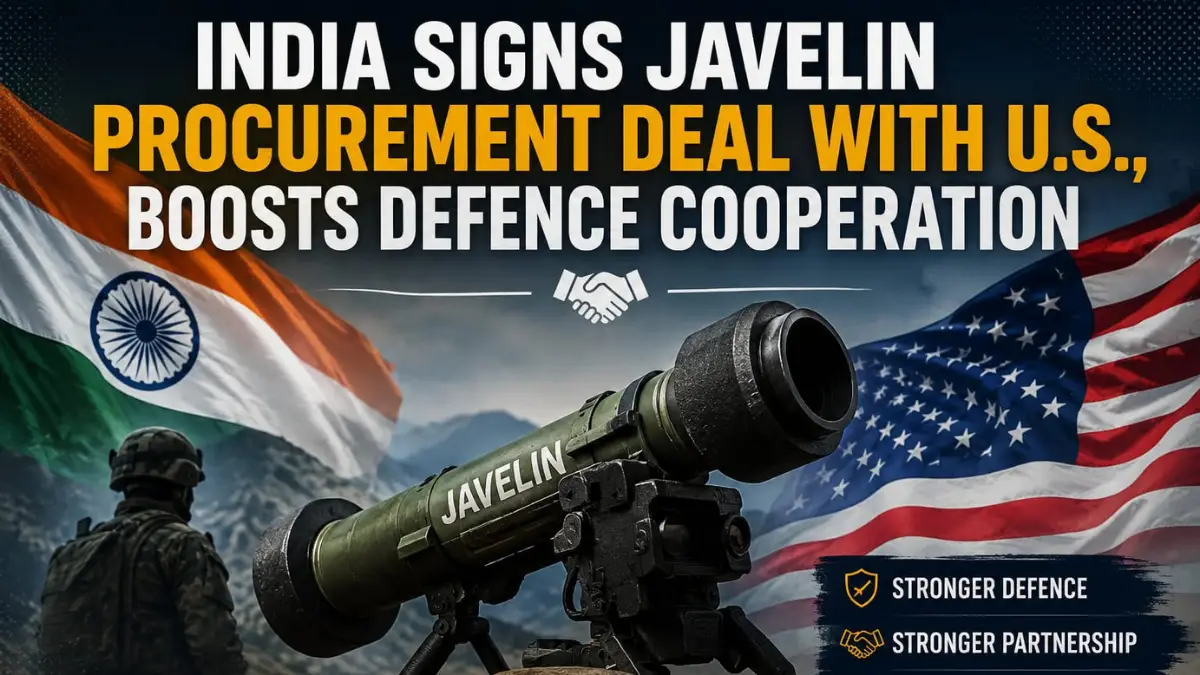
In order to strengthen its defence partnership with the United States, India has signed a Letter of Offer and Acceptance (LOA) for the procurement of Javelin anti-tank guided missile systems. The agreement, signed on Friday, marking an important development in military cooperation between the two countries and it is expected to enhance the operational capabilities of the Indian Army.
The Javelin missile systems would be procured through the U.S. Foreign Military Sales (FMS) route. The decision came in the backdrop of India’s continuing efforts to strengthen its armed forces and to improve their preparedness following the military developments associated with the Operation Sindoor.
The procurement is being undertaken under the emergency procurement powers granted to the armed forces, which allow the military to acquire critical equipment quickly whenever there is an urgent operational requirement. The defence sources said that the Indian Army is procuring the Javelin systems in limited numbers as a part of this effort.
Under the emergency procurement framework, the armed forces are allowed to enter into the contracts involving expenditure of up to ₹300 crore for each equipment category. The contracts are expected to be placed under the sixth tranche of the emergency procurements, with the process likely to begin by the end of 2026–27.
The Javelin is a medium-range, an anti-tank guided missile which is primarily designed to engage the armoured vehicles and the fortified positions. One of its important features is its fire-and-forget capability, which allows the operator to launch the missile and then move to another position without having to continuously guide the missile throughout its flight. This capability can be particularly useful in the battlefield situations where the mobility, the speed and the survivability play a crucial role.
The missile is produced by the Javelin Joint Venture, comprising the RTX and the Lockheed Martin. The system is already operated by the U.S. Army, the U.S. Marine Corps and several other international customers. Its deployment by multiple armed forces has established it as a significant anti-armour weapon system.
The agreement also has its significance beyond the immediate acquisition of the military equipment, as it reflects the growing strategic relationship between the India and the United States, especially in the defence sector. Over the past several years, the defence cooperation between the two countries has expanded across areas such as the military exercises, the technology, equipment procurement and the industrial cooperation.
The U.S. Ambassador to India, Sergio Gor said that the agreement showcased the growing depth of the U.S.-India Major Defence Partnership. According to the U.S. Embassy, the deal reflects deeper, more capable and a consquential defence relationship between the two countries. It also demonstrates the U.S. support for the Indian Army as it creates the opportunities for greater bilateral cooperation.
For India, the procurement is significant from an operational perspective, as the Army needs the modern anti-armour capabilities to respond effectively to the evolving security challenges. Anti-tank guided missiles can provide the ground forces with the ability to engage the armoured threats from a distance while reducing the exposure of soldiers to the direct combat.
Simultaneously, the agreement highlights the importance of India’s diversified defence procurement strategy. While India has increasingly focused on developing and manufacturing the defence equipment domestically under the broader objective of achieving greater self-reliance, the imports remain important for meeting the immediate operational requirements and accessing the advanced technologies.
The Javelin deal therefore represents a balance between the short-term military requirements and the longer-term objective of strengthening India’s indigenous defence-industrial capacity. The emergency procurement enables the armed forces to address the urgent capability gaps, while the partnerships with the countries like the U.S. can potentially create opportunities for the technological cooperation and the industrial collaboration.
The agreement, therefore is more than a straightforward missile purchase, as it strengthens the India’s anti-armour capabilities, reinforces the growing defence partnership with Washington and opens possibilities for the deeper cooperation between the defence industries of the two countries. As India continues to modernise its armed forces, such agreements will continue to remain an important component of its broader strategy to build a technologically advanced, a better-equipped and a more operationally prepared military.