
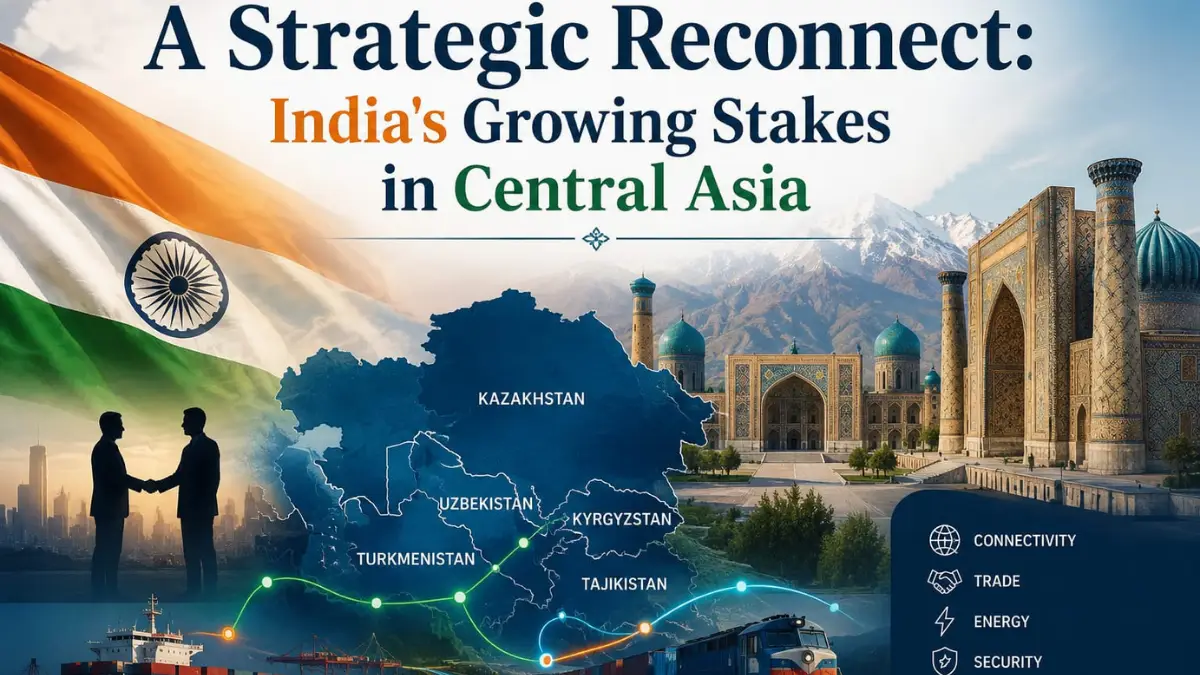
India seeks to give a fresh push to its engagement with the Central Asian countries as the Prime Minister Narendra Modi will visit Uzbekistan and Kyrgyzstan for four days from August 29 to September 1. This visit comes at a time when the geopolitical competition, the connectivity challenges and the China’s expanding economic presence are reshaping the region.
The Central Asia has long been a strategically important region for India because of its location between the Europe, Russia, China, Afghanistan and the South Asia. Yet, despite the strong historical and the cultural links, India’s economic engagement with the region remained relatively modest. The current outreach therefore represents an effort made by India to convert the political goodwill into a stronger economic, security and the connectivity partnerships. The India’s “Connect Central Asia” policy has sought to deepen the political, the economic, the cultural and the security ties with the Kazakhstan, the Kyrgyzstan, the Tajikistan, the Turkmenistan and the Uzbekistan. The first India-Central Asia Summit in 2022 further institutionalised this engagement.
However, the geography remains one of the biggest obstacles between the India and the Central Asia. Unlike China and Russia, India does not share a direct land boundary with the Central Asia. The connectivity through the Pakistan remains difficult, while the instability in Afghanistan has added an another layer of uncertainty.
This makes the alternative connectivity routes extremely important for India to connect with this region. Therefore, India has been working to strengthen the links through Iran, particularly through the Chabahar port, while also supporting the International North-South Transport Corridor. The efficient connectivity could reduce the transportation costs and make the Indian goods and the investments more competitive in the Central Asian markets.
However, the India’s renewed interest in the Central Asia also comes against the backdrop of China deepening its economic footprint in Central Asia, as through the Belt and Road Initiative, the Beijing has invested heavily in the infrastructure, the transport and the energy projects across the region.
For India, the challenge is not necessarily to compete with the China project-for-project, but to offer the Central Asian countries the credible alternatives and the areas of cooperation where India possesses the comparative strengths. These include the pharmaceuticals, the information technology, the education, the healthcare, the digital services and the capacity building.
The experts say that even if India may not be able to match the China or the Russia in terms of investment and influence, it possesses significant strengths in areas such as the education, the technology and the human-resource development.
The security cooperation is an another important pillar of India’s Central Asian policy. The terrorism, the extremism, the drug trafficking and the instability emanating from the Afghanistan are the shared concerns.
India’s participation in the Shanghai Cooperation Organisation provides an important platform for discussing these challenges with the Central Asian nations, the Russia and the China. During the upcoming SCO summit in Bishkek, India is expected to emphasise on the regional security, the connectivity and the economic cooperation.
Uzbekistan occupies a particularly important position in the India’s Central Asian strategy because of its population, geographical location and the economic potential. During the PM Modi’s current visit to Uzbekistan, India and Uzbekistan have agreed to deepen their strategic partnership, with a target of taking the bilateral trade to $5 billion by 2030. The areas such as the trade, the investment, the defence, the energy, the education and the digital connectivity are receiving greater attention.
The relationship also benefits from the strong historical and the cultural connections. India’s educational and cultural influence in Central Asian region gives New Delhi an important form of soft power that can complement its economic diplomacy.The Central Asian countries can also play a role in the India’s wider diplomatic ambitions. The Tajikistan and the other regional states have generally maintained the constructive relations with India, while India seeks greater support for its long-standing demand for the reform of the United Nations Security Council. The region’s diplomatic importance is increasing as the Central Asian states attempt to maintain strategic autonomy amid competition among China, Russia, the United States, Turkey and the other powers.
The biggest challenge for India is therefore the implementation. The high-level visits and diplomatic statements can strengthen the political relations, but the lasting influence will depend on the trade, the investment, the connectivity and the regular institutional engagement. India needs to move beyond the symbolic diplomacy and develop the commercially viable projects, improve the transport links, encourage greater private-sector participation and expand the educational and the technological cooperation.
The Central Asia is entering a period of the significant geopolitical transformation. For India, reconnecting with this region is not simply about expanding its diplomatic footprint; but it is about securing access to the markets, the resources and the connectivity routes while contributing to the regional stability. The stakes are high. If India can translate its historical goodwill and the soft power into the sustained economic and the strategic engagement, the Central Asia could become an important pillar of India’s broader Eurasian strategy. If the connectivity and investment gaps remain unresolved, India risks watching the other powers consolidating their influence in a region that is too strategically important to ignore.