
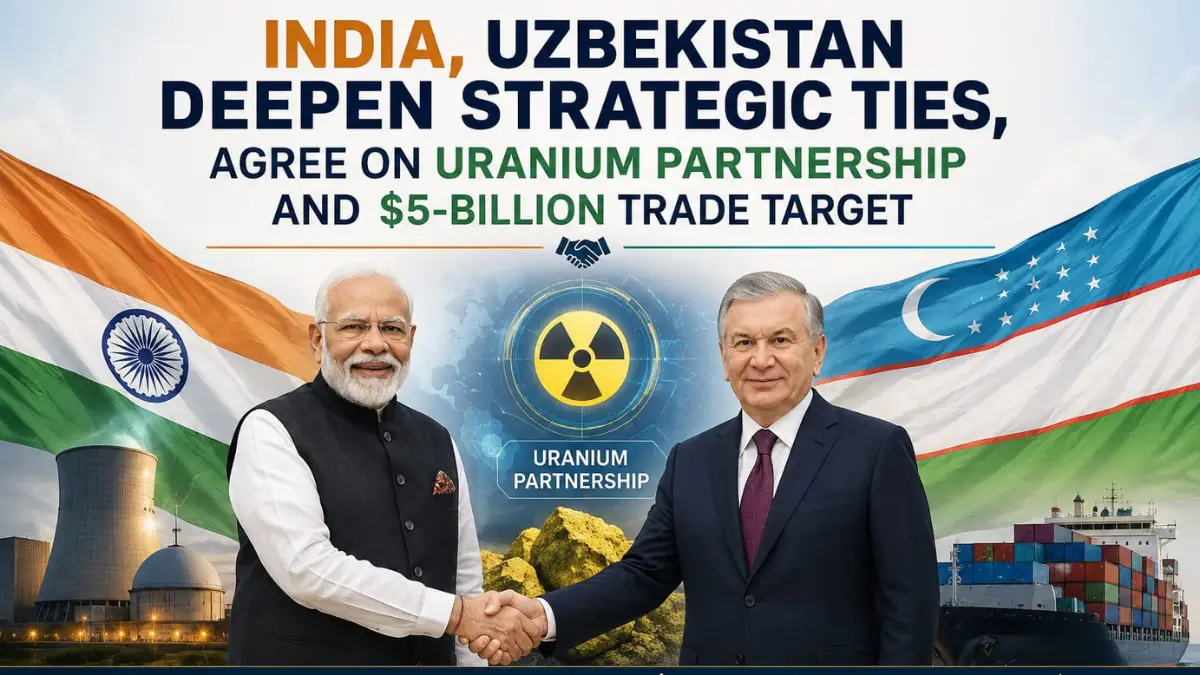
India and Uzbekistan have agreed to give a fresh momentum to their bilateral relationship by upgrading the ties to a Comprehensive Strategic Partnership and setting up an ambitious target of $5 billion in annual bilateral trade by 2030.
This understanding was reached during the talks between the Indian Prime Minister Narendra Modi and Uzbek President Shavkat Mirziyoyev, as the two countries marked the 15th anniversary of their strategic partnership, with the discussions focused on expanding the cooperation across the trade, the investment, the energy, the mining, the defence, the agriculture, the pharmaceuticals, the healthcare, the information technology and the educational sector.
A key outcome of the talks was the decision to establish a framework for the long-term supplies of uranium from the Uzbekistan to India, which is in line with the cooperation in the civil nuclear energy sector. The two sides also agreed to strengthen the collaboration in the critical minerals, the mining and the geological exploration.
With the growing global competition over the strategic resources, the cooperation in critical minerals could become an important component of the India’s engagement with the Central Asia. The Uzbekistan’s mineral resources and the India’s expanding industrial and energy requirements provide the scope for a greater economic cooperation.
The two countries noted that the bilateral trade between them has already crossed $1 billion, but both sides believe there is a considerable scope for further growth. The new $5-billion target for the year 2030 is intended to encourage greater investment and the commercial exchanges.
This partnership will cover the sectors such as the energy, critical minerals, mining, defence and security, agriculture, pharmaceuticals, healthcare, information technology, Ayurveda, digital public infrastructure and the education.
The existing Joint Commission mechanism between the two countries is also expected to be strengthened, with the plans to raise its functioning from the secretary level to the ministerial level. This could provide a stronger political oversight and will help accelerate the implementation of the bilateral agreements.
The digital connectivity has emerged as an another important area of cooperation. An agreement between the NPCI International Payments Limited (NIPL) and the Uzbekistan’s National Interbank Processing Centre will facilitate the use of the India’s UPI technology for the merchant payments in Uzbekistan through the country’s UZQR system.
Such cooperation could deepen India’s digital diplomacy in the Central Asian region while offering the Uzbekistan the access to India’s experience in building a large-scale digital payment infrastructure.
The partnership is not limited to the economics and the technology as India and Uzbekistan have also agreed to work towards the restoration and the conservation of the Buddhist heritage sites, including the Fayaz Tepa and the Kara Tepa in Uzbekistan.
The initiative highlights the historical links between India and Central Asia and the role of Buddhism in connecting the two regions centuries ago. The greater cultural cooperation could therefore complement the growing strategic and economic relationship.
Uzbekistan occupies a strategically important position in Central Asia, a region that has a growing significance for India’s economic, security and geopolitical interests. It is also one of the region’s key economies and has the substantial resources in areas such as the minerals and the energy.
For India, the stronger ties with Uzbekistan can contribute to a greater access to the Central Asian markets and the resources while helping the New Delhi expand its regional presence. The cooperation in the areas such as the defence, counter-terrorism, connectivity and the energy can also strengthen India’s strategic engagement with the wider region.
Prime Minister Modi described Uzbekistan as being at the heart of Central Asia and India’s engagement with the region. The two leaders stressed that the upgraded partnership should produce the concrete outcomes rather than remaining confined to diplomatic commitments.
The latest agreements therefore represent an effort by the India and the Uzbekistan to transform their longstanding relationship into a broader economic, strategic, technological and the cultural partnership. The success of this renewed engagement will ultimately depend on how effectively the two countries implement the agreements and translate their ambitious trade and cooperation targets into the tangible results