
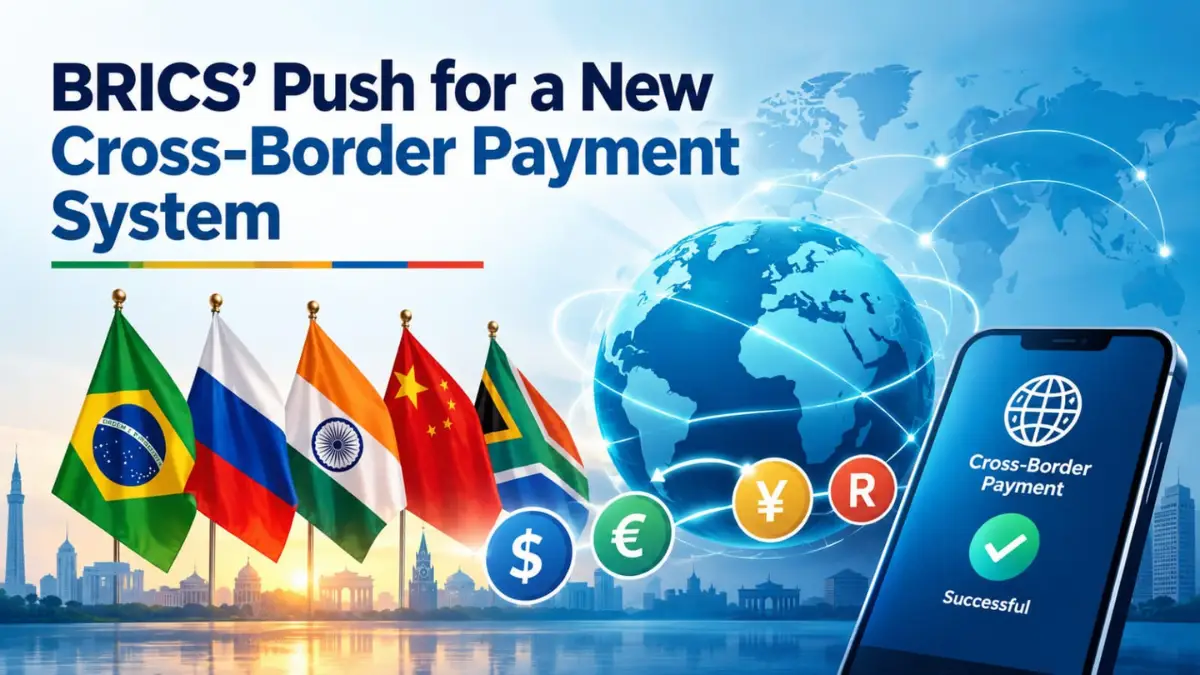
In the present day globalised economy, the money frequently moves across the borders for the trade, tourism, remittances and the investment. Yet, sending money from one country to another is often a slow, expensive and dependent on a complex network of the banks and the dominant international currencies. This is why the BRICS is exploring the alternative mechanisms for the cross-border payments.
How do the cross-border payments work today?
Suppose an Indian importer wants to purchase some goods from a seller in the South Africa. The payment usually does not travel directly from the Indian bank to the South African bank. Instead, it may pass through several correspondent banks that maintain the accounts with one another. The transaction can involve multiple currencies. For example, the Indian rupees may first be converted into the U.S. dollars and then into South African rand. Here, every intermediary can charge a fee, while the currency conversion creates the additional costs. This system relies heavily on the SWIFT (Society for Worldwide Interbank Financial Telecommunication). The SWIFT does not actually transfer the money; rather, it provides a secure messaging network through which the financial institutions can communicate the payment instructions.
Why are costs and delays a concern?
It should be noted that every intermediary in the payment chain can the add charges. The currency conversion may also happen more than once, therefore increasing the foreign-exchange costs. Although the technological improvements have made the international payments faster, the system still faces structural problems. The Bank for International Settlements (BIS) has highlighted a decline in correspondent banking relationships in several regions. A smaller banking network can make cross-border transactions more difficult and expensive. For the developing economies, these costs are particularly significant because the businesses and the individuals often have limited alternatives.
Why does BRICS want to change the system?
A major concern for the BRICS countries is their dependence on the dominant currencies such as the U.S. dollar, the euro and the Japanese yen. The international transactions conducted through these currencies can expose the countries to the monetary policies and the financial systems of the nations issuing them. The 2024 BRICS report under the Russian chairmanship argued that the existing financial architecture is heavily concentrated and can contribute to the higher transaction costs. However, creating an alternative is not easy. A new payment system would need the participation from a large number of banks, regulators and the financial institutions. Moreover, the countries must consider the sanctions and the other geopolitical risks before joining an alternative network.
What alternatives are being explored?
One important idea is a direct payment system in which banks from the participating countries connect with an another bank rather than relying on the several correspondent banks. Another possibility is a shared payment hub. The BIS-backed Project Nexus is an example of an initiative designed to connect the national payment systems. India’s Unified Payments Interface (UPI) and Singapore’s PayNow systems already demonstrate how the national instant-payment systems can be linked for the cross-border transactions. The BRICS has also discussed the potential role of the Central Bank Digital Currencies (CBDCs). Unlike cryptocurrencies, the CBDCs are digital versions of the sovereign currencies issued by the central banks. They could potentially allow the participating countries to settle the transactions more directly. A BRICS settlement platform could therefore reduce the number of intermediaries, lower the costs and speed up the international payments processes.
What is India’s position?
India has taken a relatively cautious approach. Its proposal has focused on linking the CBDCs for the trade and the tourism, while improving the speed and the efficiency of settlements. Importantly, the Indian officials have framed these efforts primarily as a way to reduce the transaction costs and improve the payment efficiency, rather than simply as an attempt to replace the U.S. dollar. The Indian experience with the UPI provides an important technological foundation. If successful, linking the national payment systems could make the international transactions as convenient as the domestic digital payments.
Challenges ahead
The creation of a BRICS-wide payment system will require more than just the technology. The countries would need to agree on the common technical standards, the currency conversion mechanisms, the regulatory frameworks, the data and the cybersecurity rules, the settlement and the liquidity arrangements, the sanctions and the compliance procedures, and most importantly the trust among participating financial institutions. There is also a question of scale. A payment network becomes more useful when more countries, banks and businesses participate in it. Therefore, to make it more effective and relevant, more and more countries should participate.
Conclusion
The interest of the BRICS in the cross-border payments reflects a broader transformation of the international financial system. The objective is not simply to create an another payment platform, but to make the international transactions faster, cheaper, more direct and less dependent on a small number of currencies and the financial intermediaries. For India, the priority appears to be practical, i.e., leveraging the technologies such as UPI and the CBDCs to reduce the transaction costs while improving the settlement efficiency. If BRICS can successfully combine the national payment systems with the common standards and the trusted settlement mechanisms, it could gradually create a more multipolar and an efficient global payments architecture.