
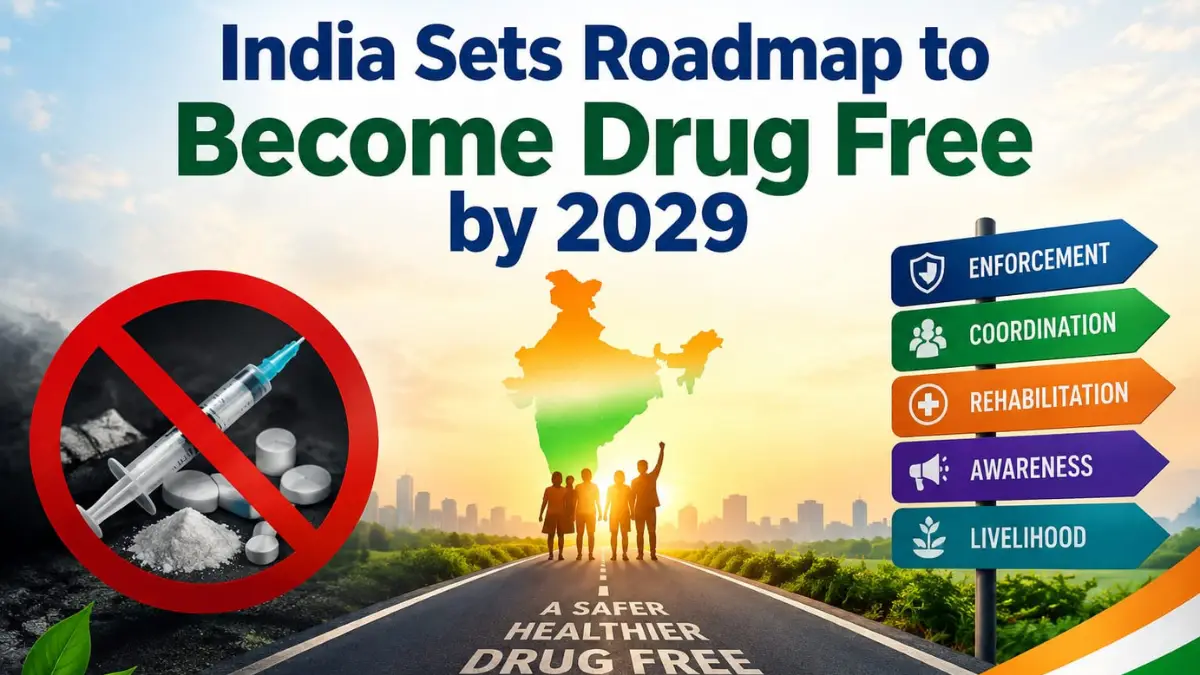
India is taking strict actions to combat the growing threat of drug trafficking and the addiction of the drugs. The Union Home Minister Amit Shah has stated that the government has prepared a comprehensive roadmap to make India drug-free by the year 2029. The initiative focuses not only on controlling the drug trafficking but also on the rehabilitation, awareness and creating the better livelihood opportunities for people affected by the drug addiction.
The government has adopted a coordinated and nationwide approach to dismantle the entire narcotics network. The strategy covers the complete chain of the illegal drug trade, including the trafficking, the financing and the distribution. At the same time, a greater attention is being given to the rehabilitation so that people struggling with the addiction of the drugs can return to the productive and the healthy lives.
According to Amit Shah, achieving a drug-free India is an important step towards the broader vision of a Viksit Bharat by 2047. The government believes that a healthy and drug-free population can contribute more effectively and positively to the country’s economic and the social development.
One of the major challenges in fighting the drug trafficking is that such networks often operate across different states and may have international connections beyond the national borders. To address this challenge, the government has strengthened the coordination among the Centre, the states and the local police forces.
In 2019, a four-tier National Coordination Committee for Countering Drug Trafficking (NCORD) mechanism was created at the executive, the state and the district levels. Its objective is to ensure a coordinated action against the drug menace.
The dedicated Anti-Narcotics Task Forces (ANTFs) have also been established across the states and the Union Territories. These forces are expected to strengthen the enforcement and improve the cooperation between different agencies.
The government has also formed the Joint Coordination Committee, which will enable the central and the state agencies to take collective decisions against the major drug networks, their international connections and the operational weaknesses.
The Narcotics Control Bureau (NCB) plays a crucial role in India’s fight against the illegal drugs. According to the Home Minister, the NCB has been strengthened through the reorganisation of its cadre, an increase in its manpower and the improvements in its zonal presence and the operational capabilities.
Such institutional strengthening is important because the drug trafficking networks are becoming increasingly sophisticated. The better-trained personnel, the stronger intelligence-sharing mechanisms and the improved coordination can help the enforcement agencies in identifying and disrupting these networks more effectively.
A significant aspect of the governmental strategy is that the fight against drugs is not limited to the arrests and the seizures. The government is also focusing on the awareness, the treatment, the rehabilitation and the livelihood opportunities.
This approach recognises that the drug addiction is not simply a law-and-order issue, rather, the individuals affected by the drug dependence may require the medical support, the counselling, the rehabilitation and the opportunities to rebuild their lives. Also, providing the livelihood opportunities can help the rehabilitated individuals to reintegrate into the society and to reduce the possibility of the relapse.
The government has introduced the 1933, a MANAS helpline number to support people dealing with the menace of the drug addiction. Such initiatives can provide an additional channel for the individuals and the families seeking the assistance.
The target of making India drug-free by the year 2029 is very ambitious and it will require the sustained cooperation between the central government, the state governments, the police forces, the enforcement agencies, the communities and the civil society organisations.
While the strong enforcement is essential to dismantle the trafficking networks, the long-term success will also depend on the prevention, the public awareness, the accessible rehabilitation and the social reintegration. The schools, the families and the communities can play an important role in educating young people about the dangers of the substance abuse.
The India’s roadmap for a drug-free nation by the year 2029, therefore represents a multi-dimensional approach combining the enforcement with the prevention, the rehabilitation and the social support. Strengthening the NCB, creating the coordination mechanisms such as the NCORD and the Joint Coordination Committees, establishing the Anti-Narcotics Task Forces and introducing the support mechanisms like the MANAS helpline are important components of this strategy.
Ultimately, making India drug-free will require more than the governmental action. It will depend on the collective responsibility and the sustained efforts to prevent the addiction, to dismantle drug networks and to ensure that those affected would receive the support necessary to rebuild their lives.