
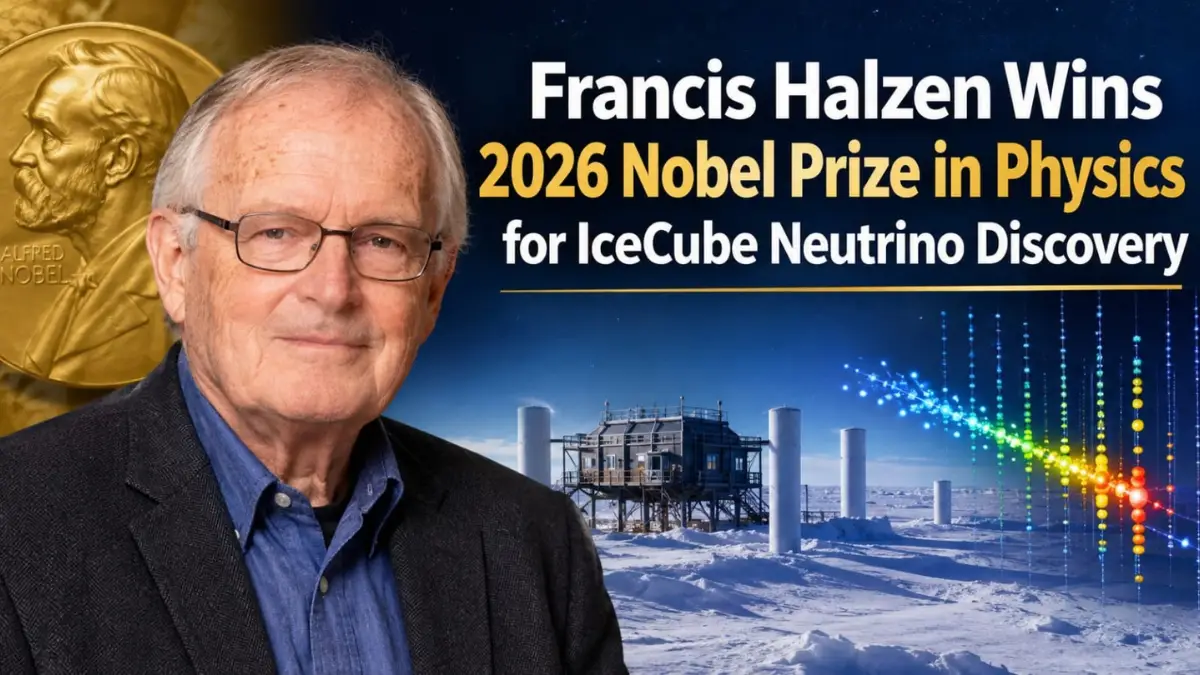
The Belgium-born physicist Francis Halzen has been awarded the Nobel Prize in Physics for the year 2026 for his decisive contributions to the IceCube, which is a neutrino observatory as he has discovered the high energy neutrinos of astrophysical origin. The Royal Swedish Academy of Sciences announced the award on October 6, and has recognised the work that has opened a new way of studying some of the most powerful and the mysterious events in the universe.
Halzen, who is 82-year-old, and is currently a physicist and a professor at the University of Wisconsin- Madison in United States, has spent decades in the development of the idea of using the enormous quantity of clear ice beneath the South Pole as a detector for the elusive subatomic particles known as the neutrinos. His vision ultimately led to the creation of the IceCube, which is one of the largest and the most unusual scientific instruments in the world.
Understanding the Ghost Particles
The neutrinos are electrically neutral particles that interact in an extremely weak way with the ordinary matter. As a result, enormous numbers of them pass through the Earth and the human bodies without leaving any noticeable trace. This makes them extremely difficult to detect.
However, their ability to travel vast distances without being significantly deflected or absorbed also makes the neutrinos valuable to the scientists. They can carry the information from some of the most energetic environments in the cosmos, including the distant galaxies and the powerful cosmic particle accelerators.
Halzen recognised that the clear and undisturbed ice at the South Pole could provide an enormous natural medium for the detection of these particles. When a high energy neutrino occasionally interacts with an atomic nucleus in the ice, it can produce a charged particle that travels through the ice faster than the light can travel through that medium. This generates a brief flash of blue Cherenkov light, which can be detected by the sensors embedded deep in the ice.
IceCube Turns Antarctic Ice Into a Telescope
The IceCube Neutrino Observatory has effectively transformed about a cubic kilometre ( or about 917 million litres of water) of Antarctic ice at the South Pole into a giant particle detector. The thousands of optical sensors that are buried deep below the surface monitor the faint flashes produced by the interactions of the neutrinos.
Halzen first proposed the idea of detecting the high energy astrophysical neutrinos using the Antarctic ice in the late 1980s. The concept eventually got developed into the the international IceCube project, which was was completed in 2011. The observatory is now being operated by an international collaboration involving more than 450 scientists from 58 institutions across 14 countries.
The approach proved its scientific value in the year 2013, when the IceCube announced the discovery of the high energy neutrinos originating from outside the solar system. At first, the scientists could not identify their precise cosmic sources. However, the subsequent research provided the evidence by linking the neutrino emission to the objects including the active galaxy TXS 0506+056 and the NGC 1068, also known as the Messier 77.
In an another major achievement, the IceCube announced in 2023 that it had observed the neutrinos originating from within the Milky Way galaxy, thereby providing the scientists with an another powerful tool for studying our own galaxy.
Opening a New Window on the Universe
The astronomy has traditionally relied heavily on the electromagnetic radiation such as the visible light, the radio waves and the X-rays. The neutrino astronomy adds a fundamentally different source of information.
Because the neutrinos can escape the extremely dense and the energetic environments and can travel enormous distances, they can potentially reveal the processes that the conventional telescopes cannot observe directly. Their detection therefore gives the researchers an opportunity to investigate the violent environments surrounding the objects such as the black holes and the other powerful cosmic sources.The Nobel recognition is consequently not only about building a detector, rather it has acknowledged the establishment of a new method of exploring the universe.
The Next Generation of Neutrino Research
The scientific programme of the IceCube is continuing to expand. An upgrade of the IceCube was installed during the year 2025 and the 2026 to lower the energy threshold of the detector and improve the calibration of the Antarctic ice. The improvements are expected to enhance the ability of the scientists to determine the direction from which the neutrinos arrive.
The researchers are also looking ahead to the IceCube Gen2, which is a proposed expansion that would significantly increase the effective volume of the detector and would improve its ability to study even the higher energy astrophysical neutrinos.
The Nobel Prize given to Francis Halzen therefore represents a landmark moment for the neutrino astronomy. By turning the frozen depths of the Antarctica into a gigantic scientific instrument, his work has given to the humanity a new way for investigating the universe. What began as an unconventional idea about using the polar ice has developed into a powerful observatory that is capable of detecting the signals from some of the most energetic phenomena in existence.