
Aristotle, the famous philosopher said that the man is a social animal, and perhaps rightly so, because we as humans can’t live alone. We crave the ‘sense of belongingness’ and the ‘we-feeling.’ Family is the most reliable group which gives us the sense of security, that yes, we have people in our lives to share our joys and sorrows with. Conjugal families are primarily built on the foundation of marriage, where the the primary bond is between the spouses, and secondarily between the parents and children.
Marriage as an institution has universally been accepted as the most legitimate ways to reproduce a society. In almost all societies, it is the most celebrated and socially acceptable way to cohabit; and is considered an auspicious affair in which both the spouses take a vow to “hopefully” spend rest of their lives together.
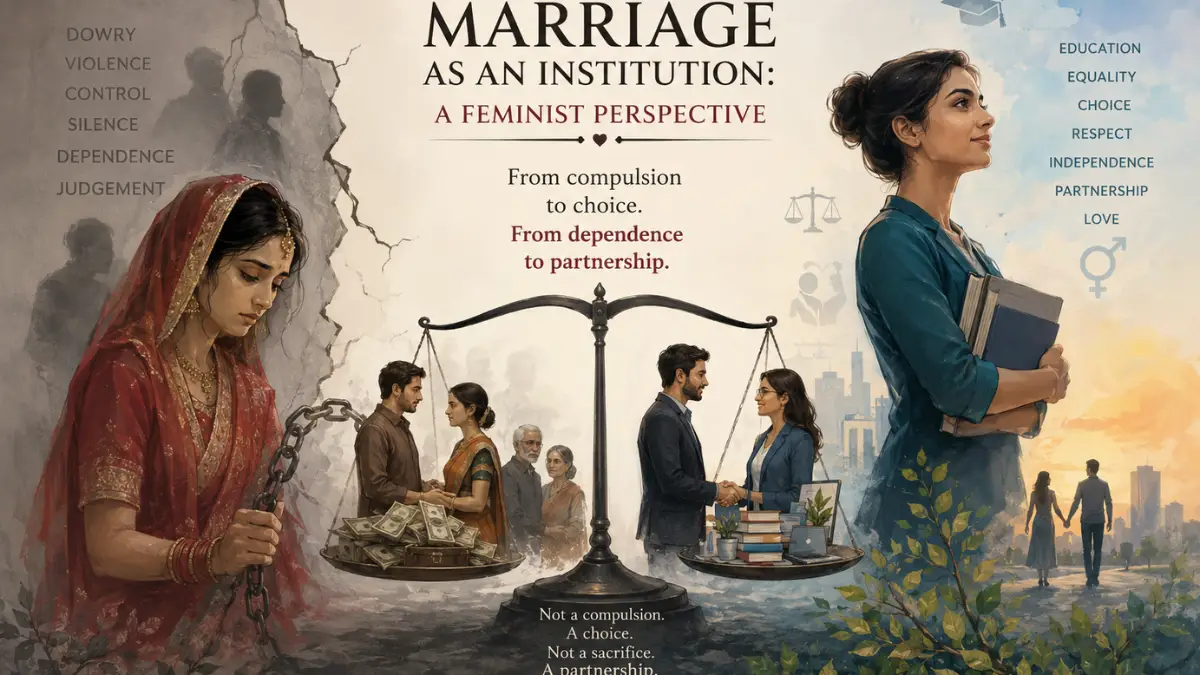
The stress on the word “hopefully” is deliberate because recently a slightly different pattern is being observed, particularly distinguished by the cases of Twisha Sharma case, Deepika Nagar case, Nikki murder case—and the list goes on. In all these cases, the cruelty against these women was so severe that it shook the conscience of society; and one thing was common that the perpetrator of the crime was the husband & the underlying issue was “dowry”, a heinous crime against women. In India, “dowry” is a punishable criminal offence under the Dowry Prohibition Act, 1961. But are we successful in curbing this menace? The answer is, “No”, a big “NO,” and we would never be able to eradicate it from our society, until we educate our girls, make them independent & equip them with the confidence that yes, they can make the right choices & right decisions in life.
Not to talk about the uneducated and underprivileged women, it is widely observed that even educated, and financially independent women are not “allowed” to take some of the basic decisions of their lives. In India, the moment a girl child is born, the burden of marrying her off starts to loom over his father. The emphasis is not on ‘her’ identity as a girl child or what would she become, rather, the whole society is more concerned about when would she get married? & if she gets, then there is no way back. One major issue in all these cases, which are mentioned above is that the parents of these girls are not ready to accept a “divorced daughter”, but the irony is that now they have to accept a “dead one”. However, the parents alone should not be blamed. Here, the entire society should be held answerable which still considers being divorced to be the worst situation to be in, particularly for women divorce is still considered a taboo.
Now the question arises, is this problem only limited to India? Again the answer is ‘No’. Because, had it been the case, then in Pride and Prejudice, Jane Austen should have depicted the character of Mrs. Bingley somewhat more empowered, whose only motive was not to marry her daughters to rich suitors but to educate & empower them to focus on their careers & be rich themselves.
However, in “A Vindication of the Rights of Women” (1792), Mary Wollstonecraft has stressed that women are rational human beings who deserve the same fundamental rights as the men. She argues that educating the women makes them the capable citizens, the professional workers, and the “rational” companions to their husbands, rather than merely a decorative property.
However, there is another side to this issue where women have resorted to violence. The Sonam Raghuvanshi case, the Meerut Blue Drum case, and the more recent Siya Goyal case in Madhya Pradesh, shocked the entire nation and became a household discussion. Consequently a large section of male population started framing the narrative: “wife kills husband”, and the “modern woman destroys family”.
The individual acts of crime then becomes a vehicle for making the sweeping claims about women, feminism & independence.
These kinds of generalisations threaten the very foundation of marriage as an institution. Undoubtedly, when a man becomes the victim of an extraordinary crime committed by a woman, he deserves justice. However, an individual act of violence cannot become an evidence that men as a class should fear women; distort the marriage as an institution & abandon the possibility of love and companionship.
Just as the crimes against women should never be used to declare that all men are inherently violent, the crimes committed by women should never be transformed into a narrative that the women as a whole are inherently dangerous, manipulative or materialistic.
To conclude, marriage as an institution has not lost its relevance, and it will continue to hold its ground; though the pattern & the kind of relations may vary. Unlike the traditional setup where the women were responsible for household chores and child rearing, and the man was responsible for livelihood and outdoor activities, with education and skills, women are now empowered enough not only to step out and fend for themselves but also to contribute to society in a meaningful way. Today, the ideal is not a woman dependent on man, but two economically and emotionally capable individuals choosing to share their lives. Therefore, both men and women should enter this institution as equals; where it is not a compulsion to remain together, but a choice.