
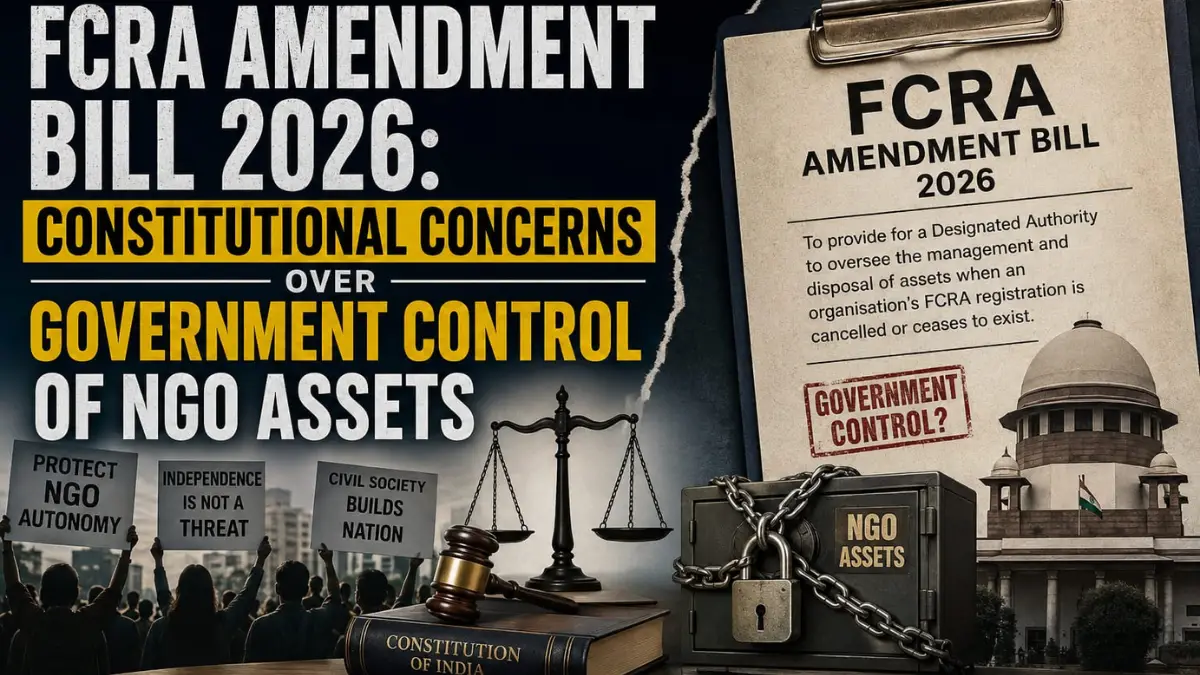
The debate over the Foreign Contribution (Regulation) Amendment Bill, 2026, is not simply about how the foreign donations should be regulated. At its heart, it raises a more difficult question regarding how far can the government go in controlling the organisations that receive the foreign contributions without affecting their independence?
The proposed legislation seeks to create a Designated Authority to oversee the management and the disposal of the assets when an organisation’s FCRA registration is cancelled or ceases to exist. The government stated that the foreign funds must be used lawfully, and there must be an accountability when they are misused. But the proposed mechanism also raises the questions about the extent of state intervention in the civil society.
The Foreign Contribution (Regulation) Act, or FCRA, has long provided the legal framework for regulating the foreign contributions in India and it is intended to ensure that such funds do not threaten the national security, the transparency or the public accountability. The proposed amendment, however, goes beyond the regulation of the receipt and the use of the foreign donations. It also addresses what may happen to the assets of an organisation after its FCRA registration is cancelled, surrendered or allowed to lapse. Under the proposal, a Designated Authority may be appointed to take the possession of the assets created from the foreign contributions and manage them whenever considered necessary in the public interest. The government may argue that this is needed to prevent the diversion or the misuse of the charitable property. Yet, the important constitutional question is that whether such powers could allow the state to exercise an excessive control over the institutions that are not themselves the government bodies.
There is a difference between the ownership of an institution and the control over its management. An organisation may legally own a school, a hospital or a laboratory. But its ability to function depends not only on ownership. It also depends on its independence, its administrators and the charitable purpose for which it was established. Even if the legal ownership of an institution remains unchanged, transferring control over its management can fundamentally alter the relationship between the institution and the state. For instance, consider a charitable hospital that has been built with foreign contributions. If its FCRA registration is cancelled, the proposed mechanism could potentially allow the government to take possession of the assets and manage them. The question is not merely who owns the building. It is who decides how the institution will function and whom it will serve. That is why the editorial argues that the consequences of the amendment cannot be dismissed as a simple administrative matter.
The proposed amendment also raises the question of whether such extensive powers are necessary when the existing FCRA framework already contains provisions for dealing with assets created from foreign contributions after cancellation of registration.
The editorial points out that the existing law provides for the vesting of such assets in a prescribed authority. The proposed Designated Authority, therefore, appears to expand the statutory framework for the vesting, the possession, the management, the restoration and the disposal of these assets. The concern is that a provision introduced to prevent the misuse of funds could gradually become a mechanism for the wider administrative intervention. This is particularly important because the consequences of cancellation may extend beyond the ability of the organisation to receive the foreign contributions. They may affect the management of the institutions, their assets and their continued functioning.
The strongest constitutional argument against excessive state intervention comes from the doctrine of proportionality. The Supreme Court has repeatedly held that even when the state pursues a legitimate objective, the means adopted must bear a reasonable connection to that objective. The measures must also maintain an appropriate balance between the public purpose and the burden imposed on the individual rights. In simple terms, the government may have a legitimate reason to prevent the misuse of foreign contributions. But the question is whether taking control of an institution’s assets is always necessary and proportionate to achieve that purpose. It must be taken into consideration that whether the same objective be achieved through the stronger audits, the financial monitoring, the penalties or the judicial supervision? If the less intrusive measures are available, the need for a more sweeping power becomes difficult to justify. Therefore, it becomes an important question to ask that whether the proposed amendment gives the executive too much discretion and whether its safeguards are sufficiently clear.
The issue is not limited to the foreign-funded organisations rather it concerns the broader relationship between the state and civil society. The charitable institutions often work in the areas where the government agencies may not have the sufficient reach, including the education, the healthcare, the research and the social welfare. Their independence is important because their credibility depends on their ability to function without unnecessary governmental interference. At the same time, the independence cannot mean the freedom from accountability. The organisations receiving the foreign contributions must comply with the law, maintain the proper records and ensure that the funds are used for the legitimate purposes.
The challenge, therefore, is to create a system that prevents the misuse without weakening the autonomy of institutions that serve the public.
The FCRA Amendment Bill, 2026, highlights the need for a careful balance between maintenance of the accountability and the institutional independence. The government must ensure that foreign contributions are not misused. However, any power to take the possession of the assets or to alter their management should be clearly defined, subject to the safeguards and should also be open to the effective judicial review. The central question is not whether the state should regulate foreign contributions rather it is whether the regulation should extend into the management of the institutions in a way that changes their character and the independence. A strong regulatory framework is necessary. But in a constitutional democracy, the means used to achieve a legitimate objective must remain within the constitutional limits. The debate over the FCRA Amendment Bill is therefore a reminder that the public accountability and the civil society autonomy must not be treated as opposing goals. Both are essential to a healthy democracy.