
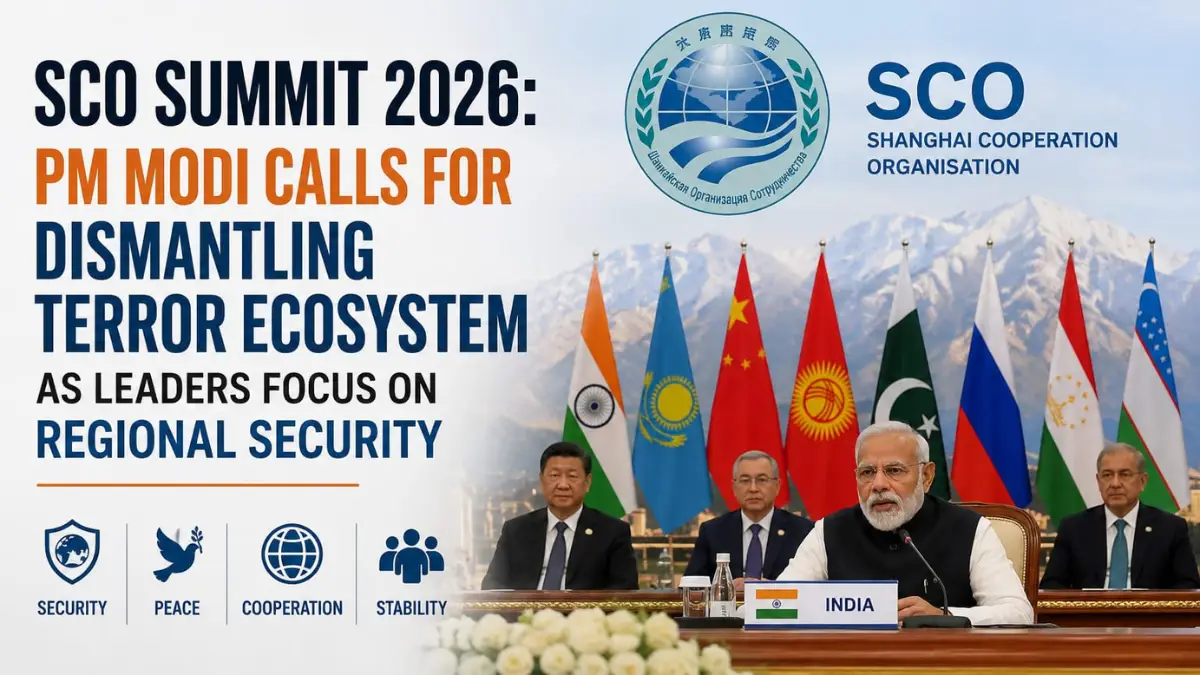
The 25th summit of the Shanghai Cooperation Organization (SCO) held in Bishkek, Kyrgyz Republic, and brought together some of the most influential Asian leaders at a time when the world is faced with the multiple security and the geopolitical challenges. From the terrorism and the instability in Afghanistan to the conflicts in West Asian region and the disruptions in the global supply chains, the summit reflected the growing concern over an increasingly uncertain international order.
For India, however, one message stood above the rest that the terrorism must be fought collectively, consistently and without any double standards. The Prime Minister Narendra Modi used the SCO platform to make a strong appeal to dismantle what he described as the entire ecosystem of the terrorism. At the same time, the summit saw the discussions on the Afghanistan, the regional peace, the transnational crime, the drug trafficking and the new forms of the security threats. The Chinese President Xi Jinping also called for the greater coordination among the SCO countries to deal with both the traditional and the emerging security challenges. The summit, therefore, was not merely a diplomatic gathering. It highlighted the changing priorities of Eurasia and the growing importance of the regional cooperation in a world marked by the conflict and the instability.
The Prime Minister Modi’s addressed the SCO summit and delivered one of the strongest messages on the issue of terrorism, emphasizing that all the countries must work together to dismantle the complete ecosystem that allows the terrorism to survive and expand. This ecosystem, according to the Prime Minister, includes the terror financing, the recruitment, radicalization and the provision of safe havens. India made its position clear, particularly on the issue of the countries that allegedly use the terrorism as an instrument of the state policy. “We must speak with one voice,” the Prime Minister said, stressing that there should be no place for the double standards when dealing with the issue of the terrorism. This is an important position because the global fight against terrorism has often been criticized for being selective. As the countries may strongly condemn terrorism when they are directly affected, while they remain silent or adopt a softer approach when the terrorist groups operate against an another country. India has consistently argued that the terrorism cannot be categorized as “good” or “bad” depending upon the political interests. A terrorist attack in one country must be treated with the same seriousness as an attack on another country. At the SCO summit, the Prime Minister Modi also made it clear that the terrorists should never be allowed to become a strategic asset for any country. This statement reflects the long-standing concern of India about the cross-border terrorism and the use of the extremist groups for the geopolitical purposes.
An another important issue discussed at the summit was Afghanistan. The Prime Minister Modi said that the peace and the stability in the Afghanistan are closely connected to the dream of a peaceful and a secure Eurasia. India highlighted its contribution to the development of the country and the humanitarian assistance it has provided to the Afghan people over the years. The Prime Minister reiterated that India would continue to support the people of the Afghanistan. The summit’s Bishkek Declaration also addressed the situation in the Afghanistan, calling for the creation of an inclusive government with the participation of all the ethnic and the political groups in the country. The stability of the Afghanistan is a major concern not only for its own people but also for the entire region. A politically unstable Afghanistan can become a source of terrorism, extremism, the illegal arms trafficking and the drug smuggling. Therefore, the SCO countries recognised that Afghanistan’s future cannot be separated from the larger question of the security of the Eurasian region.
The discussion at the summit showed that the idea of the security is changing. In the past, the security was mainly associated with the wars, the borders and the military conflicts. Today, countries also have to deal with the terrorism, the cyber threats, the organized crime, the drug trafficking and the new technological challenges. The Chinese President Xi Jinping called on the SCO member countries to strengthen the cooperation to deal with a wide range of threats. These include the three major concerns that have long been associated with the SCO—the terrorism, the separatism and the extremism. However, the list of the challenges has expanded considerably.
Xi also called for the greater cooperation against the transnational organized crime, the drug trafficking, the telecom and the online fraud, the information security threats, the biological security challenges, and the outer space-related security concerns, which reflect the changing nature of the global security. For example, a criminal organization can now operate across the several countries through the digital networks. The fraud can be carried out from the one country while the victims live thousands of kilometers away. The terrorist groups can use the internet for the propaganda and the recruitment. The drug trafficking networks are operating across the international borders. No single country can effectively deal with these challenges on its own. Therefore, the regional organizations such as the SCO are increasingly focusing on the intelligence-sharing and the coordinated action.
Prime Minister Narendra Modi also referred to the wider geopolitical situation, particularly the conflict and the tensions in the Persian Gulf region. He pointed out that the crises in the West Asia have affected the energy security and the global supply chains, with the countries of the Global South bearing a significant part of the burden. This observation is important for countries like India. When conflict affects the oil-producing regions or the major shipping routes, the consequences are felt far beyond the countries that are directly involved. The oil prices can rise, the transportation becomes more expensive and the supply chains are disrupted. The developing countries often suffer the most because they have the limited economic capacity to absorb the sudden increases in the energy and the food prices. The SCO summit therefore underlined an important reality that the regional conflicts are no longer regional in their consequences, as a war in one part of the world can affect the cost of the fuel, the food and the transportation in another part of the world.
The Bishkek Declaration also addressed the broader international conflicts, including the US-Iran conflict and the Ukraine-Russia war, reportedly expressing the concern over the actions by certain countries or the groups of countries that could negatively affect the international security. It also raised concerns regarding the unilateral deployment of the global missile defence systems.
These issues show that the SCO is not looking at the terrorism in an isolation. Its members see the global security as an interconnected issue. The military conflicts, the geopolitical rivalry, the terrorism, the economic instability and the supply-chain disruptions can all influence one another. The challenge for the SCO, however, will be to convert these shared concerns into a practical cooperation.
The SCO brings together countries with the enormous geographical, economic and the political influence. Its member states represent a significant part of the world’s population and territory. However, the organisation also faces an obvious challenge that its members do not always agree with one another and often there are differences among them on various issues.
The political differences, the competing strategic interests and the bilateral tensions can make the collective action difficult.
This makes the Prime Minister Modi’s call for speaking with the one voice against the terrorism particularly significant.
The effectiveness of the SCO will ultimately depend on whether its member countries are prepared to move beyond the declarations and take a consistent action. A successful regional security framework requires more than the declarations and the speeches made at the summit. It requires the intelligence-sharing, the coordinated action against the issue of terror financing, and the stronger border cooperation and a genuine refusal to provide shelter or support to the extremist groups.
The Bishkek SCO summit also demonstrated that the Eurasian countries are facing a complicated security environment, where the terrorism remains a serious threat, but is now accompanied by the cybercrime, the drug trafficking, the telecom fraud, the geopolitical conflicts, the energy insecurity and the disruptions in the global supply chains. India used the summit to put the terrorism at the centre of the conversation. The Prime Minister Modi’s message was direct as it reflects that the fight against the terrorism cannot succeed unless the entire ecosystem that supports it is dismantled. The China, meanwhile, emphasised broader cooperation against the traditional and the non-traditional security threats. The Afghanistan remained a major regional concern, while conflicts in the West Asia and the Europe highlighted the wider consequences of the geopolitical instability.
The most important takeaway from the SCO summit is perhaps that the security can no longer be treated as the responsibility of the individual countries alone. In an interconnected world, the terrorism, the war, the energy crises and the organized crime easily cross the borders. The challenge before the SCO is to transform this understanding into a coordinated action. For India, the message remains clear that there can be no peace, stability or any meaningful regional cooperation unless the world is prepared to confront the terrorism with the consistency, the unity and the zero tolerance.