
Very few songs in India carry the emotional and historical weight of Vande Mataram. From the freedom struggle to the contemporary India, this song has remained deeply connected with the idea of nationalism. It inspired the generations of Indians during the struggle for freedom against the colonial rule and continues to evoke the strong patriotic sentiments. Yet, the debate surrounding Vande Mataram is not simply about whether one respects the nation. It seeks an answer to the question about Whether a person can be compelled to become patriotic or does the Constitution protect an individual’s right to respectfully dissent?
However, the critical distinction is that protecting a song from disruption is not necessarily the same as compelling every citizen to sing it. This question became even more important after the recent amendment to the Prevention of Insults to National Honours Act, 1971 which has extended criminal legal protection to the India’s national song, Vande Mataram by giving it the same status as the National Anthem. Historically, in 1950, this has been proposed by the Contituent Assembly’s President Dr. Rajendra Prasad that Vande Mataram deserves equal honour to the national anthem. The amendment, therefore, made it illegal to stop people from singing the national song or to disrupt a group singing it. The first time offenders will be punished with the imprisonment for upto 3 years or fine or both, and the second and every subsequent offence will be punished with atleast 1 year imprisonment. However, there is a difference between deliberate interruption of an assembly to disrupt the peaceful singing of Vande Mataram and quitely being present in the assembly but not singing the national song because you conscience is not allowing you to do it. This distinction is more clearly examined through the Supreme Court’s landmark judgement in Bijoe Emmanuel v. State of Kerala (1986) case.
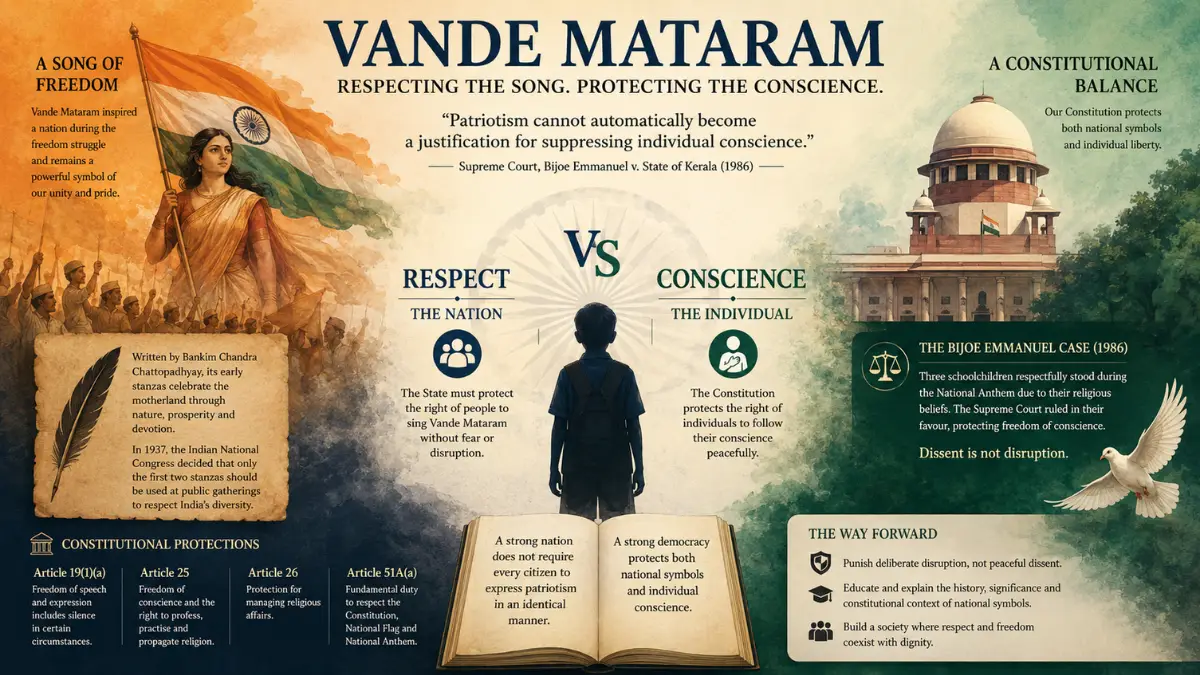
Vande Mataram, written by Bankim Chandra Chattopadhyay, is one of the most powerful cultural symbols of the India’s freedom movement as its opening stanzas celebrate the motherland through beautiful imagery of nature, prosperity and devotion. During the freedom struggle, this song became associated with resistance to the British colonial rule. It was sung at the political meetings and the nationalist gatherings and became a powerful expression of India’s desire for the freedom. However, the subsequent stanzas of this song contains religious imagery associated with the Hindu traditions, which created concerns about its suitability as a common patriotic expression in a religiously diverse country. This issue was addressed even before Independence, when, in 1937, the Indian National Congress decided that only the first two stanzas should generally be used at the public political gatherings as these portions were considered less religiously specific and therefore more appropriate for India’s diverse population.
However not every citizen has a legal obligation to sing Vande Mataram. India being a democratic society protects he people who wish to express their patriotism. However, at the same time it also protect citizens who, because of their religious beliefs or conscience, may choose not to participate in a particular form of patriotic expression and therefore, respecting a national symbol does not require compulsory participation. In Bijoe Emmanuel v. State of Kerala, three schoolchildren belonging to the Jehovah’s Witnesses faith, during the morning assembly, respectfully stood while the National Anthem was being sung, but they did not sing it because their religious beliefs prevented them from doing so. As a consequence, the school authorities expelled them. The Supreme Court, however, protected the children’s rights by recognizing that freedom of conscience is an important constitutional value and that the children were not disrupting the National Anthem, insulting the nation or preventing others from singing. They simply remained silent to observe their sincerely held beliefs.
Therefore, the court held that there is a fundamental difference between dissent and disruption. For instance, if someone deliberately prevents others from singing a patriotic song, threatens them or creates disorder, the State can legitimately intervene. But if a person stands respectfully and chooses not to participate, the constitutional position is very different. To be more precise, the court held that patriotism cannot automatically become a justification for suppressing individual conscience.
Moreover, the Indian Constitution provides several protections relevant to this debate. Firstly, the Article 19(1)(a) of the constitution guarantees the freedom of speech and expression. Here, the word expression does not always mean speaking or singing rather in certain circumstances, even silence can communicate a person’s choice or belief. Secondly, the Article 25 guarantees the freedom of conscience and the freedom to profess, practice and propagate the religion of one’s choice, subject to constitutional limitations. Thirdly, the Article 26 provides additional protections concerning the management of religious affairs. Lastly, the Article 51A(a) imposes a fundamental duty upon the citizens to respect the Constitution, the National Flag and the National Anthem, thereby creating an interesting constitutional balance. The citizens, undoubtedly, have a duty to respect national symbols. But this duty to respect cannot automatically be interpreted as an unlimited power of the State to prescribe every form of patriotic behavior. It is important to note that the respect and the participation are not necessarily identical. A citizen can respect a national symbol, even if, he/she has chosen not to participate in a particular ceremony because of his/ her conscience or religious belief.
The debate should therefore shift from the simplistic question of “Are you still a patriotic if you do not sing Vande Mataram?” to a more meaningful question “Can we protect national symbols while simultaneously protecting constitutional dissent?” The answer should be in the affirmative. The State must protect the people who wish to sing Vande Mataram, preventing and rather punishing the deliberate disruption. However, at the same time, the authorities should distinguish between someone who is genuinely disrupting a public ceremony and someone who is simply exercising their freedom of conscience peacefully. The schools and the public institutions should also have an important role. Instead of treating the national symbols merely as compulsory rituals, they should explain their history, the cultural significance and the constitutional context.
Moreover, the young Indians should understand why Vande Mataram became important, why some citizens may have the concerns about its religious imagery, and why the Constitution protects both national unity and individual liberty. To conclude, a strong nation does not necessarily require every citizen to express patriotism in an identical manner, rather a strong constitutional democracy should have the confidence to protect both national symbols and individual conscience. The Bijoe Emmanuel judgment offers a valuable constitutional principle, i.e., respectful silence is not automatically disrespect, just as disagreement is not automatically disruption. The prestigious, Vande Mataram, our national song, will continue to occupy an important place in our national history, because of the extraordinary role it played in the freedom struggle. But the Constitution also deserves equal respect because it protects the freedom of conscience that allows a diverse society to live together.