
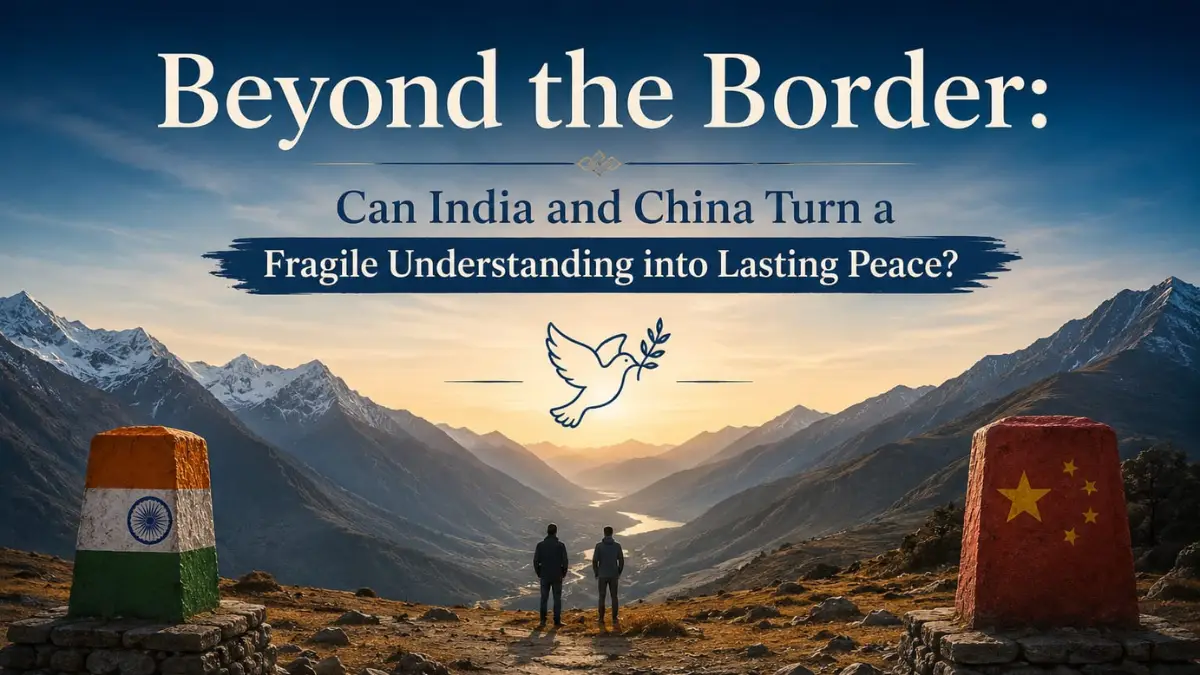
The bilateral relations between India and China have always been the complicated mixture of cooperation, competition and mistrust. The two countries share a long and a disputed boundary, but they are also two of the world’s largest economies, the major Asian powers and the significant players in the global affairs. Therefore, the developments along their border influence trade, diplomacy, security, regional stability and the broader balance of power in Asia. Against this background, the recent agreement between India and China to advance the discussions on the boundary delimitation is an important development. This understanding has emerged during the 25th meeting of the Special Representatives mechanism, where India’s National Security Advisor, Mr. Ajit Doval and China’s Foreign Minister and Politburo member Wang Yi discussed the ways to take forward the question of boundary and to strengthen the mechanisms for the management of the differences between the two countries.
At the first glance, such an agreement may appear to be technical. The boundary delimitation involves the determination and formal demarcation of the international boundary between the two countries. However, in the India-China context, it is way more than a technical exercise. It touches upon the decades of historical claims, the strategic interests, the geographical realities and the national security concerns.The most immediate significance of the latest development is that it provides a diplomatic channel to address a dispute that has repeatedly generated tension in the bilateral relations. The Line of Actual Control (LAC) is not the mutually accepted international boundary. There are differences in the perception regarding where the LAC lies on the map, and both the countries are reluctant to consider each other’s claims.
This disagreement has historically contributed to face-offs between the two militaries. Therefore, improving the communication and creating the institutional mechanisms can help prevent the local disagreements from developing into the larger crises.The two countries have agreed to convene an Expert Group meeting at the earliest. This is significant because the boundary question cannot be resolved simply through the political statements, but it requires the detailed examinations of the maps, the historical claims, the geographical features and the competing interpretations. An expert-level process can provide the technical inputs to the political negotiations and can potentially make the future discussions more structured and balanced.
Another important aspect is the emphasis on maintaining peace and tranquillity along the border. The maintenance of peace along the LAC is essential for creating an environment in which the more difficult negotiations can take place. If the troops remain locked in the repeated confrontations, even the minor incidents can damage the diplomatic relations and make the compromise politically difficult. The agreement also highlights the importance of strengthening the existing communication mechanisms. The military-to-military and the diplomatic communication can play a crucial role in preventing the misunderstandings. In a disputed and the geographically difficult border region, the ability of commanders and officials to communicate quickly can be the difference between containing an incident or allowing it to escalate.
However, the optimism must be accompanied by the realism. The India-China boundary dispute is not a recent disagreement but has deep historical roots and involves approximately 3,488 kilometres of disputed frontier from the Indian perspective. The two sides have different perceptions and claims regarding several sectors of the boundary. Consequently, achievement of a final settlement will be a long and a complicated process. This is why the latest agreement should not be interpreted as an immediate solution to the boundary dispute, rather, it should be seen as an attempt to create the conditions necessary for sustained dialogue.
The relationship between the two countries also extends far beyond the border as China is an important economic partner for India, while India is an important market and regional power for China. At the same time, both countries compete for the strategic influence in Asia. Their relationship is therefore characterised by what can be described as the “cooperation amid competition.”
The border issue also has a social dimension. The People living in the border regions experience the consequences of the military tensions directly. The infrastructure development, the restrictions on the movement and the uncertainty can affect the local communities their livelihoods, whereas a peaceful border can create the opportunities for the better connectivity and the economic development in these regions.
The reference to the border trade and the pilgrimage is particularly significant. The Kailash Mansarovar Yatra has a cultural and a religious importance for Indians, and the regulated border trade can contribute to economic opportunities for the communities on both sides. Such people-centred issues can complement the high-level diplomatic negotiations by creating the practical areas of cooperation. India, however, must continue to approach the process with strategic caution. The dialogue does not mean ignoring the national security concerns. A sustainable relationship requires both the sides to respect the existing agreements, maintain peace along the LAC and avoid the unilateral actions that alter the status quo. Similarly, China has an interest in ensuring that border tensions do not permanently damage its relationship with India, as the continued confrontation between the two Asian powers could divert the resources, increase the military risks and complicate their economic and diplomatic interests.
The real test, therefore, will not be the announcement of another meeting. It will be whether the meetings produce measurable progress on the ground. Can the two sides reduce incidents along the LAC? Can they improve transparency and communication? Can they gradually resolve differences over the alignment of the boundary? Can border trade and pilgrimage be expanded without creating new security concerns? And, most importantly, can political leaders create enough trust to make difficult compromises?
These questions will determine whether the latest understanding becomes a meaningful turning point or simply another chapter in a long history of negotiations.
For India, the objective should not merely be a temporarily quieter border but its larger goal should be a stable, predictable and peaceful relationship with China while protecting its territorial integrity and strategic interests. For China, too, stable relations with India can contribute to a more predictable Asian environment. The latest agreement is therefore best understood as a small but potentially meaningful step. It does not resolve the India-China boundary dispute, nor does it erase years of mistrust. But the diplomacy often progresses through incremental steps rather than dramatic breakthroughs. Ultimately, borders are not merely lines drawn on the maps, rather they affect the lives of people, the security of nations and the stability of entire regions. India and China may continue to disagree on many issues, but establishing the mechanisms to manage those disagreements peacefully is in the interest of both the countries. The challenge now is to transform the dialogue into trust, trust into cooperation, and cooperation into a durable framework for sustainable peace along the border. The success of this process will depend not only on what India and China say across the negotiating table, but also on what they are willing to do on the ground.