
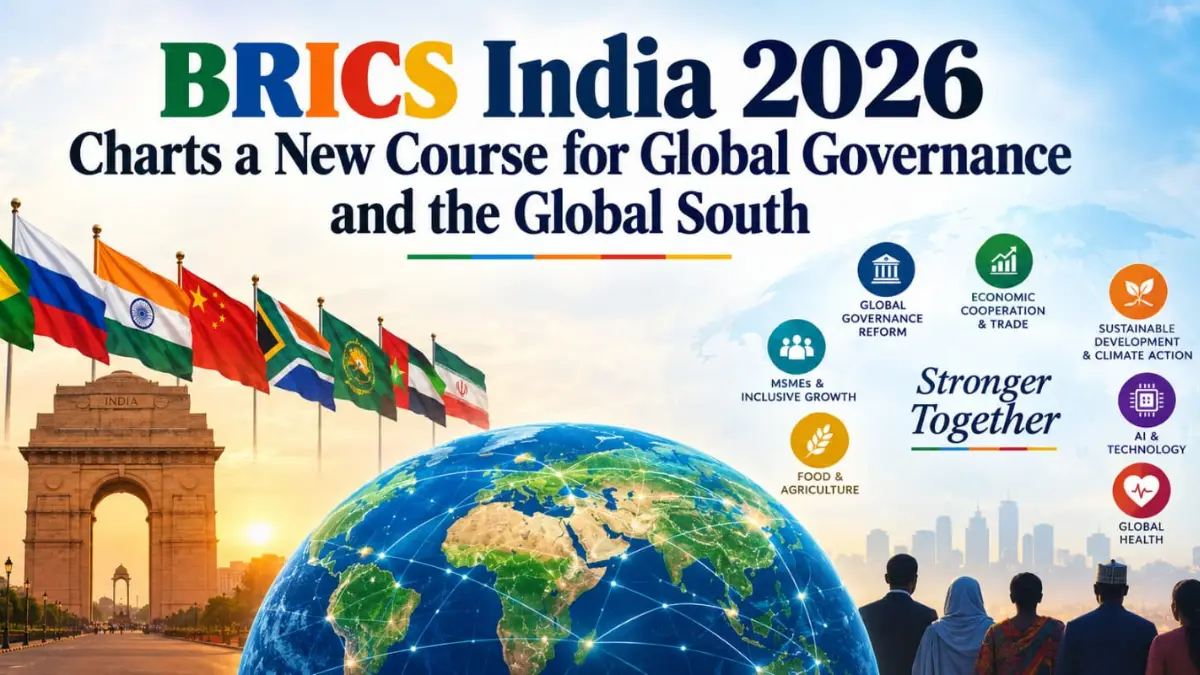
The 18th BRICS Summit, recently held in New Delhi has placed India at the centre of an important debate over the future of the global governance, the economic cooperation and the role of the Global South. It was held on September 12 and 13, 2026, the summit brought together the BRICS leaders and the representatives at a time of geopolitical tensions, trade disruptions, conflicts in the West Asian region, technological transformation and the growing demands for the reform of the global institutions.
The summit was held under India’s 2026 BRICS theme, that is, “Building for Resilience, Innovation, Cooperation and Sustainability.” The New Delhi Declaration reaffirmed the commitment of the group to the mutual respect, the sovereign equality, the inclusiveness, the cooperation and the consensus. It also stressed that BRICS nations should strengthen their cooperation across their political and the security, the economic and the financial, and the cultural and the people-to-people ties pillars. The summit also marked the 20th anniversary of the BRICS cooperation and saw the attempt made by India to give the grouping a more practical and an action-oriented direction.
India Pushes for Reform of Global Governance
One of the most important messages from the Prime Minister Narendra Modi was that the existing global governance system does not adequately reflect the contemporary economic and the political realities. He argued that countries in the Global South are frequently among those who are most affected by the global crises but have comparatively less influence over the international decision-making. He called for the existing “pyramid of privilege” to be transformed into a “platform of partnership” to make the global institutions more inclusive. He also said the Global South should move from being a rule-taker to a rule-shaper. This means the developing countries should have a meaningful role not only in implementing the international rules but also in designing them. The New Delhi Declaration similarly called for the greater and the more meaningful participation of the emerging markets and the developing countries in the global decision-making. It specifically supported the greater representation of the developing countries in the international organisations and called for a more equitable geographical representation.
Reform of the United Nations and Security Council
The reform in the United Nations was one of the major institutional issues that was focused upon at the summit. The New Delhi Declaration reaffirmed the BRICS’ support for a comprehensive reform in the United Nations, including its Security Council, with the aim of making it more democratic, representative, effective and efficient. It also supported the greater representation of the developing countries from the African , the Asian and the Latin American and the Caribbean region. Importantly, the China and the Russia reiterated that they support the Indian and the Brazilian aspirations to play a greater role in the United Nations, including the Security Council. The declaration also called for the greater geographical diversity in the senior positions within the UN system and highlighted the need for the greater participation of the women, the particularly women from the emerging and the developing economies.
Modi Proposes a BRICS Reform Roadmap
The Indian Prime Minister, Mr. Modi proposed that the BRICS nations work towards the 10 proposals for the global governance reform and to develop them into a reform roadmap. The broader objective is to ensure that the decisions made by the BRICS nations do not remain the declarations without a follow-up. He proposed the mechanisms for the continuity and the implementation as the BRICS chairmanship changes from one country to another each year.
He also suggested a secure digital repository to track the decisions, the responsibilities, the timelines and their implementation process. The proposed that the continuity approach is intended to preserve the institutional momentum despite the annual rotation of the BRICS presidency.
Another specific proposal was a BRICS Seafarers’ Emergency Support Network, through which he pointed out that the seafarers would be able to play a vital role in the global trade, without being vulnerable during the crises situation. The proposed network would provide a mechanism for an emergency assistance to them.
New Delhi Declaration Finds Common Ground
Despite there are significant differences among the BRICS countries, the leaders adopted the New Delhi Declaration by a consensus. The declaration consisting of 140 paragraphs, covers a remarkably broad range of issues, including the global governance, the peace and the security, the trade, the finance, the development, the health, the agriculture, the energy, the climate change, the technology, the AI, the culture and the people-to-people cooperation. It also welcomed more than 400 BRICS meetings and engagements held across the 30 Indian cities during the term of the Indian chairmanship at the BRICS platform. The declaration that emphasized the multilateralism, the international law, the sovereignty, the peaceful settlement of disputes and the more representative international order.
West Asia Tests BRICS Unity
The most difficult diplomatic issue during the summit was the situation in the West Asian region .The different positions of BRICS members, particularly the Iran and the UAE, made the negotiations over the declaration complicated. India ultimately helped the members nation to reach a consensus. The declaration expressed grave concern over the deteriorating situation in the West Asian region and called for the maximum restraint and the avoidance of the actions that could further escalate the conflict.
It also addressed the humanitarian situation, the status of the Jerusalem, the situation in the Lebanon and the role and safety of the UN peacekeepers. On Palestine, the declaration reaffirmed support for the UN agency, The United Nations Relief and Works Agency for Palestine Refugees in the Near East (UNRWA), calling for the humanitarian assistance and referred to the legal obligations concerning the humanitarian aid to the Gaza. The declaration also welcomed the ceasefire in the Lebanon and called for the adherence to the resolution 1701, which had been proclaimed by the UN Security Council.
Beyond the West Asian region, the BRICS leaders expressed their concern over the situation in the Sudan, and called for an immediate and a permanent ceasefire and supported an African-led approach to resolve the conflict. The declaration also reaffirmed the support for the sovereignty of the Syria and an inclusive, and the Syrian-led political process.
Strong Message Against Terrorism
The terrorism was an another important component of the declaration, where the BRICS leaders strongly condemned the terrorism in all its forms and specifically condemned the terrorist attack in Jammu and Kashmir on April 22, 2025, in which 26 people were killed. The declaration called for the accountability, the action against terrorist financing and the safe havens and a zero-tolerance approach to deal with terrorism. It also stressed that the terrorism should not be associated with any particular religion, nationality, civilization or an ethnic group. This was an important issue for India because it linked the broader BRICS agenda on the matter of counter-terrorism with the security concerns of India.
BRICS Raises Concerns Over Unilateral Tariffs
The economic and the trade concerns were another major theme. The BRICS members expressed their concern about the unilateral tariff and the non-tariff measures, particularly their impact on the global trade and the developing economies. The declaration supported a fair, predictable and a rules-based international trading system and reaffirmed the importance of the World Trade Organization. The concern is significant for the developing countries because the sudden tariff changes can affect the exports, the investment, the production costs and the global supply chains.
No Common BRICS Currency
One point that requires particular clarification is the of a common currency for the BRICS nations. The summit did not establish a common BRICS currency. Instead, the discussions focused on increasing the use of national currencies in trade and improving the cross-border payment systems, the BRICS is examining the interoperability between the payment and messaging channels, rather than creating a single currency. This distinction is particularly important because it refutes the claims that the BRICS has decided to launch a common currency.
MSMEs Receive Major Attention
The Micro, small and the medium enterprises were another important priority for the BRICS nations. The New Delhi Declaration recognized that the MSMEs are the important drivers of the economic growth and the employment but noted that the access to an affordable finance remains a major constraint.The BRICS nations welcomed the guiding principles for the credit assessment of the export-oriented MSMEs and supported the innovative digital and the platform-based mechanisms to improve the access to trade finance. The declaration also welcomed the Jaipur Consensus to study an invoice-discounting mechanism for the BRICS members. Such a system could help the MSMEs in unlocking the working capital tied up in unpaid invoices and in improving their participation in the international trade. The broader agenda of India for the BRICS also included the initiatives involving the MSME cooperation, the startups, the incubation and the global supply-chain integration.
Strengthening Food and Agricultural Cooperation
The Agricultural sector received a considerable attention in the declaration. The BRICS countries recognized their importance as the major food-producing economies and stressed the need to strengthen the food security and the nutrition. The declaration discussed the food-price volatility, the fertilizer shortages and the supply disruptions. It also welcomed further work towards the launch of a possible BRICS Grain Exchange. The members also supported the stronger cooperation in the agricultural trade, the resilient supply chains, the climate-adaptive seeds and the food production.
A collaborative BRICS AGRIN network covering the agro-inputs, the genetic resources and the information was also welcomed, along with a Global Forum on Farmers’ Rights in Seed Systems. The declaration further supported the networks of the centres of excellence on the agroecology, the regenerative agriculture and the digital agriculture.
Energy Security and Critical Minerals
The energy security was an another important concern, particularly because the geopolitical tensions have affected the global energy markets and the supply routes. The BRICS nations emphasized the need for the reliable energy supplies, the diversified energy sources and the resilient energy infrastructure. The declaration recognized that the fossil fuels will continue to play an important role, particularly for the emerging markets and the developing economies, while simultaneously supporting the orderly and the inclusive energy transitions and the efforts to reduce the greenhouse-gas emissions. The BRICS nations also discussed the renewable energy, the nuclear power, the hydropower, the hydrogen, the energy storage and the other technologies. The critical minerals also received the attention at the BRICS platform. The declaration called for the reliable and the diversified supply chains while respecting the sovereign rights of the resource-rich countries over their mineral resources.
Artificial Intelligence and Emerging Technologies
The artificial intelligence has become an increasingly important part of the BRICS agenda. The grouping recognized the enormous potential of the AI for the economic growth, the scientific development and the innovation but also emphasized the need for a safe, a secure, an inclusive, a reliable and a trustworthy AI. The BRICS cooperation is intended to ensure that the developing countries can participate in the technological transformation rather than becoming the passive users of the technologies and the standards created elsewhere. The summit also connected the AI with the cybersecurity, the financial systems, the energy management and the other emerging technologies. This fits closely with the PM Modi’s argument that the developing countries must become the rule-shapers in the emerging technological fields.
Health and Disease Surveillance
The summit also placed the global health at the centre of the resilience agenda. The BRICS supported the stronger health infrastructure and the local production of the medical products, along with the better preparedness for the future health emergencies. The declaration called for the stronger surveillance systems, the laboratory networks, the digital health technologies and the AI, as well as the greater cooperation among the public-health institutions. It also highlighted the need for the stronger regulatory systems, the skilled health workforces, the research cooperation and an equitable access to the vaccines, the therapeutics and the diagnostics. India also promoted an integrated early-warning system for the infectious diseases, which aimed to improve the collective preparedness.
Financial Cooperation and BRICS Safety Nets
The financial cooperation was the another major area, as the declaration supported the continued efforts to strengthen the BRICS financial mechanisms and to improve the resilience of the Contingent Reserve Arrangement, which functions as a financial safety net for the member countries. The declaration also addressed the climate finance, the sustainable finance, the taxation and the cooperation between the financial institutions. The BRICS countries supported the greater cooperation in the areas such as the financial cybersecurity, the AI and the quantum computing in the financial services. The objective is not simply to create the alternatives to the existing institutions but also to make the global financial governance more representative and responsive to the developing countries.
India-China Relations Gain Fresh Momentum
The meeting between the Prime Minister Narendra Modi and the Chinese President Xi Jinping was one of the most closely watched bilateral engagements of the summit.The two leaders welcomed the steady progress in the bilateral relations since their previous meeting in Tianjin in August 2025.PM Modi stressed that the peace and the tranquility in the border areas remain essential for the continued development of the bilateral relations. Both the sides agreed that the differences should not become disputes and emphasized the mutual respect, the mutual sensitivity and the mutual interest. The discussions also covered the boundary question, the people-to-people relations, the cultural exchanges, the business links, the mobility and the economic relations. Importantly, the both sides acknowledged the concerns relating to the structural trade imbalances, the supply chains and the predictable market access. Also, the China will host the next BRICS summit in 2027, making the India-China relations particularly relevant to the future direction of the grouping.
India-UAE Partnership Deepens
The Prime Minister Modi also met the Sheikh Khaled bin Mohamed, the Crown Prince of Abu Dhabi, on the sidelines of the summit.The two sides reaffirmed the importance of the India-UAE Comprehensive Strategic Partnership, which covers the political, the cultural, the commercial, the energy and the people-to-people relations.
A significant development discussed during the meeting was the UAE’s International Holding Company that announced the $11.5 billion integrated greenfield aluminium project in Odisha, described by the Indian government as the country’s largest integrated aluminium investment. The leaders also discussed their cooperation in the defence, the space, the nuclear energy, the technology and the innovation.
Modi Meets Iran’s President
PM Modi also met the Iranian President Masoud Pezeshkian on the sidelines of the summit.
The two leaders discussed the bilateral relations and the developments in West Asia. Modi reiterated the Indian position that the conflicts should be resolved through the dialogue and the diplomacy and emphasised the importance of the freedom of navigation and commerce as well as the safety and the well-being of seafarers. The visit of Pezeshkian is particularly significant because it was his first visit to India.
President Droupadi Murmu also met Pezeshkian at the Rashtrapati Bhavan. She highlighted the India’s longstanding cultural and the people-to-people ties with Iran and reiterated the Indian support for resolving the conflicts through the dialogue and the diplomacy.
India and Brazil Forge Closer Ties
Also, the Brazil was an another important partner during the summit.The Brazilian President Luiz Inácio Lula da Silva was represented at the summit by Foreign Minister Mauro Vieira. The India-Brazil relations have been expanding in the trade, the investment and the cooperation in the multilateral forums. Vieira emphasized that the Brazil and India see the BRICS as a platform for the dialogue, the negotiation and the consensus-building grouping rather than an anti-Western bloc.
He also discussed the importance of the New Development Bank, describing it as an important mechanism for financing the development and supporting the reform of the global governance. The two countries also share broad interests in the multilateralism, the development, the trade and the greater representation for the emerging economies.
BRICS as a Bridge Between Developed and Developing Worlds
An important idea emerging from the summit was that the BRICS should not simply be viewed as an anti-Western grouping.India has repeatedly presented the BRICS as a platform through which the emerging economies can work with one another while also engaging with the wider international system. The New Delhi Declaration called for the stronger cooperation with Emerging Markets and the Developing Countries, including the BRICS partner countries.
India also used its presidency to highlight its own development experiences, the digital public infrastructure, the innovation and the other home-grown solutions as the possible contributions to the wider Global South cooperation.
Climate Change and Sustainable Development
The sustainability was another major pillar of India’s BRICS presidency. The declaration recognized that the developing countries are particularly vulnerable to the climate change and often face significant financing gaps, especially for the adaptation. The BRICS discussed the sustainable finance, the energy transition, the climate-resilient agriculture, the disaster preparedness and the environmental cooperation. The emphasis was on balancing the climate action with the developmental needs and the national circumstances of the emerging economies.
Trade, Taxation and Customs Cooperation
The economic agenda extended beyond the tariffs and the currencies. The BRICS countries discussed the cooperation on the taxation, the customs and the international trade. The declaration welcomed the initiatives to improve the cooperation among the tax authorities, including the knowledge-sharing and the capacity building. It also supported the stronger customs cooperation, including the training, the information exchange and the work towards the mutual administrative assistance in the customs matters.The objective is to make the cross-border trade more efficient while also combating the smuggling and the other illicit activities.
Digitalisation, Cybersecurity and Financial Technology
The digital transformation featured throughout the summit. The BRICS members discussed the cybersecurity, the AI, the quantum computing and the digital systems, including their application to the financial services. The declaration also welcomed the annual cyber exercises and the drills aimed at strengthening the cooperation and the resilience in the financial sector. The grouping also supported the cooperation in the standards, the intellectual property and the responsible use of emerging technologies.
Women, Youth, Education and People-to-People Cooperation
The summit also had a strong social and a people-centred dimension. The BRICS reaffirmed the importance of the women’s participation in the governance, the economic activity, the entrepreneurship and the digital inclusion. The declaration welcomed the outcomes of the BRICS Women Ministerial Meeting that was held in Kochi and that supported the greater cooperation on the women’s economic participation and the digital capacity building.
The education and the skills were also highlighted. The BRICS Technical and Vocational Education and Training cooperation platform was recognized as an important mechanism for sharing the resources, the information and the sustainable skill-development initiatives. The cultural festivals, the tourism, the youth programmes, the academic exchanges and the civil-society platforms were also part of the wider BRICS engagement.
Delhi Prepares for a High-Profile Summit
The hosting of such a major international gathering required the extensive preparations in Delhi.
The New Delhi Municipal Council increased the sanitation, the beautification, the maintenance and the civic-preparedness activities along the routes used by the visiting dignitaries. Its command-and-control arrangements were also strengthened to coordinate the traffic, the security and the civic services.
The movement of the foreign leaders led to the traffic restrictions and the diversions across parts of the capital. The authorities introduced the special arrangements around the Bharat Mandapam, the airport and the other important routes.
The air traffic and the security arrangements were also carefully managed because of the movement of high-level delegations.
The Controversy Over the Delhi Slum
The summit also generated a domestic political controversy over the screening of a slum settlement in the south Delhi.
The settlement, identified in reporting as the Coolie Camp, was covered with large sheets or curtains along a route associated with the summit. The residents criticised the move and questioned why the poverty was being concealed rather than addressed through the long-term welfare and the rehabilitation measures. The reporting also noted that the settlement had previously been screened during the 2023 G20 Summit.
The Opposition parties criticised the government over the move, alleging that it was intended to present a more sanitized image of Delhi to the foreign visitors. Those statements should be understood as a political criticism, rather than an independently established explanation for the authorities’ actions. The episode nevertheless raised an important question about the relationship between the global ambitions of India and its domestic developmental challenges.
Koraput Coffee Takes Centre Stage
The summit also provided a platform for showcasing the regional products of India. The Koraput Coffee from Odisha was selected to be presented to the BRICS delegates and the guests. The reports said that around 1,500 packets of the Tiger Blend were sent to the New Delhi for the summit. The initiative connected India’s international diplomacy with its local agricultural economy and a offered greater visibility to the coffee producers from Odisha.
A Wider Cultural and Diplomatic Showcase
The summit also included the cultural programmes and the people-to-people initiatives. The New Delhi Declaration also welcomed the BRICS Culture Festival, the WAVES Bazaar, the Theatre Festival and the Film Festival, describing them as the platforms for showcasing the cultural diversity and strengthening the people-to-people ties.
These activities reflected the India’s effort to use the summit not only for the high-level diplomacy but also to showcase its cultural diversity and the creative industries.
Significance of the BRICS 2026 Held in India
The New Delhi Summit demonstrated that the BRICS has evolved far beyond its original economic identity.
Its agenda now includes the global governance, the UN reform, the trade, the finance, the local-currency settlements, the MSMEs, the agriculture, the energy, the critical minerals, the AI, the cybersecurity, the health, the climate change, the terrorism, the food security and the cultural cooperation.
For India, the central objective was to strengthen the BRICS as a platform through which the emerging and the developing countries can have a greater voice in the international affairs.
The summit also demonstrated the difficulties involved. The BRICS membership contains the countries with the different political systems, the economic priorities and the foreign-policy positions. The negotiations over West Asia showed how difficult it can be to create consensus on the contentious geopolitical questions. Yet the adoption of the New Delhi Declaration showed that members were able to find a common ground.
India’s central message was that the Global South should not remain at the back row of the decision-making while facing the front-line consequences of the global crises. Instead, the developing countries should participate in shaping the rules governing the international institutions, the trade, the finance and the emerging technologies.
With China taking over the BRICS chairmanship for the year 2027, the next phase will test whether the initiatives discussed under the Indian presidency can be carried forward.
The real measure of the New Delhi Summit will therefore not simply be the declaration adopted in New Delhi, but whether its proposals lead to the stronger institutions, the better economic opportunities, the greater technological access, the improved health preparedness and the more representative global governance system.
The BRICS India 2026 has ultimately presented a vision of a more inclusive international order in which the emerging economies seek not merely a larger seat at the table, but also a greater role in deciding how the table itself is organized.