
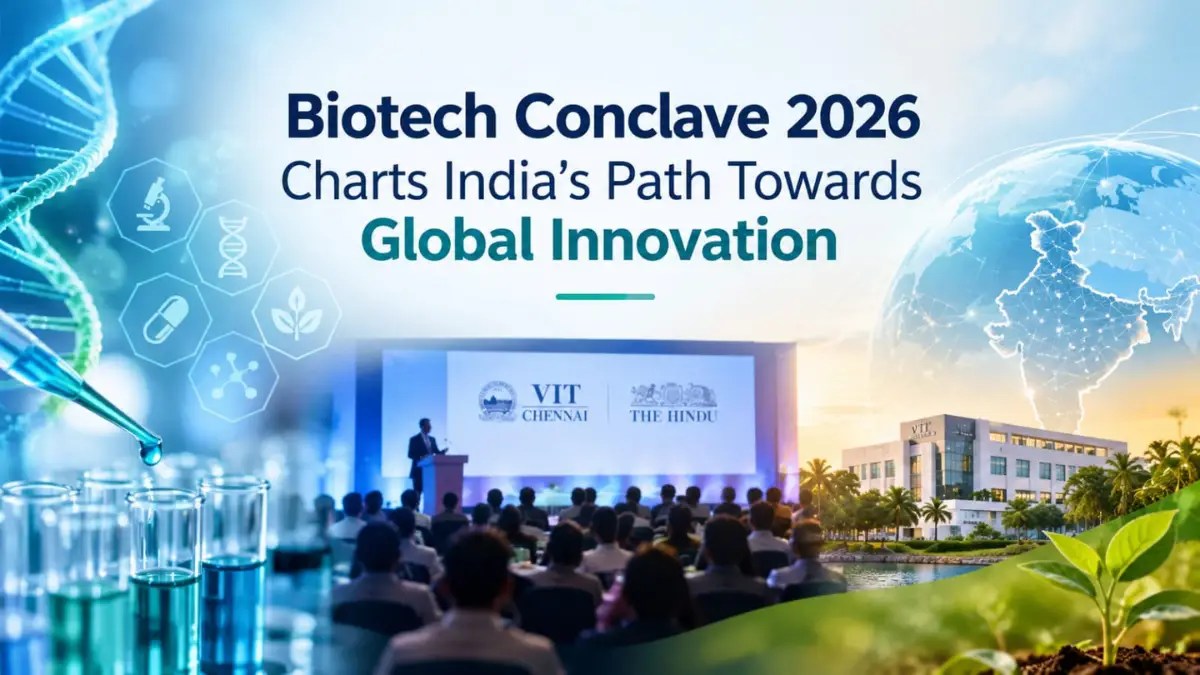
The Biotech Conclave 2026, organised by the VIT Chennai in association with The Hindu, brought together the scientists, the researchers, the academics, the entrepreneurs, the industry leaders and the students to examine the rapidly changing biotechnology landscape. It was held in Chennai under the theme of “Exploring New Frontiers in Science,” and the conclave focused on the biomedical research, the drug discovery, the healthcare technology, the biotechnology innovation and the translation of the scientific research into the practical applications.
The discussions went beyond the scientific discoveries. They examined how India can build a stronger biotechnology ecosystem through the long-term capital, the better industry-academia collaboration, the global expansion, the responsible regulation, the artificial intelligence, the translational research and the stronger safeguards for the genetic information.
The conclave highlighted the rapid expansion of the Indian biotechnology ecosystem, with more than 1,100 biotech start-ups been launched in the previous year, while the sector has been recording the strong compounding annual growth. The discussions suggested that the biotechnology is becoming an increasingly important part of the innovation economy of India.However, the experts stressed that simply increasing the number of start-ups is not enough. The country needs the companies which can undertake serious the research, develop the intellectual property, create the commercially viable products and compete internationally with the other countries.
One of the major concerns raised in the conclave was the availability of the long-term capital. The biotechnology research often requires the years of experimentation, development, testing and the regulatory approvals before a product reaches the market. Therefore, the companies cannot always be evaluated through the short-term investment expectations that are common in the other sectors. The speakers argued that India needs the patient capital that allows the biotechnology enterprises to take the scientific risks, build the research capabilities and develop the products over the long term.
Another important message was that the Indian biopharma industry needs to move from the volume to the value.
India has established itself as a major producer of the vaccines and the pharmaceutical products. The next challenge is to build greater strength in the original research, the advanced biotechnology and the high-value products. Suchitra Ella, the co-founder and the managing director of Bharat Biotech, Padma Bhushan recipient and CII President-Designate, stressed that India has already made an important transition,as instead of depending primarily on the vaccines developed in the West, the Indian companies are increasingly building their own research and the manufacturing capabilities. She argued that the Indian biotechnology companies should now look beyond the domestic market and develop products for the other developing countries, particularly the solutions for the infectious diseases. This would allow India to use its scientific and the manufacturing strengths to address the healthcare problems across the developing world.
The conclave also placed a strong emphasis on the social purpose of the biotechnology. A panel discussion on the topic “Innovation should cater to people with limited access” examined how the technology can improve the healthcare while ensuring that its benefits are not restricted to the privileged sections of the society. The speakers highlighted the importance of making the new healthcare technologies affordable and accessible. The biotechnology may produce the sophisticated treatments and the diagnostic tools, but their real social value depends on whether the ordinary people can actually access them.
This approach also connects biotechnology with the broader One Health perspective discussed at the conclave. The speakers emphasised that there are stronger links among the life sciences, the food security, the healthcare and the public health.
Another key theme was the translational research, which is known for taking the scientific discoveries from the laboratories and converting them into the useful products, the treatments and the technologies. T. Thiyagarajan of VIT Chennai emphasised that the translational research is crucial for producing the socially conscious results. The students and researchers should not stop at the theoretical discoveries. They should be encouraged to develop the prototypes and explore how their research can address the real-world problems.
The conclave also stressed the collaboration among the universities, researchers, industry and the investors. Such partnerships can help the scientific discoveries to move more effectively from the laboratories into the hospitals, businesses and the communities.
The students were encouraged to take the advantage of the opportunities to work with research institutions and the industry instead of remaining confined to their academic environments.
Suchitra Ella, the co-founder and the managing director of the Bharat Biotech and the CII president-designate, offered a particularly strong message to the biotechnology students to leave the comfort zone and embrace the new roles.
She advised students to step outside their campuses, gain exposure to the laboratories and the research institutions, and develop skills beyond their formal academic curriculum. She particularly highlighted the importance of developing both the wet-lab and the computational skills. This is increasingly important because the biotechnology is becoming an interdisciplinary field. The laboratory biology is now being combined with the artificial intelligence, the data processing and computational discovery.
Ella also suggested that the graduates should spend three to five years in understanding how the organisations actually function and that being a good scientist alone may not be sufficient for someone who wants to become a successful biotechnology entrepreneur. The entrepreneurs need to understand the business, the commercial operations, the scientific marketing, the distribution, the safety requirements, the regulatory systems and the supply chains.
The growing divide between the traditional laboratory research and the AI-driven discovery was an another important subject.
The conclave recognised the enormous potential of the artificial intelligence in the biotechnology. The AI can assist the researchers in analysing the large amounts of the biological information, identifying the patterns and accelerating the scientific discovery.
However, the speakers stressed that AI should complement rather than replace the laboratory research.
The wet lab remains the starting point for validating the scientific discoveries, while computational tools can provide the powerful support. The future of the biotechnology is therefore likely to depend on combining the experimental science with the computational capabilities.
The rapid growth of biotechnology has also created the regulatory challenges. Former NCBS director Prof. K. VijayRaghavan discussed the expanding start-up ecosystem and the need for more appropriate regulation. He pointed out that the regulatory principles had, until recently, often been influenced by the models developed elsewhere. The use of such approaches could unintentionally favour the companies with the deeper pockets because smaller companies may struggle to meet the complicated requirements. The answer, according to the discussion, is the contextual regulation, the rules that protect safety and the public interest without creating the unnecessary barriers for the innovative start-ups.
The rapid growth of the biotechnology sector makes this especially important. If the regulation becomes excessively burdensome, the promising research may never reach to the market. At the same time, the scientific innovation cannot be allowed to proceed without the adequate safety and the ethical safeguards.
One of the most significant discussions at the conclave concerned the protection of the genetic data from the misuse.
As genetic testing becomes more common, the people are generating increasingly valuable and sensitive biological information, which can help the doctors in understanding the inherited diseases, assessing the risks and moving towards the more personalised treatment. But the genetic data also raises serious concerns about the privacy, the consent and the misuse.
The experts emphasised the need to safeguard the genetic information and to ensure that the people understand how their data will be collected, stored and used.
The Clinical geneticist and the counsellor Dr. Kalpana discussed the importance of family history in deciding when the genetic testing may be appropriate. There are certain patterns such as the diseases appearing unusually early or the same condition occurring repeatedly within a family, which can provide important clues about the possible genetic disorders.
At the same time, the diagnostic practices must be handled carefully because the genetic testing can have the emotional and the financial consequences for the families.
The discussion also moved towards the gene editing, the embryonic gene therapy and the precision medicine.
The experts noted that the genetic technology has already changed the treatment landscape for the several genetic disorders. However, the newer technologies also raise the ethical questions about how and when they should be used.Dr Scaria, the speaker and panelist at the VIT Chennai – The Hindu Biotech Conclave 2026, while discussing the embryonic gene therapy, pointed out that the public debate often becomes dominated by the controversy before the technologies have matured sufficiently for the practical use. He called for a pragmatic approach in which appropriate policies and safeguards are established as the technologies develop.
The broader message was that the scientific progress should neither be rejected automatically nor be adopted without the necessary safeguards. The decisions should be based on the experimental evidence, the safety data and the regulatory requirements, rather than the theoretical expectations alone.
The Biotech Conclave 2026 ultimately presented the biotechnology as a field where the science, business, policy and the social responsibility must work together. The event brought together participants from the industry, academia, research institutions and the student communities. The discussions ranged from the biomedical research and the drug discovery to the AI, food security, healthcare access, genetic testing and the entrepreneurship. The conclave made it clear that the Indian biotechnology journey has entered an important phase. The country already has a growing start-up ecosystem, the research talent, the manufacturing capacity and an expanding market. The next challenge is to convert these strengths into the globally competitive innovation.
India will need the long-term capital, contextual regulation, stronger translational research, industry-academia partnerships, interdisciplinary skills and the responsible handling of the genetic information.
Most importantly, the biotechnology must remain focused on the people. The success of Indian biotech revolution will ultimately not be measured only by the number of start-ups it has launched or scientific discoveries it has made. It will be measured by whether those discoveries become the affordable medicines, better diagnostics, stronger healthcare systems and the practical solutions for people in India and other developing countries. The Biotech Conclave 2026 therefore offered a clear message that the Indian biotechnology future is promising, but its next leap will require the country to move beyond scientific the achievements alone and build an ecosystem where the innovation is globally competitive, socially responsible, safely regulated and is accessible to those who need it the most.