
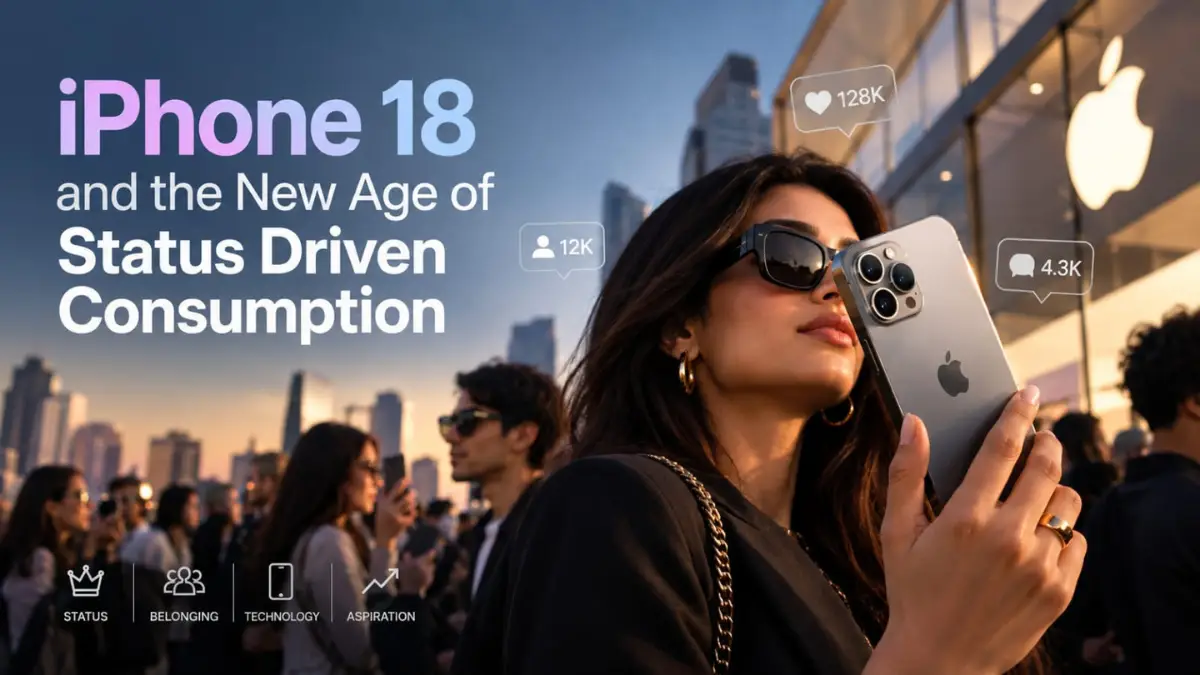
The launch of a new smartphone is no longer simply a technology event but it has increasingly become a cultural moment, which reveals how deeply the consumption, the identity and the social status are intertwined. The Apple has launched the iPhone 18 Pro and iPhone 18 Pro Max on September 9, 2026, and the pre-orders would begin by September 12 and the sales from September 18. It has once again placed the spotlight on a question that goes far beyond the technology about “Why do people want to own the latest and most expensive products, even when their existing devices are working well?” The answer can partly be understood through the economic concept of the conspicuous consumption, developed by the economist and the sociologist Thorstein Veblen in his 1899 work The Theory of the Leisure Class. Veblen argued that the people sometimes consume goods not merely because of their practical usefulness, but because those goods communicate the wealth, the prestige and the social position to others. The modern research continues to examine the conspicuous consumption primarily as a form of the status signalling.
An iPhone is, of course, a functional device, by using which one can make the calls, take the photographs, access the internet and run the applications. The latest iPhone 18 Pro models also offer substantial technological improvements, including a 48MP Fusion Main camera with a variable aperture, an enhanced performance and a longer battery life.However, the social meaning of a premium smartphone can extend beyond its technical specifications. The device can communicate something about its owner, for instance the owner can boast saying “I can afford this. I follow the latest trends. I belong to a particular social group. I value premium products.” This is when a product becomes a status symbol. A person may therefore be purchasing two things at once, the physical product and the social meaning attached to it.
Now the question arises, “What Is a Veblen Good?” A Veblen good is a special type of the luxury or the status-oriented product where a high price can itself contribute to its desirability. The idea is named after Veblen and is associated with the situations in which the consumers can value the products partly because they signal the wealth or the social standing. The economic research on the Veblen effect examines how the consumers may use expensive goods to advertise their economic position. The luxury watches, the designer handbags, the premium cars and the high-end fashion can fit in this logic. The Smartphones such as premium iPhones can also function as the status goods, although it would be too simplistic to classify every iPhone purchase as a Veblen purchase, because many consumers buy them because of their genuine technological preferences, the ecosystem integration, the reliability or the professional requirements. The important point is that the same product can have both the functional value and the symbolic value.
The modern consumer culture has made the products increasingly connected to personal identity because what we wear, drive, carry and display can become part of the stories we tell about ourselves. The social media has amplified this phenomenon, as a luxury purchase is no longer visible only to the neighbours, the colleagues or the friends. It can potentially be displayed to the hundreds or the thousands of followers online. The smartphone itself is also the tool through which much of this status signalling takes place. This creates an interesting paradox, making the people to purchase the devices because they represent the status, and then use those devices to publicly display their lifestyles. In this environment, the consumption can become a form of communication.
Veblen’s ideas also help explain the psychological pressure behind the familiar phrase “keeping up with the Joneses.”
It occurs when the people constantly compare themselves with their peers, the celebrities, the influencers or the colleagues.
A person who bought an expensive smartphone last year may suddenly feel that it looks outdated when a new generation arrives. The previous device may still perform perfectly well, but its symbolic value has changed. This creates a cycle where the new product gets social attention and creates a desire for its ownership in the public, psychologically forcing them to purchase it, thereby getting temporary feeling of improved social status, but this feeling goes with the launch of the new model. This cycle does not necessarily mean consumers are irrational. The people derive the real pleasure from the new technology, the new design and the latest innovation, but the social comparison can add another layer to the purchasing decision.
This phenomenon is particularly interesting in India, where the rising incomes, expanding consumer markets and the increasing exposure to the global brands are reshaping the consumption patterns. The recent research using the Indian household data has specifically examined the conspicuous consumption as a form of status signalling across the income groups and the social identities. Elsewhere, the experts argue that visible inequality and the social comparison can influence the household spending on the status-oriented goods. For the India’s aspirational middle class, the premium products can represent more than the wealth. They can represent social mobility, because owning a premium phone, a car or a branded product may communicate that an individual has moved upward economically or socially. The consumption therefore becomes connected with the aspiration.
Are We Buying Products or Buying Status? This is perhaps the most important question. If a person buys a premium smartphone because they genuinely need its camera, the processing power it provides or the professional features it has, the purchase is primarily functional. But if the primary motivation is the prestige attached to the logo, the model number or the ability to demonstrate the ownership, then purchase moves closer to the conspicuous consumption. In reality, the two motivations frequently coexist, making the products such as the iPhone culturally significant. This demonstrates how the boundary between the utility and the identity has become increasingly blurred.
There is also a larger question about when a modern society considers a person to be successful. For decades, the visible possessions have been used as the shorthand for the achievement. A luxury car, an expensive watch, a designer clothing or a premium smartphone can become a visual representation of the personal success. However, some contemporary discussions of the wealth increasingly focus on the less visible forms of the privilege, for instance, the free time, the privacy, the health, the flexibility and the ability to disconnect. In other words, the status symbol may be changing. Yet the underlying principle remains similar, that is, the scarce resources become the symbols of the social position.
The iPhone 18 is therefore more than simply a technological upgrade. It provides a useful window into the relationship between the capitalism, the technology, the aspiration and the identity. The real significance of the conspicuous consumption is not that the people buy the expensive products. It is that the products can acquire the social meanings far beyond their practical functions. A smartphone can become a statement. A car can become an identity. A handbag can become a social signal. A watch can become a declaration of success. And in an increasingly visual, the social-media-driven world, the question is no longer simply, “What can this product do?” It is also important to ask “What does owning this product say about me?” That is the enduring power of the Veblen effect and perhaps one of the clearest ways to understand why the status symbols continue to play such a defining role in the modern life.