
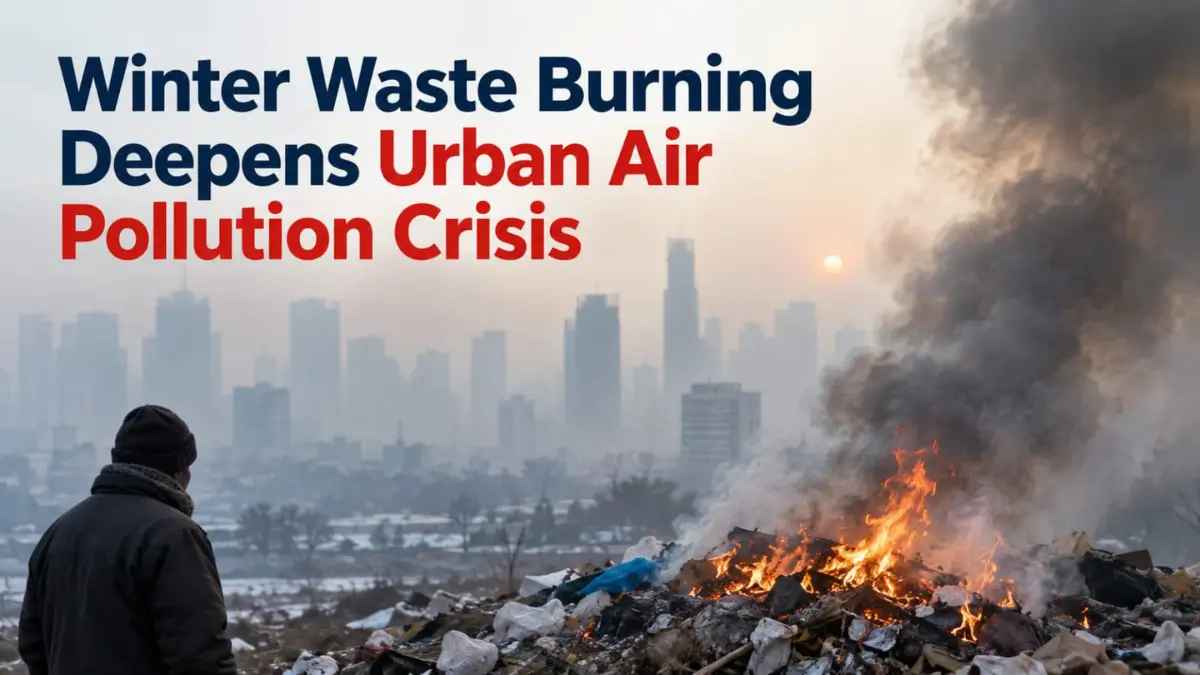
The open waste burning remains a persistent but often an overlooked source of the air pollution in the Indian cities. A recent study by the World Resources Institute (WRI) India highlights that a worrying seasonal trend of open waste burning increases sharply during the winter season, with its incidence in the cities nearly tripling in comparison to the summer. The findings underline how the poor waste management, the socio-economic inequalities and the seasonal weather conditions combine to worsen the quality of air in the urban areas.
The study, based on the field surveys conducted between the year 2019 and 2026 across the polluted Indian cities, examined the incidence of open waste burning, the quantity of waste burned and the emissions associated with it. The researchers found that the problem becomes particularly serious during the post-monsoon and the winter months. During this period, the lower temperatures and the stagnant atmospheric conditions make it more difficult for the pollutants to disperse.
One of the significant findings is that the Tier 2 cities with the populations between the 500,000 and the five million recorded the highest quantities of the waste being burned among the cities examined. These cities may not always receive the same attention as being recieved by the largest metropolitan areas in India, but their waste-management challenges can have the serious environmental consequences.
Interestingly, the highest winter incidence of the open waste burning was recorded in the Tier 3 cities, with on an average around 49.6 incidents per square kilometre per day. This was higher than the corresponding figures of approximately 46 incidents in the Tier 2 cities and the 39.4 incidents in the Tier 1 cities.
The findings suggest that the scale of a city alone does not determine the severity of the open waste burning. The smaller cities can face significant challenges because of the inadequate waste collection systems, the limited municipal resources and the weaker enforcement of regulations.
Winter weather plays an important role in the determination of the impact of open waste burning. During the colder months, the atmospheric conditions can become less favourable for the dispersion of the pollutants. As a result, the smoke and the particulate matter can remain concentrated closer to the ground. The open burning releases the pollutants such as the fine particulate matter (PM2.5), the PM10 and the other harmful substances. Although the study indicates that the open waste burning is not the dominant source of the citywide particulate pollution, its importance cannot be dismissed.
The report points out that the waste-burning incidents frequently occur close to the homes, the streets and the waste dumps. Therefore, even if their contribution to the overall citywide emissions is relatively smaller, the people living or working nearby may experience significant short-term exposure to the toxic smoke.
An another important dimension highlighted by the study is the relationship between the open waste burning and the socio-economic conditions. The poorer areas experienced substantially more waste burning than the higher-income neighbourhoods.
In the study, the highest incidence was recorded in poorer areas of the Tier 2 cities, reaching nearly 84 incidents per square kilometre per day during winter season. This disparity points towards a larger problem in the urban governance. When waste collection is irregular or inadequate, the residents and the local communities may resort to burn the accumulated waste. Consequently, the communities that are already facing the poorer public services can also experience greater the exposure to the pollution.
The redressal of the problem of the open waste burning requires more than just the imposition of the penalties. The municipal authorities need to strengthen the door-to-door waste collection, the segregation, the transportation and the scientific processing of waste. The local governments should also identify the recurring waste-burning hotspots and then the increase monitoring during the winter season.
The public awareness is equally important. The residents need the accessible alternatives for the proper disposal of the household and the community waste, while the local authorities must ensure that these services are reliable.
The technology can further assist the cities through GPS-based waste-collection monitoring, the citizen reporting systems and the satellite or the ground-based identification of burning hotspots.
Ultimately, the study demonstrates that open waste burning is both an environmental and a social issue. Its sharp rise during the winter season, particularly in the smaller and the poorer urban areas, shows the need for the targeted interventions. Improvisation of the municipal waste-management systems can simultaneously reduce the pollution, improve the public health and make Indian cities cleaner and more equitable.