
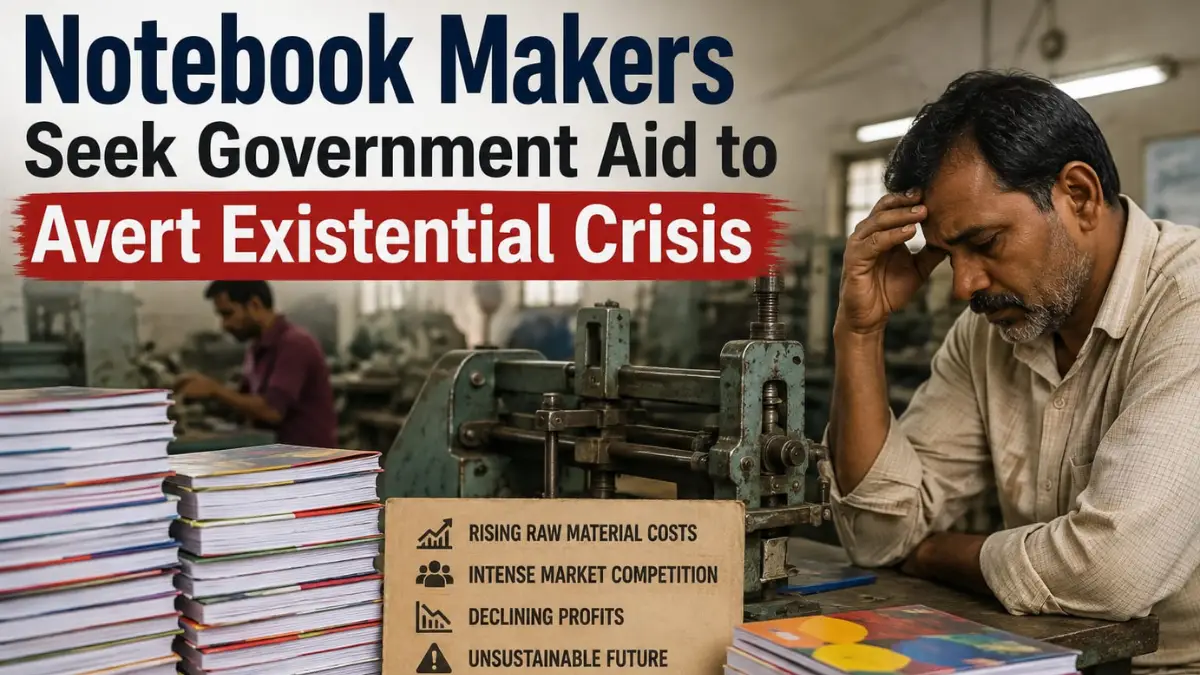
The Indian domestic notebook manufacturing industry is facing a serious challenge as the low-cost imports from the Southeast Asian countries and the recent changes in the Goods and Services Tax structure put an increasing pressure on the local manufacturers. The All India Notebook Manufacturers Association has appealed to the government for an urgent support, warning that the industry could face an “existential crisis” if the corrective measures are not introduced on time.
The association has highlighted that there are two major developments behind the present situation, the first being the Indian Free Trade Agreement with the Southeast Asian countries and the second is the revision of GST rates by the government in September 2025. According to the industry, these developments have unintentionally created an uneven competitive environment for the domestic notebook manufacturers.
One of the biggest concerns of notebook manufacturers is that the low-cost finished notebooks imported from the Association of Southeast Asian Nations (ASEAN) region are increasingly available in the market.
Under the existing ASEAN Free Trade Agreement, there are several finished paper products, including the exercise books, the graph books and the laboratory notebooks, that are allowed to enter the Indian market without the Basic Customs Duty. The imports from the countries such as the Indonesia, the Thailand and the Malaysia can therefore compete directly with the notebooks manufactured by the Indian companies.
The association argues that the present international trade agreements, when combined with the domestic tax rationalisation, have inadvertently created a highly asymmetrical trading environment. While free trade agreements are fundamentally designed to promote the reciprocal and the equitable trade, the specific conditions of the global paper industry have allowed the Southeast Asian countries, particularly the Indonesia, to take advantage of the existing tariff structure.
The association has particularly raised concerns about the Indonesian notebook and the paper manufacturers. The Indonesian paper manufacturers benefit from the economies of scale, the state-supported forestry programmes and the highly integrated supply chains. These supply chains can extend from the extraction of the pulp to the final assembly of the finished notebooks. Such integration helps the manufacturers to control the costs and to produce the finished products at a competitive prices.
The Indian manufacturers, in comparison, face the domestic production costs that make it difficult to compete with the extremely low-priced imported notebooks. The association believes that the continued imports of the cheap finished products could seriously affect the survival of the domestic manufacturing units.
Another major concern is the revision of GST rates on the notebooks and the exercise books.
During the 56th GST Council meeting, the government has revised the GST rate on the exercise books and the notebooks from the 12% to the zero, making them fully exempt from the GST. The decision was a well-intentioned effort to support the education sector and reduce the financial burden on the students and their families.
However, the notebook manufacturers argue that the change has created an inverted duty structure, which occurs when the taxes on inputs remain higher while the final product is taxed at a lower rate or it is completely exempt.
As a result, the domestic notebook manufacturers may continue to bear the tax-related costs on their inputs even though the finished notebooks are sold without the GST. According to the association, this has ultimately added to the cost burden of the domestic manufacturers.
The notebook manufacturing sector provides the employment to a large number of people. The association stated that the domestic industry consists of approximately 1,500 manufacturing units across the country and employs around 1.25 lakh people.
If the domestic manufacturers lose their ability to compete with the cheaper imports, the smaller manufacturing units could face the problem of the declining production, the financial difficulties and even the closure. This could have a direct impact on the employment and the wider paper and the stationery manufacturing ecosystem.
The All India Notebook Manufacturers Association has appealed to the Ministry of Commerce and Industry to protect the domestic industry, with one of its key proposals being the introduction of a Minimum Import Price (MIP) for the notebooks. A minimum import price would establish a floor below which the notebooks could not be imported, helping the domestic manufacturers to compete against the extremely low-priced products. The association has also proposed the initiation of the anti-dumping investigations into the notebook imports from the Indonesia. These anti-dumping measures can help in addressing the situations where the imported products are sold at an unfairly low prices and cause injury to the domestic producers.
In addition, the association has called for streamlining the export refund mechanisms and for investigating the alleged anti-profiteering activities by the domestic paper mills. These measures, it believes, could help in reducing the cost pressures and in improving the competitiveness of the Indian manufacturers.
The issue presents a policy challenge for the government. The notebooks and the exercise books are essential educational products, so keeping them affordable for the students is important. At the same time, the domestic manufacturers need a fair and a sustainably competitive environment. The reduction of the GST was intended to benefit the students by reducing their financial burden associated with the educational materials. However, if the resulting tax structure increases the cost of manufacturing, the government may need to reconsider how the policy affects the entire supply chain.
Similarly, the free-trade arrangements are intended to promote an equitable trade, but the domestic industries may require the necessary safeguards when the structural differences between the countries create significant competitive disadvantages.
The concerns raised by the Indian notebook manufacturers highlight the challenges of balancing the consumer affordability, the free trade and the domestic manufacturing. With around 1,500 units and an approximately 1.25 lakh employees dependent on this sector, the issue extends beyond the stationery industry. The demands raised by the association for the Minimum Import Price, the anti-dumping investigations, the streamlined export refunds and the action on the alleged anti-profiteering activities are aimed at creating a more level playing field.
The challenge before the government will be to ensure that the notebooks remain affordable for the students while also protecting the viability of the Indian manufacturers. A balanced policy response could help in safeguarding the employment, strengthening the domestic manufacturing and in ensuring that the Indian notebook industry remains competitive in the long term