
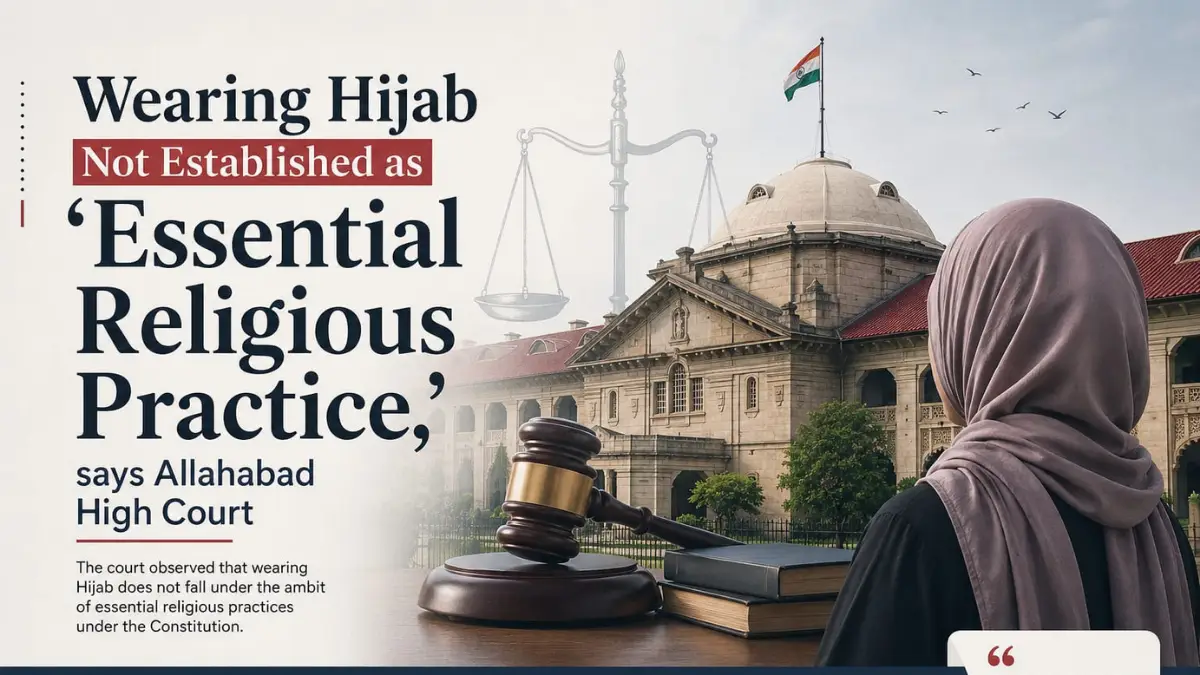
The Allahabad High Court has given a ruling that wearing a hijab or headscarf has not been established as an essential religious practice in Islam, and it upheld the authority of an educational institution to enforce its prescribed uniform. The judgment came in a a dispute involving a Class 6 student of a school in Prayagraj. The student had previously worn a scarf and later began wearing a hijab along with her school uniform. The school objected to this practice on the ground that it violated its institutional dress code.
The petitioner argued that wearing the hijab was connected with her religious freedom and therefore should be protected, relying on the constitutional guarantee of freedom of religion, particularly Article 25 of the Constitution, which provides the individuals with the freedom to profess, practise and propagate the religion of their choice. The central question before the court, therefore, was whether wearing a hijab can be regarded as an essential religious practice, and can it override the school’s uniform regulations.
The concept of an “essential religious practice” (ERP) plays a very significant role in the Indian constitutional law. The courts have, in several cases, examined whether a particular practice is fundamental or indispensable to a religion. If a practice is found to be essential to a religion, then placing restrictions on it may raise serious constitutional concerns, although even the religious freedom is subject to constitutional limitations such as the public order, morality and the health.
In the present case, the Allahabad High Court observed that the petitioner had not provided sufficient material to establish that wearing a hijab was an essential and indispensable practice of Islam. The court distinguished between a practice that may be followed by many believers and a practice that is legally demonstrable as compulsory or fundamental to the religion.
Another important aspect of the judgment concerns the autonomy of educational institutions. Schools prescribe uniforms for several reasons, including maintaining discipline, creating a sense of equality among the students and ensuring a common institutional identity. A uniform policy generally applies to all students irrespective of their individual backgrounds.The High Court held that the dispute was principally about compliance with the institutional dress requirements. According to the court, the school’s uniform policy was not shown to be specifically directed against the Muslim community or against a particular student’s faith. Instead, it was a general requirement intended to apply uniformly to all the students.The court also stressed that allowing the individual exemptions from a common uniform policy could potentially affect the institution’s ability to maintain the uniformity amongst the students. Thus, the judgment brings forward a broader question: to what extent can an individual religious expression coexist with the common institutional rules?
Article 25 of the Indian constitution protects the religious freedom, but this freedom is not absolute and can be subjected to the reasonable limitations. At the same time, the issue of religious clothing is particularly sensitive because clothing can form an important part of a person’s identity, faith and personal expression. The critics of the restrictive uniform policies may argue that the students should be given a reasonable space to express their religious identity, provided that such expression does not disrupt the education or the institutional functioning. Supporters of strict uniform policies, on the other hand, argue that schools should maintain a common dress code so that students are treated equally and the educational environment remains free from visible distinctions based on religion, caste or economic status.
The Allahabad High Court’s decision, therefore goes beyond the individual dispute raising the important questions about the relationship between religious freedom, secularism, equality and institutional discipline in India.
The judgment does not mean that religious freedom has no place in educational institutions. Rather, it emphasises that a claim for exemption from the institutional rules cannot automatically succeed merely because a practice is associated with religion. The person claiming constitutional protection may have to establish the nature and importance of the practice.
At the same time, the issue remains socially sensitive because questions surrounding the hijab involve not only the law but also the gender, the religious identity, the personal autonomy and the minority rights. The challenge for the Indian constitutionalism is to ensure that the institutional rules are applied fairly while also protecting genuinely religious and the individual freedoms.
Ultimately, the case demonstrates the continuing tension between the “uniformity” and the “diversity” in Indian educational institutions. The larger constitutional challenge is to find a balance where schools can maintain discipline and the common standards without unnecessarily interfering with the legitimate individual freedoms.