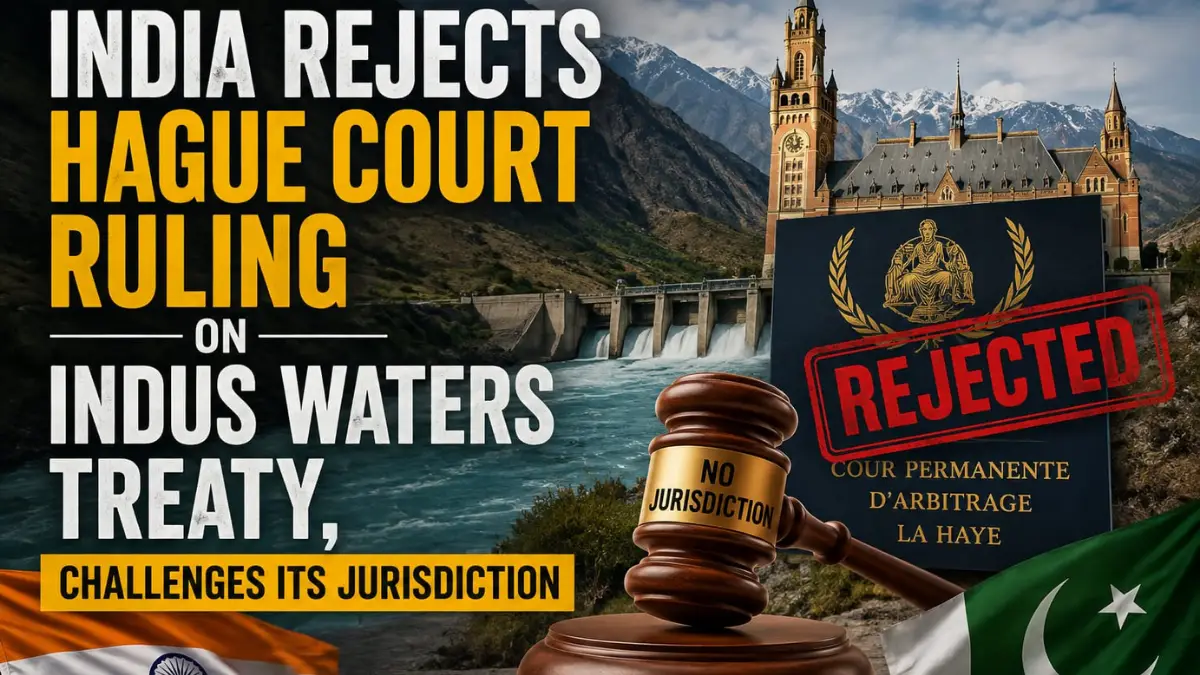
India has rejected a recent ruling by the Permanent Court of Arbitration at The Hague, Netherlands concerning the Indus Waters Treaty, maintaining that the arbitration body has no jurisdiction to pronounce the decisions on the matters involving India.
The Ministry of External Affairs said that the Indus Waters Treaty remains “fully in force” despite India’s decision to place it in abeyance following the Pahalgam terror attack in April 2025. India has reiterated that it will continue to maintain its position on the treaty.
According to the Ministry, India has never recognised the existence or legal authority of the so-called Court of Arbitration which is constituted under the treaty. It described the establishment of the body as a serious violation of the provisions of the Indus Waters Treaty.
India also stated that it has never appeared before the arbitration body and has refused to recognise or take cognisance of its earlier pronouncements. The government maintains that the court was improperly constituted and therefore cannot issue decisions that can bind India.
The dispute concerns the interpretation and implementation of the Indus Waters Treaty, a water-sharing agreement between India and Pakistan brokered by the World Bank. The treaty is related to the use of the Indus river system and it provides the mechanisms for resolving the differences between the two countries.
Following the Pahalgam attack, India announced that the treaty would remain in abeyance. However, the Court of Arbitration recently considered the position of Pakistan and examined the circumstances surrounding the decision made by India to keep the treaty in abeyance.
The arbitration court reportedly concluded that the reasons cited by India did not provide sufficient grounds for suspending or terminating the treaty. It subsequently issued an award concerning the status of the treaty and also an interim order related to Pakistan’s concerns over the Ratle Hydroelectric Power Project (RHEP) in Jammu and Kashmir.
The court maintained that the Indus Waters Treaty continues to remain in force and said India is required to fulfil its obligations under the agreement, including the provisions concerning the design and the operation of the hydroelectric projects on the western rivers.
The arbitration body also considered Pakistan’s request for the measures against India in relation to the Ratle project. In its decision, it imposed restrictions concerning the construction of certain components of the project until a final decision is delivered by the Neutral Expert. That decision is expected to be made in July 2027, according to the report.
India, however, has strongly rejected the validity of these proceedings. The External Affairs Ministry said that the present and future pronouncements made by the Permanent Court of Arbitration would have no bearing on India’s sovereign decisions or actions concerning its ongoing projects.
The disagreement highlights a deeper legal and diplomatic dispute between India and Pakistan over the interpretation of the Indus Waters Treaty. While the Pakistan has continued to invoke the dispute-resolution mechanisms provided under this treaty, India has argues that the arbitration process itself lack legitimacy in the circumstances.
The Court of Arbitration was chaired by Prof. Sean D. Murphy of the United States.
The latest development adds another layer to the already strained relationship between India and the Pakistan and could have significant implications for the future management and development of the water resources in the Indus river system.
India Rejects Hague Court Ruling on Indus Waters Treaty, Challenges Its Jurisdiction

BySarita
Sep 1, 2026