
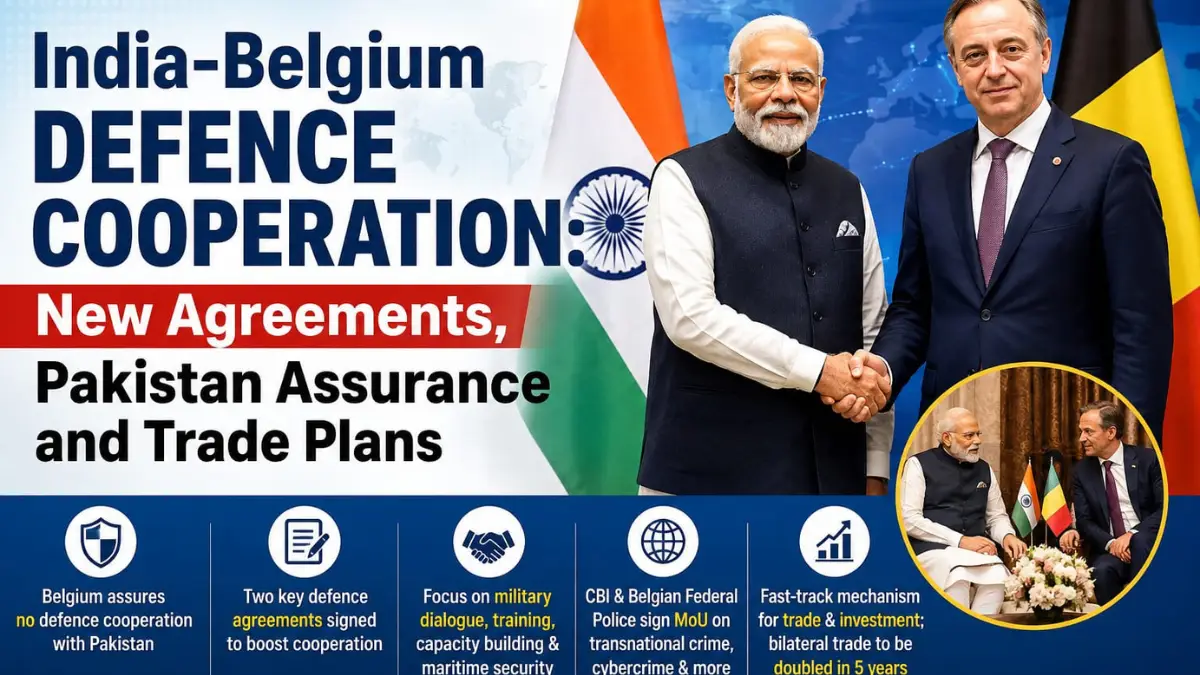
The India-Belgium defence cooperation is entering a new phase, with both the countries focusing on the defence agreements, the military training, the technology, the maritime security and the industrial partnerships. India and Belgium are taking the necessary steps to strengthen their bilateral relationship, with the defence cooperation emerging as one of the most important areas of engagement. During the Belgian Prime Minister Bart De Wever’s recent official visit to India, the discussions between the two countries covered the defence technology, the military cooperation, the industrial partnerships, the maritime security, the trade and the regional peace. This visit comes at a time when India is seeking to modernise its armed forces, expand its defence manufacturing and build the stronger partnerships with the countries that can contribute to its technological and the industrial capabilities.
A key development was that Belgium has given an assurance to India that it would not pursue any kind of defence cooperation or would not provide any technological assistance to the Pakistan. According to the report, the Defence Minister Rajnath Singh raised the Indian concerns regarding the possibility of the Belgian defence technology or expertise being extended to the Pakistan. The Belgian government assured India that there was “no question” of the defence cooperation with the Pakistan. The assurance assumes significance because India has been raising concerns with its international partners about the transfer of defence technologies and military equipment to Pakistan that could strengthen its military capabilities.
For New Delhi, such assurances are important because the defence partnerships are closely linked to the national security and the regional stability. The issue also reflects the broader effort of India to ensure that the sensitive military technologies do not reach the countries where they could create the additional security challenges.
The India-Belgium engagement also signed the two government-level defence agreements, of which the first was a Letter of Intent on Defence Cooperation and the second was a Memorandum of Understanding between the Belgian Security and the Defence Industry and Society and the Society of Indian Defence Manufacturers. These agreements are expected to provide a framework for the greater cooperation between the defence industries of the two countries. They could also encourage the exchange of the expertise, the technological collaboration and the industrial partnerships.
The agreements are particularly relevant to the efforts made by India to strengthen its domestic defence manufacturing sector. The greater engagement with the international defence companies can help the Indian manufacturers to explore the new technologies, improve the capabilities and participate in the wider defence supply chains.
During the bilateral meeting, the two Defence Ministers reviewed the entire spectrum of the India-Belgium defence and the industrial cooperation and had agreed to expand the engagement through the defence cooperation dialogue, the high-level visits, the training and the capacity building. Such measures can help to improve the institutional understanding and create the opportunities for the armed forces of both the countries to learn from each other. The discussions also focused on the regional peace and security. Both the sides acknowledged the need for greater maritime security cooperation in the Indo-Pacific as the maritime security has become an increasingly important issue because the global trade depends heavily on the safe and the uninterrupted shipping routes. The cooperation in this area can contribute to the protection of commercial shipping and help the countries to respond to the emerging security challenges.
The Belgium government’s support for India was also reflected in the discussions on the terrorism and the regional conflicts.
The Belgian Prime Minister described the current global situation as “turbulent” and called for the free globalization and an end to the unilateral imposition of the tariffs, which are a hindrance to the growth of the bilateral trade between India and the Belgium.
The two leaders discussed the conflicts in the Ukraine and the West Asia, and also supported the dialogue and the diplomacy as the way forward to solve the dispute between the two countries. The Prime Minister Narendra Modi called for an end to the ongoing conflicts and emphasized the importance of resolving them through the peaceful means.
The leaders also paid tribute to the 9,000 Indian soldiers who had perished in the Flanders Fields during the First World War which highlighted the historical connection between the India and the Belgium and the sacrifices made by the Indian soldiers in the region. Moreover, India also reiterated its commitment to eliminating the terrorism in all its forms and the manifestations. The Prime Minister Modi said that the terrorism is a shared commitment and that India and the Belgium government must work together to address this challenge.
An Another important agreement was signed between the Central Bureau of Investigation (CBI) and the Belgian Federal Police, which focuses on the cooperation in the transnational organized crime, the cybercrime and the related matters.
As the criminal networks increasingly operate across the national borders, the cooperation between the investigative agencies has become even more essential. The information sharing, the coordination and the institutional cooperation can help both the countries to strengthen their efforts against the organized crime and the cyber-related threats. The agreement adds an another dimension to the India-Belgium relationship, showing that the partnership extends beyond the traditional defence and the trade issues.
Belgian Defence Minister Theo Francken also emphasised the potential for deeper industrial collaboration, calling for the joint efforts to strengthen the armed forces of both the countries in an evolving security environment. The discussions included a Defence CEOs Roundtable and the B2B meetings, where the representatives from the defence industries of India and Belgium could explore the possible areas of the cooperation. For India, such engagement fits into its broader effort to modernise its military and to encourage the greater participation of the domestic industries in the defence production.
The Belgium, meanwhile, brings its own technological and the industrial capabilities to the partnership. The greater cooperation could create the opportunities for the investment, the technology exchange and the joint industrial projects.
The India-Belgium relationship is not limited to the defence cooperation. The two countries also announced the establishment of a fast-track mechanism to deal with the trade and the investment issues. Also, the two countries further announced that the bilateral trade would be doubled over the next five years. This is an important economic objective, as the stronger trade and investment ties can support the businesses, create employment opportunities and encourage the greater commercial engagement between the two countries. The establishment of a Consular Dialogue between the New Delhi and the Brussels was the another significant development. Such a mechanism can help in strengthening the institutional cooperation and addressing the consular matters in a more effective manner.
The latest developments suggest that India and Belgium are moving towards a more structured and a comprehensive partnership.
The Defence cooperation, the industrial collaboration, the maritime security, the trade and the institutional dialogue have become the important parts of the relationship. The two countries have also reiterated that their partnership is based on the shared values, the mutual trust and the respect. For India, the partnership offers an opportunity to strengthen its defence capabilities while building the reliable international relationships. For Belgium, it opens the door to the deeper engagement with one of the world’s major economies and an increasingly important player in global security. The success of these agreements, however, will depend on their proper implementation. The Regular dialogue, the sustained cooperation and the greater interaction between the industries and the institutions will be essential. The India-Belgium relationship is therefore entering a new phase, which seeks to combine the strategic cooperation with the economic opportunity. As both countries are working to strengthen their armed forces, expand trade and address the shared security challenges, their partnership could become an increasingly important part of their international engagement.