
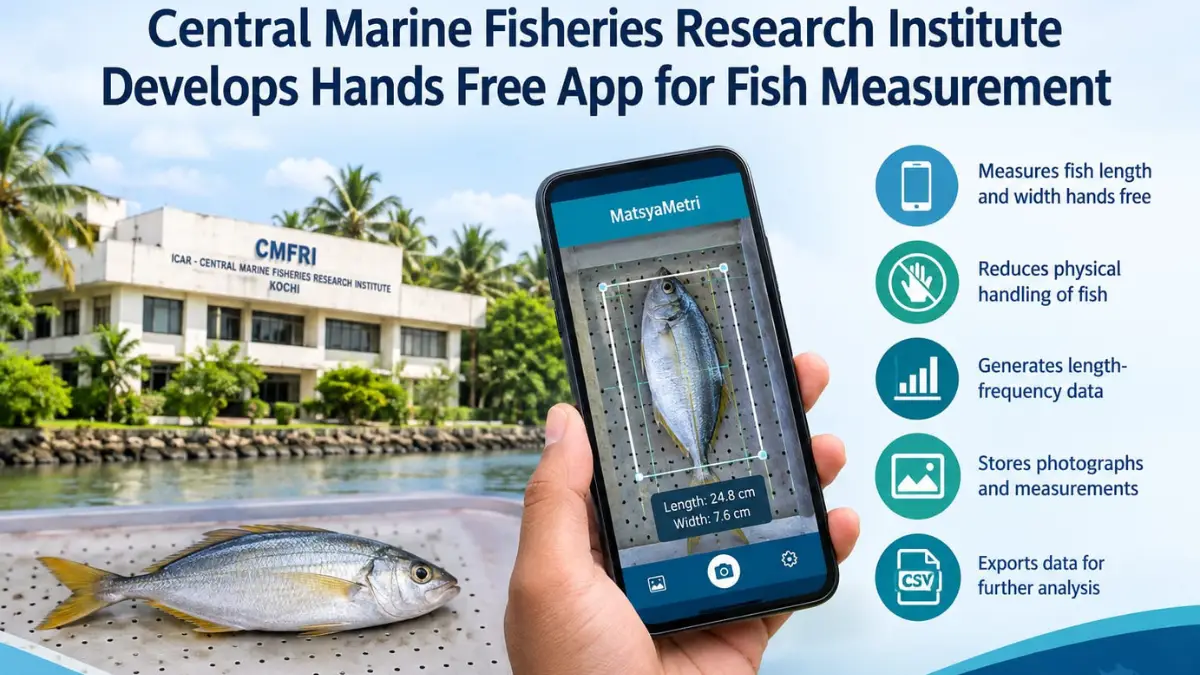
The Indian Council of Agricultural Research-Central Marine Fisheries Research Institute (CMFRI), which is located in Kochi, has developed an innovative smartphone application named as the MatsyaMetri, which can measure the length and the width of the fishes without physically handling them. The app is designed to make the biological data collection faster, systematic and more efficient, particularly for the fisheries scientists, the researchers and the field survey teams.
The accurate measurement of a fish is an important part of the fisheries research. The scientists use this information such as the length of the fish and its size to study the fish populations, assess the stocks and understand the changes in the aquatic resources. Traditionally, the collection of these measurements involved physical handling of the individual fish and then recording their dimensions manually. This can be time-consuming and arduous, especially when the researchers are working with a large number of specimens.
The MatsyaMetri addresses this challenge by using a smartphone camera and the technology involving the augmented reality. The application enables researchers to capture images of the fishes and then estimate their measurements through an on-screen measuring guide, thereby reducing the need for physical handling. The MatsyaMetri application works on the Android smartphones which are supported by the ARCore. When the phone camera is directed towards a fish, a measuring guide appears on the screen and the researchers can use this guide to determine the length and width of the fish.
An important feature of this application is that it can record the measurements of the multiple individuals of the same fish species or the aquatic resource within a single sampling session. This can make the field surveys considerably more organised and efficient. The application automatically records the measurements and then compiles them into the length-frequency datasets. After the measurements are completed, the system can automatically generate the length-frequency distributions using the appropriate class intervals. Such information is important for studying the fish populations and then conducting the stock assessments of the fisheries.
An Another useful feature is the digital storage of the information that is obtained. The recorded measurements and the corresponding photographs can be saved along with the sampling session. The collected information can subsequently be exported as a CSV file, allowing the researchers to use the data for further scientific analysis and research. This reduces dependence on the manual note-taking and makes the collected information easier to organise, analyse and share. The standardised digital datasets can also help the researchers to compare the observations collected during different surveys.
The application was developed by Dr Eldho Varghese, a senior scientist at CMFRI and an ICAR National Fellow. The technology was developed as part of an ICAR National Fellow project. The director of the CMFRI Dr Grinson George said that the application simplifies the biological data collection by automatically recording the measurements and generating the length-frequency datasets.
The development represents an effort to bring the modern digital technology into the fisheries research and the field-level data collection.The reliable biological data is essential for the effective fisheries management. Information about the size of the fish and the population structure helps the scientists to conduct the stock assessments, monitor the aquatic resources and then support the evidence-based management decisions.
The MatsyaMetri can make this process more efficient by combining the measurement, the photography, the data recording and the data organisation within a smartphone-based system. The ability to generate standardised length-frequency data can be particularly valuable for the analysis of the fisheries population in a scientific way and provide monitoring of the fisheries as a resource .
Therefore, the development of the MatsyaMetri, rightly demonstrates how the smartphones and the augmented reality can be adapted to solve the practical challenges in a scientific research. Instead of relying entirely on the traditional methods, where the fishes were being measured manually, the researchers can now use a portable digital tool to collect and organise the biological information, thereby enabling its easier assessment and management.
By enabling the hands-free fish measurement, supporting multiple samples in a single session, automatically generating the length-frequency distributions, and allowing the measurements and the photographs to be exported fo the further analysis, the MatsyaMetri has the potential to make the fisheries surveys more systematic and data-driven, which will inturn support the scientific research.
Overall, the application is an important technological innovation for the fisheries research. Its use can help the scientists to collect the biological data more efficiently and contribute to the better fish stock assessment, the aquatic resource monitoring and the sustainable fisheries management.