
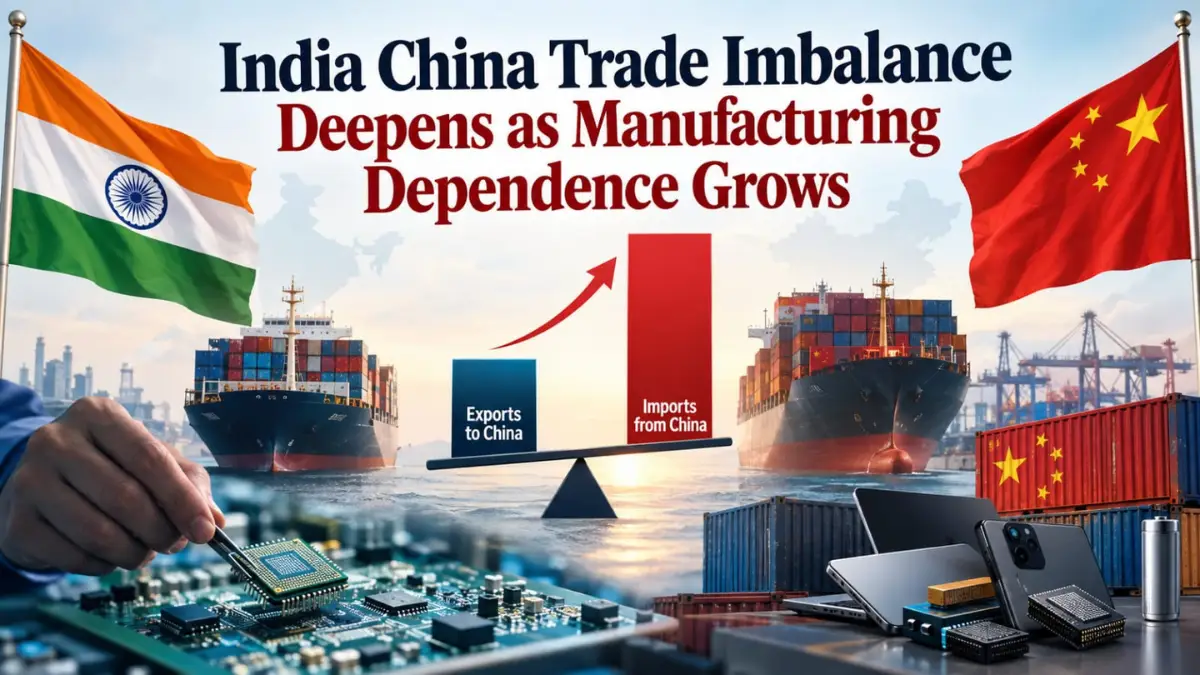
The efforts of India to strengthen the domestic manufacturing and to reduce its dependence on the foreign supply chains face a significant structural challenge, that is, its growing reliance on the China for the critical intermediate goods, the electronic components and the other manufacturing inputs. The issue has come into a sharper focus following the bilateral meeting between the Prime Minister Narendra Modi and the Chinese President Xi Jinping on the sidelines of the BRICS summit in Delhi on September 12. Among the concerns discussed in the meeting was the need to address what was described as the problem of “structural trade imbalances” and the issues related to the supply-chain process. The data presented in the accompanying analysis shows that the trade relationship between India and China has become increasingly asymmetric between the year 2021 and 2025. While India has been expanding its manufacturing and the export capabilities, the imports from China have grown much faster than the Indian exports to China.
Trade deficit widens sharply
The Indian exports to China have remained broadly stagnant during the five-year period as the exports stood at $23 billion in 2021, before declining to $15.1 billion in 2022 and then recovering gradually to $16.2 billion in 2023, $14.9 billion in 2024 and $18.1 billion in 2025. The imports, meanwhile, increased substantially. India has imported goods worth $87.5 billion from China in 2021, rising to $102.2 billion in 2022, $122 billion in 2023, $127 billion in 2024 and $149.5 billion in 2025.
As a result, the bilateral trade deficit between the two countries have expanded from $64.5 billion in 2021 to $131.4 billion in 2025.
The total bilateral trade have reached to approximately $167.6 billion in 2025, but the composition of this trade highlights the imbalance. The overwhelming increase in the trade deficit has come due to the imports made by India rather than a comparable expansion in the exports. The figures suggest that the challenge is not simply that the Indian consumers are purchasing the finished Chinese products. A substantial portion of the Indian imports from China consists of the goods used by the Indian manufacturers themselves.
Intermediate goods dominate imports
The composition of the imports provides an important insight into the nature of the dependence of India on the Chinese goods.
According to the data presented in the article, 69.7 per cent of the imports made by India from China in 2025 were the intermediate goods. The Capital goods accounted for the another 22 per cent, while the consumption goods represented 8.2 per cent and the other categories accounted for about 0.1 per cent.
This means that much of the import dependence is directly or indirectly connected with the Indian manufacturing ecosystem.
The intermediate goods include the components and the inputs that are incorporated into the other products. When the domestic manufacturers depend heavily on the imported components, the increase in the final assembly within India does not necessarily mean that the entire production chain has become domestically self-reliant.
This distinction is particularly important for the ambition of India to develop the stronger domestic manufacturing capabilities.
Electronics reveal the structural challenge
The products related to the electronics sector are at the centre of this dependence. It is important to know that the five largest import categories from China increased from a combined $19 billion in 2021 to $34.6 billion in 2025. Their share of the total imports made by India from the China has also remained substantial, accounting for roughly one-fifth to nearly one-quarter of the imports during the period.
The product groups included the items such as the laptops, the telecommunications components, the integrated circuits, the LED and the solar cells, the lithium-ion batteries and the mobile phones. By 2025, the telecom parts, the laptops, the integrated circuits, the mobile phones and the silver featured among the major import categories.
This concentration suggests that the Indian import basket has not become significantly diversified despite the initiatives designed to strengthen the domestic manufacturing. Instead, the dependence remains almost concentrated in the several technologically important sectors.
The assembly trap
India has emerged as an important destination for the assembling the mobile phones. However, the data raises some critical questions about how much of the underlying technological and the component ecosystem has actually shifted to India.
The share of the imported components used in mobile-phone manufacturing increased from 3.3 per cent of the import basket in 2022 to 10.1 per cent in 2025, according to the official data.
The figure stood at 4.7 per cent in 2021, fell to 3.3 per cent in 2022 and then increased to 7.8 per cent in 2023, 9.1 per cent in 2024 and 10.1 per cent in 2025. This creates what can be described as an assembly trap, as India has increased its role in assembling the finished products while it continues to import many of the sophisticated components that are required to make them.
However, it is important to know that such a model can generate the employment, the investment and the export opportunities, but it does not automatically establish the deep domestic capabilities in the semiconductor manufacturing, the precision components, the advanced materials and the other critical technologies, challenging the vision of India to become truly self- reliant.
Why the imports are not necessarily negative?
The imports of the sophisticated components and the capital goods can support the industrial development.
The access to the advanced machinery, the components and the technological inputs can help the Indian manufacturers improve their productivity, expand their production capabilities and participate in the global value chains.
The concern arises when such dependence becomes persistent and the domestic firms do not simultaneously develop the capability to produce these critical inputs themselves.
The analysis therefore distinguishes between the imports made as an early-stage manufacturing strategy and the permanent dependency on the external suppliers for making the finished products.
For India, the long-term challenge is to move beyond the final assembly towards the greater domestic value addition.
Make in India and the next phase of manufacturing
The initiatives launched by the government such as the Make in India and the Phased Manufacturing Programme have sought to encourage the domestic production and to strengthen the local manufacturing ecosystems.
The data suggests that these efforts need to be accompanied by a deeper development of the supplier networks.
The growth of factories that assemble the products is only one part of the manufacturing process. A comprehensive industrial ecosystem also requires the component manufacturers, the semiconductor capabilities, the specialised machinery, the research and development, the skilled workers, the logistics networks and the domestic suppliers capable of meeting the international quality standards. Without these layers, the expansion of the Indian manufacturing sector can remain dependent on the imported inputs.
Moving from assembly to technological capability
The central challenge is therefore not simply reducing the imports from China. A blanket reduction in the imports could also affect the Indian manufacturers beacuse they rely on the Chinese components, machinery or the intermediate goods. A more structural approach would involve the expansion of the domestic capabilities in the areas where the dependence creates the strategic vulnerabilities.
This could include strengthening the semiconductor and the precision component of the manufacturing process, developing the supplier networks, encouraging the technological innovation and supporting the domestic firms in moving higher in the value chain. The calibrated trade policies could also play an important role, as rather than relying solely on the broad restrictions, the policy measures can be designed around the specific manufacturing segments and their ability to develop the competitive domestic supply chains.
Looking beyond China
The data also highlights the importance of diversification. The objective of India should not be to completely eliminate the Chinese inputs. Instead, the development of the multiple sources of the critical components can reduce the risks associated with the excessive dependence on a single supply chain.
At the same time, the Indian companies need the greater access to the global value chains while developing the stronger domestic capabilities.
The ultimate test of the manufacturing strategy of India will therefore be whether the country can move from the assembly-led manufacturing to the technology-intensive production with the greater domestic value addition.
The India-China trade figures between 2021 and 2025 show why this transition remains important to understand. The manufacturing capacity of India is expanding, but the rapid rise in the imports of the intermediate and technology-related goods indicates that the foundations of that manufacturing ecosystem remain significantly connected to the Chinese supply chains.
For the long-term manufacturing ambitions of India, the next phase will have to focus not only on producing more in India, but also on building more of the critical technologies, the components and the supplier networks within India.