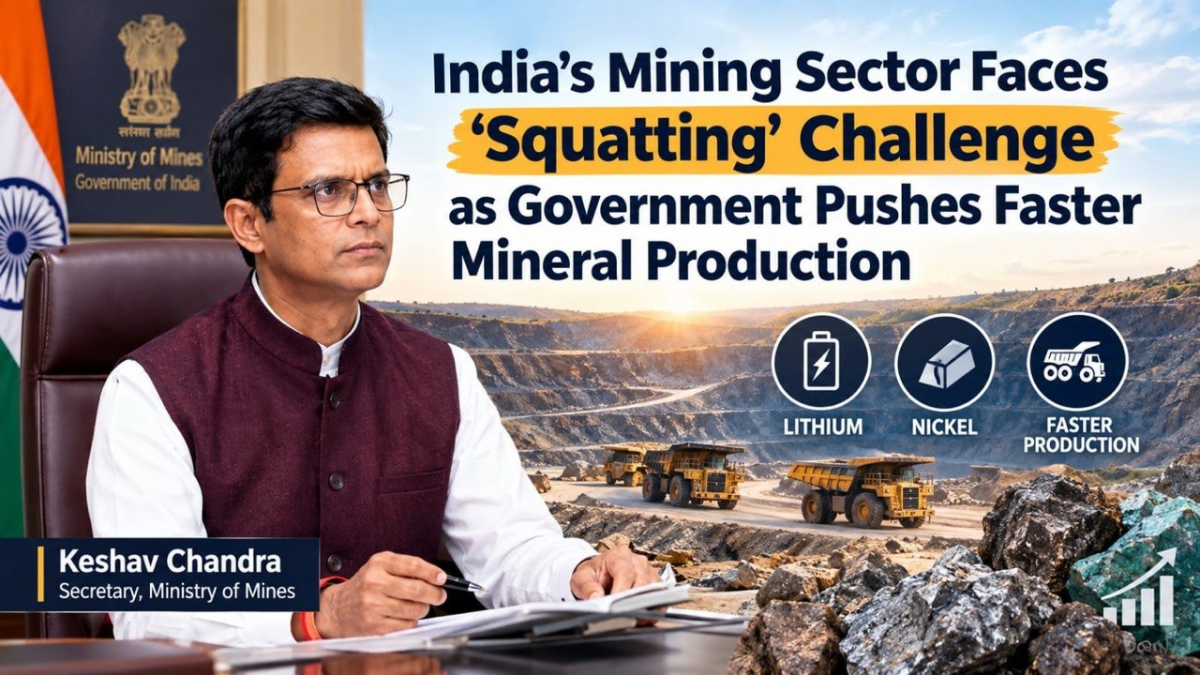
The mining sector of India needs to move faster from the mineral exploration and allocation to the actual production, Union Mines Secretary Keshav Chandra said while he addressed the 60th Annual General Meeting of the Federation of the Indian Mineral Industries (FIMI) in the New Delhi.
The Mines Secretary raised the concerns over what he described as “squatting” on the mining assets, a situation where the miners hold on to the allocated mineral blocks but do not begin the actual operations within the stipulated timeframe. According to him, such practices can delay the production and can encourage the speculative tendencies instead of supporting the country’s mineral requirements.
What is ‘squatting’ in mining?
The mining projects generally involve a lengthy process which includes various steps, for instance, obtaining the environmental and the forest clearances, securing the approvals and completing the other regulatory procedures. Once a mining lease is signed, the miner is expected to begin the operations within a specified or a “substantial” period.
However, Mr. Chandra pointed out that some mining companies continue to hold the mineral assets without commencing the required operations on time. He argued that this practice does not contribute to the development of the mining sector, rather it blocks or delays its operations.
“Squatting is not going to help anybody,” he said, stressing that holding the mineral blocks without operationalising them could be linked to the speculative activity.
The objective of the government, according to him, is to introduce the reforms that accelerate the mineral production and ensure that India makes progress in the mining sector. The faster operationalisation of mines would also help in reducing the delays between the allocation of the resources and their actual utilisation.
Need to accelerate mineral production
This issue becomes important because India requires a steady supply of the critical minerals for several emerging industries. The minerals such as the lithium and the nickel are increasingly important for the batteries, the electric vehicles, the renewable energy technologies and the other advanced manufacturing activities.
Mr. Chandra also acknowledged that the mining companies face many challenges before the beginning of the actual production. The approval process can be lengthy, particularly because the projects may require the forest and the environmental clearances.
Therefore, the government faces the challenge of balancing the faster mineral production with the regulatory and the environmental requirements. At the same time, the companies that have already secured the mining assets are expected to move towards the actual operations within the prescribed framework.
India keeps focus on lithium and nickel
The Mines Secretary also discussed the efforts being made by India to secure the critical mineral resources overseas.
Regarding a proposed lithium extraction project in Mali, he said India was keeping the possibility of cooperation open. India had earlier shown interest in a lithium project in the West African country, but the proposal was put on hold amid the political instability in Mali.
Mr. Chandra said India was looking at the possibilities “very openly” and was examining all the options that are available.
He also stated that, last year, the Russian State Atomic Energy Corporation had approached India regarding the possible cooperation for the lithium extraction in Mali.
Domestic processing of critical minerals
Another important area highlighted at the meeting was the domestic processing of the nickel and the lithium.
According to Mr. Chandra, a substantial government scheme for the domestic processing of these two minerals was under development. The proposed initiative is intended to support the creation of a domestic ecosystem around the critical minerals and the battery-related industries.
Very soon, the government is also expected to introduce a scheme by the Ministry of Mines for two minerals namely, the lithium and the nickel. Such measures could help India in strengthening its domestic capabilities in the processing of the critical minerals rather than remaining dependent on the imports of processed materials.
The larger picture
The concerns over the “squatting” reflect a broader challenge for India’s mining industry, that is, the mineral resources need to move from the allocation to the production process in an efficient way.
As the demand for the lithium, the nickel and the other critical minerals rises, India is seeking both the domestic and the international sources of supply. The faster operationalisation of the mines, the greater domestic processing and the overseas mineral partnerships could therefore become the important components of the Indian critical-mineral strategy.
At the same time, the government will need to ensure that the faster mining does not bypass the environmental and the regulatory safeguards required for the responsible development of the resources. The focus, therefore, is not simply on allocating the mineral assets but on ensuring that they are eventually developed and contribute to the industrial and economic requirements of India.
India’s Mining Sector Faces ‘Squatting’ Challenge as Government Pushes Faster Mineral Production11:11 PM

ByVarinder
Sep 23, 2026