
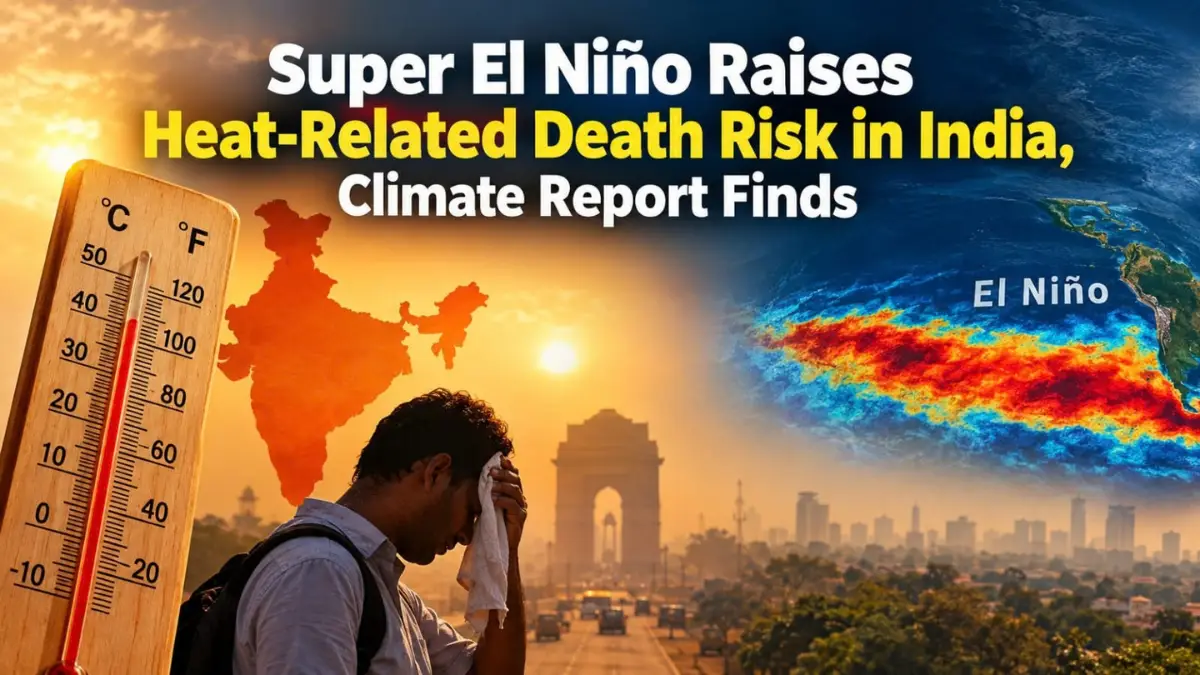
India could face a significant rise in the heat-related deaths during the coming months as a potentially strong El Niño event is about to develop, according to a recent report. This report given by the Climate Impact Lab, a research- based collaboration which involve the climate scientists and the economists, who estimates that India could experience around 15,800 additional heat-related deaths between the October 2026 and the February 2027 under the conditions associated with the development current El Niño conditions. The estimate highlights that how the climate variability and the rising temperatures can combine to create the serious risks for the public health.
What is El Niño?
El Niño is a periodic climate phenomenon that is associated with an unusually warm the surface temperatures of the sea in the central and the eastern tropical Pacific Ocean. This warming can alter the atmospheric circulation and influence the rainfall and the temperature patterns across the different parts of the world.
However, it is important to note that the El Niño does not affect every region in the same way. In the South Asia, it has historically been associated with the changes in the monsoon and periods of unusually high temperatures, although the exact effects vary from one event to another. The report describes the current event as exceptionally strong and warns that its effects could extend beyond the immediate weather conditions.
India faces increased heat risk
According to the report cited in the newspaper, the estimated 15,800 additional heat-related deaths in India are based on the historical relationships between the temperature and the mortality across the various regions.
The study reportedly uses the temperature-mortality relationships covering 24,378 regions to estimate how the changes in the temperature could affect the deaths. Importantly, this figure should be understood as a modelled estimate, rather than a prediction that exactly 15,800 people will die due to extreme heat.
The heat-related mortality is influenced by several factors, including the age, the existing health conditions, the access to healthcare, the housing conditions, the availability of cooling, the occupational exposure and the ability of the people to adapt to the extreme temperatures.
Global impact
The report also estimates the substantial global impact of the El Niño. It projects that approximately 451,000 additional heat-related deaths could take place at the global level during the first six months of the El Niño event.
The period between the September 2026 to February 2027 could account for a large share of these projected deaths. India is included among the countries that are identified as the particularly vulnerable to the effects of this event.
These estimates clearly demonstrate that why the heat is increasingly being treated as a major public-health issue rather than simply a weather-related inconvenience.
Rainfall deficit adds to India’s concerns
The heat threat comes alongside the concerns over the Indian rainfall.
According to the report, the national rainfall deficit of India stood at around 15% below the normal as of September 22, 2026, with some southern and the eastern parts of the country experiencing the larger shortfalls in the rainfall.
A rainfall deficit can have the severe consequences for the agriculture, the water availability and the rural livelihoods. However, the rainfall conditions can change considerably during the remaining part of the season, so a deficit at a particular point in time should not automatically be interpreted as the final seasonal outcome.
The combination of the deficient rainfall and the high temperatures can nevertheless increase the pressure on the water resources and the agricultural systems in the affected regions.
Pressure on electricity demand
The extreme heat also has an immediate effect on the electricity consumption.
As the temperatures rise, the households and the businesses increasingly become dependent on the air conditioners, the coolers and the other cooling equipment. This can lead to a substantial increase in the electricity demand.
The report notes that the Indian coal-fired power plants have been experiencing the pressure from the low fuel stocks, while the electricity demand has increased during the hotter-than-usual conditions.
This creates a potential challenge for the Indian power system, that is the higher temperatures can increase the need for the electricity at the precise time when the thermal power generation may face the fuel-supply constraints.
El Niño and climate change
One of the most important aspects of the report is its connection between the short-term climate variability and the long-term climate change.
The El Niño is a natural climate phenomenon, and individual El Niño events are not particularly caused by the climate change. However, the global warming has increased the baseline temperatures. As a result, an El Niño event occurring in the present-day warmer climate can produce the heat conditions that are more dangerous than the similar events in the past.
The Climate Impact Lab reportedly describes the current El Niño as a “postcard from our future”, suggesting that the temperatures associated with the event provide an indication of the type of conditions that could become more common as the planet warms further.
This distinction is important that the El Niño is a natural variation in the climate system, while the human-driven greenhouse-gas emissions are responsible for the long-term warming trend.
Why the death estimate matters?
The projected number of deaths illustrates the importance of the heat adaptation.
The measures such as the heat-action plans, the early-warning systems, the public cooling centres, the adequate drinking-water supplies, the changes in the outdoor working hours and the targeted protection for the elderly people and the other vulnerable groups can reduce the health impact of the extreme heat.
India has already developed the heat-action plans in several states and the cities. Their effectiveness, however, depends on the timely warnings, the coordination between the agencies and the ability of vulnerable communities to actually access the protective measures.
Conclusion
The projected 15,800 additional heat-related deaths in India should be viewed as a model-based estimate rather than a guaranteed outcome. Nevertheless, the report highlights a serious risk from the interaction of the El Niño, the rising background temperatures, the rainfall variability and the increasing heat exposure.
For India, the issue extends beyond the temperature records. The extreme heat can affect the public health, the agriculture, the water availability, the electricity demand and the economic productivity. To conclude, the strengthening of the heat preparedness and the climate adaptation therefore becomes the increasingly important tasks as the global temperature continue to rise.