
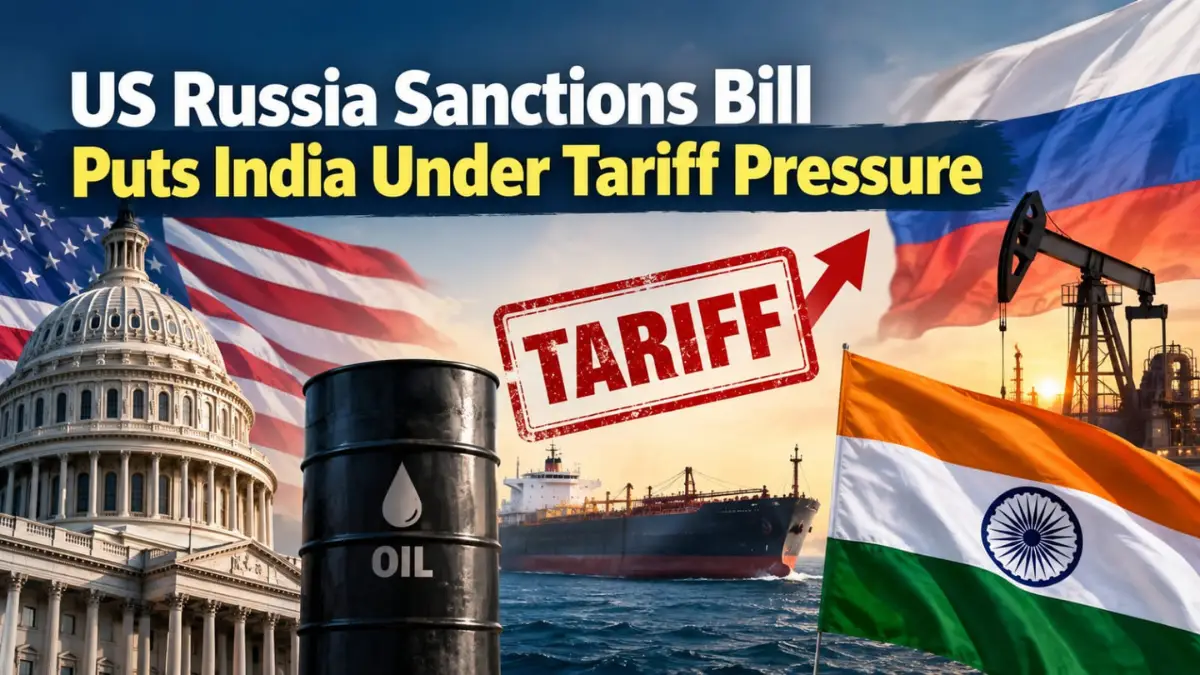
The United States has taken an another major step towards tightening the economic pressure on the Russia, as the U.S. House of Representatives has passed a legislation that could expose the countries buying the large quantities of Russian oil and the natural gas to up to 100% of the tariffs. India has emerged as an important country, which is in focus because it has imported more than half of its crude oil from Russia.
The Lindsey O. Graham Sanctioning Russia and Iran Act of 2026 was passed by the U.S. House on September 16 by 262 votes to 159. The legislation had already cleared the Senate and has now been sent to the President, Donald Trump, and it would certainly become a law if he would sign it.
Importantly, the legislation authorises the President to impose tariffs of up to 100%; however, it does not mean that a 100% tariff has already been imposed on India. The actual application of such tariffs would depend on whether the legislation would become the law and the subsequent action on it by the U.S. administration.
What the US bill targets?
The legislation is intended to increase the economic pressure on the Russia over its war in the Ukraine. Along with the Russian energy sector, it targets the individuals, the entities and the networks involved in the sanctions evasion and the so-called Russian shadow fleet of tankers that are used to transport oil.
A key provision concerns the countries purchasing the substantial quantities of the Russian energy. The bill provides for the tariffs of up to 100% on the countries identified among the largest purchasers of the Russian-origin crude oil or the natural gas. The relevant calculation is based on the import volumes during the 12 months preceding the enactment of this act.
The proposed measures also provide the scope for the sanctions to be waived in the circumstances involving the U.S. national interests. The legislation therefore gives the U.S. President the considerable discretion over how the sanctions and the tariff provisions are to be ultimately implemented.
The measure also contains the additional provisions concerning the Iran, extending the sanctions framework beyond Russia.
India becomes a major focus because of Russian oil imports
The proposed legislation comes at a very sensitive time for India because the Russian crude has become a particularly large component of the country’s oil supply. According to the data highlighted in the newspaper report, India imported 110.4 lakh tonnes of the Russian oil in July 2026. The Russian crude accounted for more than 51% of the total Indian oil imports.
This represented a sharp increase as the Russian oil imports by India in July were reported to be 26% higher than in June and nearly 55% higher than in July 2025. The increase in the imports, combined with the higher oil prices, also substantially increased the Indian spending on the Russian crude. The import bill for the Russian oil reached about $7.3 billion in July 2026, compared with approximately $3.6 billion in July 2025. These figures show why the energy relationship of India with Russia has become an important part of the debate surrounding the new U.S. legislation.
Russian crude remained slightly cheaper
Despite the increase in the overall import bill, the Russian crude continued to provide a modest price advantage. India paid an average of about $669 a tonne for its total oil imports in July 2026. The average price paid for the Russian oil was approximately $658.6 a tonne. This price difference is one part of the broader commercial calculation made by the Indian refiners when sourcing the crude from Russia. The Indian oil purchases are also influenced by the availability, the refinery requirements, the international prices and the need to maintain the reliable energy supplies.
India’s energy security position
India has responded by emphasising that its priority is to maintain the energy security while it continues to diversify its sources.
The Ministry of External Affairs said that India remains firmly committed to ensuring the energy security for its 1.4 billion people through diversified sourcing and decisions based on evolving market dynamics. The New Delhi has also said that it will take the necessary measures to protect its trade and the economic interests.
The Indian government said the issue had been discussed at the high levels with the U.S. interlocutors in the recent months and that the potential implications had been clearly communicated to the American side. It also said India would work with the Indian trade and the industry bodies to address the consequences of the developments related to the legislation.
India has maintained that its energy procurement decisions are closely linked to the national energy requirements and the market conditions. The government is therefore facing the challenge of balancing the continued access to the energy supplies with the possible consequences of the measures, like the trade and the sanctions that can be imposed by the US.
Why the issue matters beyond oil
The proposed tariffs could have implications beyond the purchase of Russian crude by India because the United States is an important market for the Indian exports.
If the new tariff authority is actually used against the Indian interests, the consequences would depend on the rate that would be ultimately imposed, the products covered and the manner in which the U.S. administration implements the legislation. The Indian exporters are therefore monitoring the situation very closely, but the precise economic impact cannot be established yet.
The issue also comes as the India and the United States continue the discussions on a bilateral trade agreement, adding another dimension to the situation.
A broader pressure campaign against Russia
The U.S. legislation forms part of the wider effort to reduce the ability of the US to generate revenue from the energy exports. By targeting the countries that continue to purchase the Russian oil and the gas, the measure seeks to create an economic incentive for the major buyers to reduce their dependence on the Russian supplies.
For India, however, the issue involves a much broader calculation as the Russian crude has become a significant component of the India oil imports, while the affordable and the reliable energy supplies remain important for a large and a growing economy.
The legislation therefore places the energy security, the international trade and the India-U.S. relations at the centre of an increasingly complicated economic equation.
For now, the most important distinction is that the House has passed the legislation authorising tariffs of up to 100%, but India has not automatically become subject to a 100% tariff. The next stage depends on the presidential action and the subsequent implementation of the law.
As a consequence, these developments will be closely watched by the Indian refiners, the exporters, the policymakers and the businesses as the New Delhi assesses how to maintain the energy security while protecting its wider economic and the trade interests.