
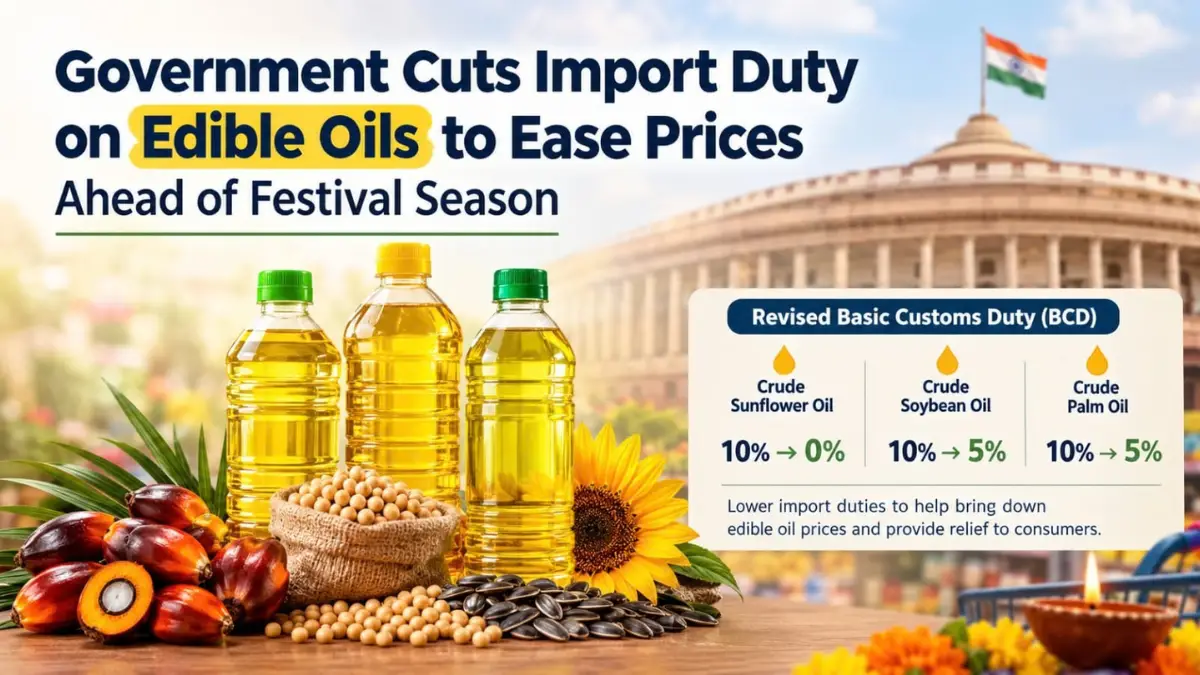
Ahead of the beginning of the festive season, the Union government has reduced the Basic Customs Duty (BCD) on the major imported crude edible oils, including the crude palm oil, the crude soybean oil and the crude sunflower oil. The move is aimed at moderating the domestic edible oil prices, providing relief to the consumers and easing the inflationary pressures at a time when the demand for the cooking oils traditionally rises.
The government announced the reduction in the duty on Thursday through the Union Ministry of Food and Consumer Affairs. The decision comes against the backdrop of the higher international edible oil prices and their impact on the domestic landed and the retail prices.
Duty reduced on major crude edible oils
Under the revised structure, the BCD on the crude sunflower oil has been reduced from 10% to nil. At the same time, the duty on the crude soybean oil and the crude palm oil has been reduced from 10% to 5%. The government has also reduced the applicable duty on the corresponding refined edible oils. However, it has retained a 19.25% duty differential between the crude and the refined edible oils.
A duty differential refers to the difference in the import taxation between a raw or a relatively less-processed product and its processed counterpart. The maintainance of such a differential can influence the economics of the domestic refining by making the import of the crude oil relatively more attractive than the importing refined oil.
Why has the government reduced the duty?
The edible oils are an important component of the Indian household consumption. India also relies significantly on the imports to meet its edible oil requirements. Therefore, the changes in the international prices and the import duties can have a direct bearing on the domestic market. The government said the rationalisation of the duty takes into account the increase in the international edible oil prices and the consequent rise in the domestic landed costs and the retail prices.
Import duties form a part of the landed cost of imported edible oils. When such duties are reduced, the cost of importing the commodity can fall, provided the other market conditions remain unchanged. The government expects this reduction to lower the landed cost of the crude edible oils and to facilitate the transmission of the benefit through the domestic supply chain.
This is particularly relevant before the festival season, when the demand for the edible oils can increase because of the higher household consumption and the greater demand from the food-related businesses.
Focus on consumers and domestic refining
The government has said that the measure is intended to provide the much needed relief to the consumers. The lower import costs can potentially ease the pressure on the retail prices, although the final impact will also depend on the international prices, the exchange rates, the transportation costs, the domestic refining expenses and the market conditions.
At the same time, the maintenance of the duty differential between the crude and the refined edible oils is significant for the growth of the domestic refining industry. A larger relative duty burden on the refined imports can provide an incentive for the domestic processors to import the crude oil and undertake the refining within India.
This can support the domestic refining capacity and the associated activities while allowing the government to address the consumer price concerns.
Festival-season significance
The timing of the decision is important because the upcoming festival months are generally associated with the increased consumption of the food products, including the sweets, the snacks and the fried foods. The government is expecting that the lower import duties will help in ensuring the adequate availability of the edible oils during this period.
The Indian Vegetable Oil Producers’ Association (IVPA) has also highlighted the importance of ensuring the sufficient availability of oil during the upcoming festive season. According to the report, the association said the edible-oil sector should receive the immediate attention of the government because the demand from the households as well as the sweets, the snacks, the food-service and the hotel or the catering businesses is expected to rise.
The government has also issued an advisory to the industry stakeholders, asking them to ensure that the benefit arising from the reduction in import duty is passed on to the consumers.
What does the move mean?
The reduction in import duty represents an attempt to balance the consumer price relief, the edible oil availability and the interests of the domestic refining sector. Its effectiveness will ultimately depend upon how the global edible oil prices and the domestic market conditions will evolve.
For the consumers, the key issue will be whether the reduction in import costs translates into the lower or the more stable retail prices during the festival season. For the domestic industry, the maintainance of the differential between the crude and the refined oils could continue to encourage the domestic refining and the processing.
Overall, the decision of the government is focused on managing the edible oil prices and the availability at a time when the seasonal demand is expected to increase, while retaining a tariff structure that differentiates between the crude and the refined edible oils.