
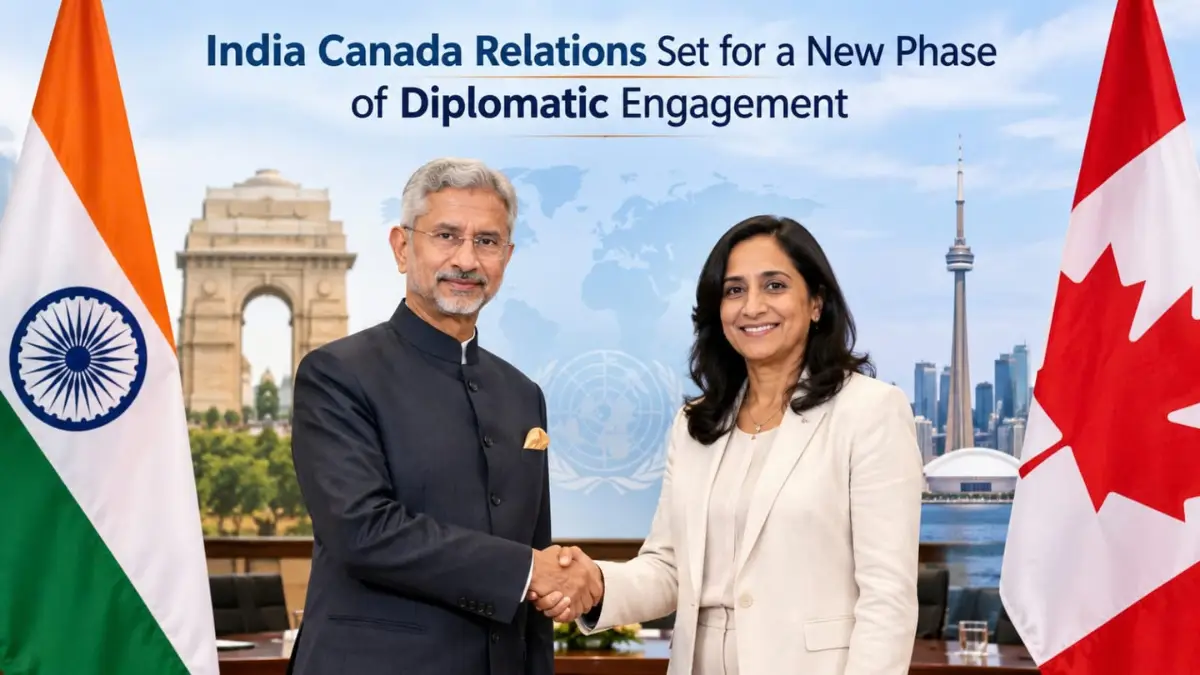
India and Canada are preparing to take their bilateral relationship to a higher level, the External Affairs Minister Mr. S. Jaishankar said after holding a “productive discussion” with his Canadian counterpart Ms. Anita Anand on the sidelines of the United Nations General Assembly (UNGA) in New York. The meeting signals the continued efforts by both the countries to restore the stability and expand the cooperation after a period of serious diplomatic tensions.
Mr. Jaishankar said on the social media that he was pleased to meet Anita Anand and described their discussion as productive. The meeting is significant because the India-Canada relations had deteriorated considerably in the recent years, affecting the diplomatic ties, the political engagement and the people-to-people relations.
Efforts to normalise India Canada ties
The relations between the New Delhi and the Ottawa came under the severe strain during the tenure of the former Canadian Prime Minister Mr. Justin Trudeau. The dispute had been intensified in 2023 after the Canada raised the allegations concerning the killing of the Canadian citizen Mr. Hardeep Singh Nijjar in British Columbia and suggested a possible link to the Indian agents.
India rejected the allegations and strongly objected to way of handling of the issue by the Canadian government. The diplomatic dispute subsequently resulted in the reciprocal expulsions of the diplomats and a reduction in the diplomatic personnel between the two countries.
The situation began showing the signs of improvement after Mr. Mark Carney became the Canadian Prime Minister in the March 2025. According to the report, both the Prime Minister Mr. Narendra Modi and Mr. Carney had agreed in June 2025 to take the calibrated steps to restore the stability in the bilateral relations. These measures were followed by the return of high commissioners and the resumption of the high-level diplomatic engagement.
The renewed engagement does not mean that all the differences between the two countries have disappeared. However, the regular diplomatic contacts provide an opportunity for both the sides to address the outstanding issues through dialogue.
Trade remains an important area
The economic relations are one of the major areas where the India and the Canada are seeking a greater engagement. The two countries have committed to conclude the negotiations for a free trade agreement by the end of 2026.
The Canadian Prime Minister Mr. Mark Carney has said that the negotiations are making good progress. A trade agreement could provide a framework for expanding the bilateral commerce and for creating greater opportunities for the businesses in the both countries.
The two sides have also discussed the objective of increasing the bilateral trade substantially. The report notes that the Canadian ambition is to double the bilateral trade to around $70 billion annually by 2030.
For India, the stronger economic engagement with Canada can have the implications for the sectors such as the energy, education, technology, agriculture and the investment. The Canada, meanwhile, has a significant Indian-origin population and maintains the longstanding educational and the economic links with India.
Possible visit by Prime Minister Modi
Another important development is the expected visit of Prime Minister Mr. Narendra Modi to Canada around December 2026. Mr. Carney has indicated that he expects Mr. Modi to pay a visit to the Canada later this year.
A visit at the leadership level could provide an opportunity to discuss the trade, investment, energy cooperation, technology, security and the people-to-people relations. It could also help in consolidating the diplomatic normalisation that has taken place since 2025.
Wider areas of cooperation
During his engagements on the sidelines of the UNGA, Mr. Jaishankar also met the foreign ministers from several other countries, including the Venezuela, Belarus and the Mexico. The discussions with Canada included the bilateral cooperation as well as the broader international and the regional issues.
India and Canada have important links through their large people-to-people connections. The students, the professionals, the businesses and the families have contributed significantly to the relationship over the years.
The latest Jaishankar-Anand meeting therefore represents an another step in the ongoing diplomatic engagement between the New Delhi and the Ottawa. While differences remain, both the governments appear to be focusing on the restoration of the institutional communication and expanding the cooperation, particularly in the trade and the economic relations.
The coming months will be important for determining how far this diplomatic normalisation will progress, especially as both the countries work towards their proposed trade agreement and prepare for the possible high-level political engagement later in 2026.