
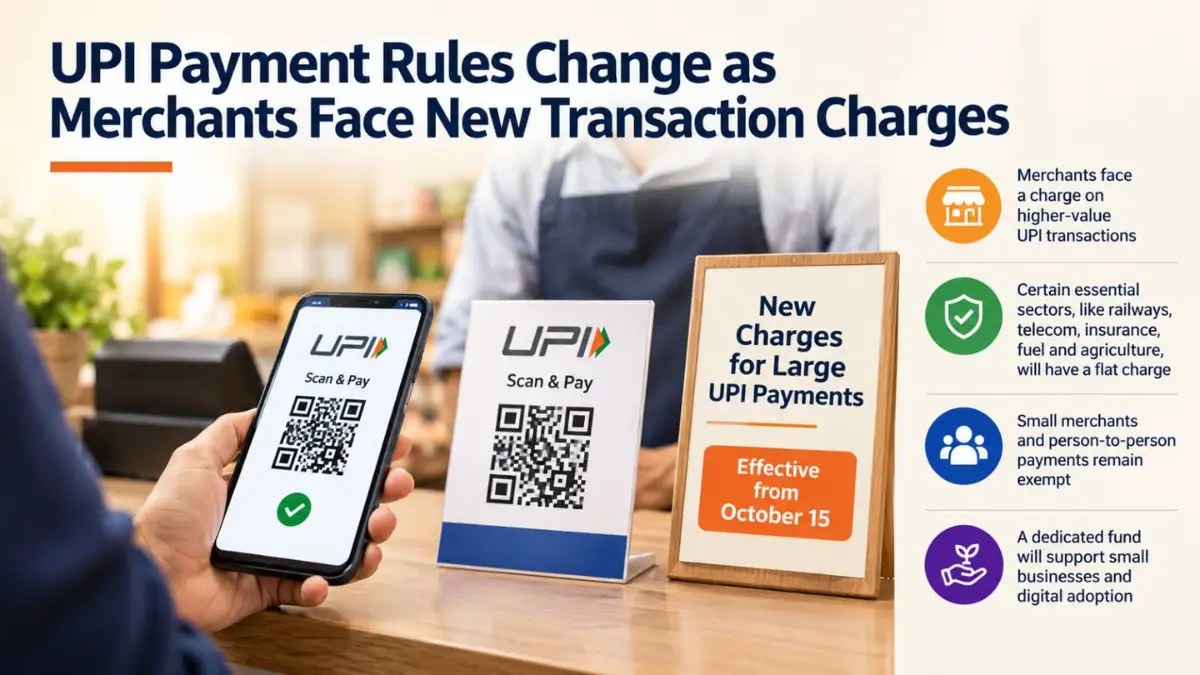
The Indian Unified Payments Interface (UPI) ecosystem is set to undergo a significant change with the introduction of a Merchant Discount Rate (MDR) on certain large-value merchant transactions. The merchants receiving the UPI payments above ₹2,000 will face an MDR of 0.4% from October 15, while several categories of the transactions will continue to remain exempt. The move has brought a renewed attention to the question of how India can maintain the rapid expansion of the digital payments while ensuring that the UPI ecosystem remains financially sustainable for the banks, the payment service providers and the other participants.
What Is Changing for the UPI Payments?
Under the new framework, the person-to-merchant (P2M) UPI transactions exceeding the ₹2,000 will attract an MDR of 0.4%. This charge is to be paid by the merchants through the payment processors and is not intended to be directly passed on to the customers. The government has advised the banks to ensure that the merchants do not transfer the MDR cost to the customers. This is very important because one of the major advantages of the UPI payment system has been its convenience and the general charge-free experience for the consumers. For certain essential sectors, however, the percentage-based MDR will be replaced with a flat charge. Transactions involving the sectors such as the railways, the telecom, the insurance, the fuel and the agricultural inputs will attract a flat MDR of ₹5 for the transactions exceeding the amount of ₹2,000. Another category receiving a differential rate includes the payments to the mutual funds, the securities, the stockbrokers and the dealers. These transactions will attract an MDR of 0.02%, subject to a maximum cap of ₹300.
Transactions That Will Remain Exempt
The new system does not mean that every UPI transaction will become chargeable. The person-to-person (P2P) transactions will remain free regardless of the value of the transaction. The UPI transactions involving the small vendors and the person-to-merchant transactions of up to ₹2,000 will also remain exempt.The small merchants receiving up to ₹1 lakh per month through the UPI QR codes under the Person-to-Person Merchant (P2PM) classification will also not have to pay the MDR on the UPI payments they receive. This structure is intended to protect the small businesses and the vendors that depend heavily on the low-value digital payments.
Why the Government Is Introducing MDR?
The Finance Ministry has described the new MDR framework as a step towards making the the UPI ecosystem more financially sustainable. The UPI has expanded rapidly across India, but maintaining the infrastructure requires the participation and the investment from the banks, the payment service providers and the other ecosystem partners. The government estimates that only around 4% of the merchant transactions will actually be affected by the new MDR framework. Most transactions will either fall below the ₹2,000 threshold or will qualify under the zero-MDR person-to-person( P2P) framework. The government also stated that the P2P transactions account for around 70% of the UPI transaction value, while the P2P transactions constitute about 37% of the total UPI transaction volume.
A Fund for Small Merchants
Another significant feature of the framework is the creation of a dedicated fund to support the use of UPI among the small merchants. The fund will receive 5% of the total MDR collections. The government says that this mechanism is intended to help in bridging the gap between the informal and the formal economy. As, by supporting the small merchants in acquiring the formal merchant accounts, the initiative could encourage the greater digital adoption among the businesses that have traditionally operated outside the formal financial systems.
What It Means for Customers?
For the ordinary UPI users, the immediate impact is expected to be limited because the person-to-person payments and the merchant transactions up to ₹2,000 will remain exempt from the Merchant Discount Rate. The government has also specifically directed the banks to ensure that the merchants do not pass the MDR directly to the customers.
The new framework therefore focuses primarily on the selected higher-value merchant transactions rather than imposing a universal charge on the UPI users. Overall, the revised MDR structure represents an attempt by the government to balance the twin objectives, that are keeping the majority of the UPI payments free while creating a revenue mechanism for sustaining the wider digital-payment ecosystem. Its implementation from the October 15 will determine how the merchants, the banks and the payment providers adapt to the new framework.