
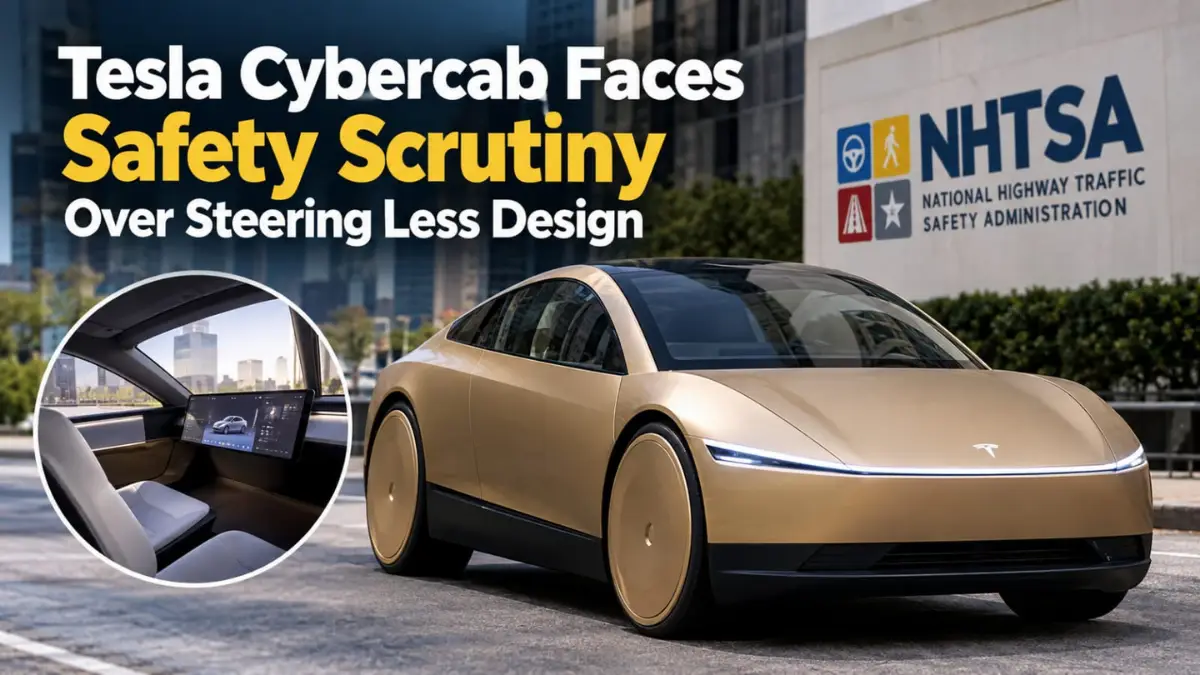
The Tesla is in news for its innovation, Cybercab, which is designed to represent a new era of transportation, the one in which the passengers can travel without a steering wheel, an accelerator or a brake pedal. But as the futuristic robotaxi begins its limited operations in Austin, Texas, its unconventional design has attracted the regulatory scrutiny in the United States.
The US National Highway Traffic Safety Administration (NHTSA) has opened an investigation into the self-certification made by the Tesla of its newly launched Cybercab. The agency is examining whether the Tesla has properly determined that the vehicle complies with the applicable Federal Motor Vehicle Safety Standards (FMVSS). The investigation does not mean that the regulators have come to a conclusion that the Cybercab is unsafe for use; rather, they are reviewing the certification made by the Tesla and the compliance of this vehicle with the federal requirements.
A Car Without Traditional Driving Controls
The Cybercab is a two-seater, autonomous vehicle that is developed specifically for the robotaxi operations. Unlike the conventional cars, it does not have a steering wheel, an accelerator pedal, the brake pedal or the conventional exterior mirrors. These features are particularly significant because the federal vehicle-safety standards were largely developed around the vehicles in which a human driver is able to control the car.
The Tesla has taken the position that the Cybercab meets the relevant requirements through its self-certification process. However, the NHTSA is examining whether that interpretation is justified, particularly given the unusual design of the Cybercab.
The regulatory question is important because the United States generally relies on the manufacturers to certify that their vehicles comply with the federal safety standards. The NHTSA can subsequently examine those certifications and then investigate whether the claims and the conclusions made by the manufacturers were correct or not.
Why the Lack of a Steering Wheel Matters
In a conventional vehicle, a driver can react immediately, incase something unexpected happens. If an obstacle suddenly appears, an emergency vehicle approaches or the traffic conditions change, the driver can steer, brake or accelerate, whereas a fully autonomous vehicle has to make those decisions through its automated driving system.
That makes the Cybercab fundamentally different. The passengers cannot simply reach for a steering wheel or the brake pedal if they believe something is going wrong. Instead, the vehicle must correctly identify the hazards and then respond to them on its own.
The issue becomes even more complicated during the unusual situations. The autonomous vehicles must be capable of dealing with the road construction, the blocked lanes, the pedestrians, the cyclists, the emergency vehicles and the other unpredictable circumstances. Recently, some reports have also revealed a hidden virtual joystick interface in some of the Cybercabs. The interface reportedly perform the functions such as moving the vehicle, stopping it and sounding the horn, although it does not function as a conventional passenger driving system and appears to be intended primarily for the operational purposes.
The Promise of Autonomous Transportation
The Tesla believes the the autonomous vehicles could eventually transform the urban transportation. The company’s robotaxi programme is based on the idea that the people should be able to request a vehicle through an app and travel without the need to drive the vehicle on their own.
The innovative idea of the Tesla to launch the Robotaxi service describes an autonomous transportation as a way to make the travel more efficient, affordable and accessible.
The supporters of the autonomous driving also argue that removing the human driving errors could potentially reduce the accidents associated with the distraction, fatigue or the impaired driving. However, these remain potential benefits rather than the proof that the Cybercab itself will be safer than the conventional vehicles.
The Cybercab could also provide the greater mobility for the people who cannot drive. But accessibility will depend on how the vehicle accommodates the passengers with the different physical and medical needs and how it handles the emergencies involving the different passengers.
A Test for Tesla and Regulators
The Tesla has begun to offer the Cybercab rides in the limited areas of Austin, making the regulatory scrutiny particularly significant. The NHTSA’s investigation involves as many as about 1,000 Cybercabs that the Tesla has self-certified, according to the Reuters. The investigation therefore extends beyond the one new Tesla model. It raises a broader question about whether the existing vehicle-safety rules are adequately prepared for a future in which the cars may be designed to function automatically, without any human driving controls.
The NHTSA has been considering the changes to the regulations to accommodate the automated vehicles, but the existing federal safety requirements still matter. The Cybercab is consequently more than a technological experiment. It is also a regulatory test. The Tesla is attempting to demonstrate that a vehicle designed entirely around the autonomous driving can operate within the existing safety framework.
Whether it succeeds will depend not only on the performance of its artificial intelligence but also on its ability to satisfy the regulators that the passengers and the other road users can be protected when something unexpected happens.
The Cybercab may offer a glimpse of the future of the transportation, but the NHTSA investigation shows that the road to that future still has the important safety and the regulatory questions to answer.