
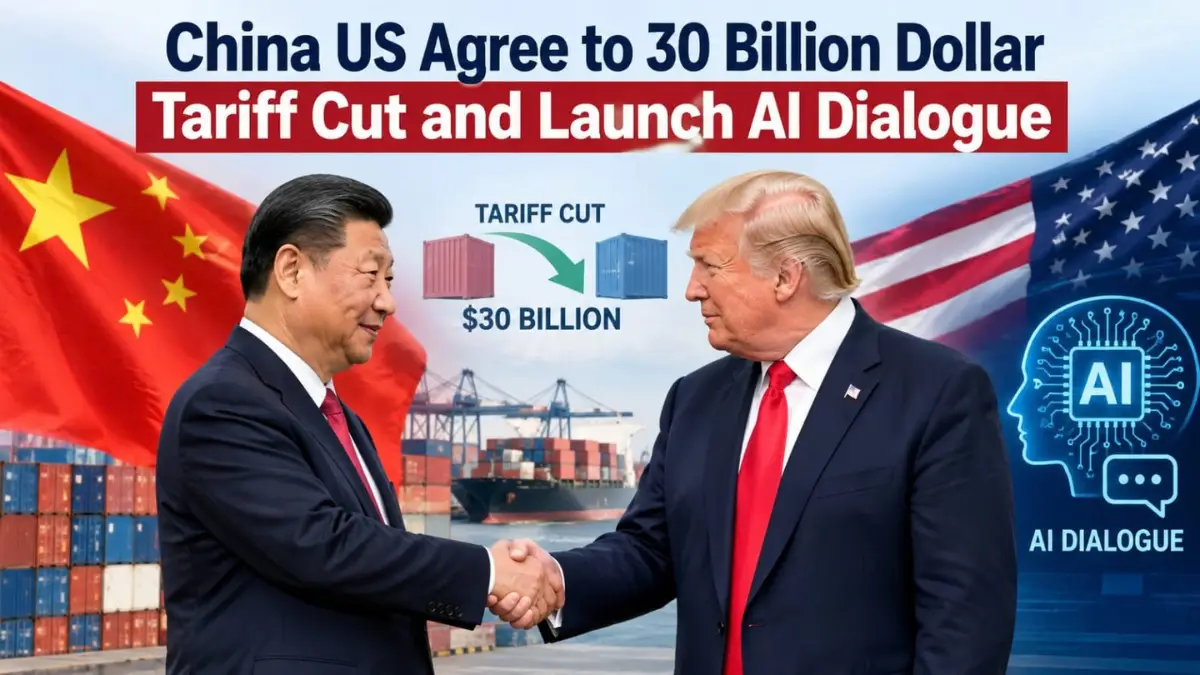
The China and the United States have agreed on a significant reduction in tariffs and decided to establish a new dialogue on the artificial intelligence (AI), according to a report by the Reuters. The understanding follows the high-level discussions between the Chinese President Mr. Xi Jinping and the U.S. President Mr. Donald Trump and is being presented as an effort to stabilise the relations between the two largest economies of the world.
According to the Chinese Foreign Ministry, the Beijing has agreed to a $30-billion reciprocal tariff-reduction arrangement with the Washington. The agreement is linked to an eight-point consensus that has been reached during the President Xi Jinping’s visit to the United States. The two countries have also agreed to establish a trade council and extend the outcomes of the earlier negotiations held in the Kuala Lumpur.
A move to ease trade tensions
The trade relations between the China and the U.S. have been marked by the tariffs, the restrictions and the disagreements over the market access, the technology and the supply chains. The tariffs imposed by both the countries have increased the costs for the businesses and created an uncertainty for the global trade.
The latest agreement is therefore significant because it indicates an attempt by both the sides to reduce some of the pressure created by their trade dispute. The reported $30-billion tariff reduction could provide the greater predictability for the exporters and the importers in both the economies.
The agreement also extends an earlier tariff on truce that was due to expire. According to the report, the extension gives the two sides an additional time to work towards a potentially long-term trade arrangement.
However, the agreement does not mean that all the economic disagreements between the Washington and the Beijing have been resolved. The issues involving the technology, the industrial policy, the market access and the trade imbalances remain important parts of the broader U.S.-China relationship.
New focus on artificial intelligence
Another important element of the agreement is the decision to launch a dialogue on the artificial intelligence.
The two countries agreed to establish a communication channel to discuss the issues related to the AI. The Chinese state news agency Xinhua reported that the Beijing valued the use of the term “super intelligence” by the Washington rather than simply the “artificial intelligence”.
The AI has become an increasingly important area of competition as well as cooperation between the two countries. The advancements in the advanced computing, the semiconductors, the large language models and the other AI technologies have also become closely connected with the economic and the national-security concerns.
According to the report, both sides said that the AI technology should be developed in a way that supports the human development and that they would work towards the consensus in alignment with their respective domestic laws and the regulations.
The proposed dialogue could provide a forum for the two governments to discuss the opportunities and the risks associated with the rapidly developing AI technologies. These could include the issues such as the responsible AI development, the technological standards, the data, safety and the international governance of the emerging technologies.
Trade council and wider diplomatic engagement
The China and the U.S. also agreed to establish a trade council, which could provide a regular channel for addressing the economic disputes and implementing the understandings that have been reached by the two governments.
The two sides further agreed to support each other in hosting the major international gatherings, including the Asia-Pacific Economic Cooperation (APEC) leaders’ summit and the G20 summit. According to the report, both the countries have expressed an intention to attend the important international meetings hosted by the other.
The developments come amid the efforts to prevent the disagreements between the Washington and the Beijing from escalating into a broader confrontation.
For the global economy, the relationship between the China and the U.S. has the consequences that would have an impact far beyond the two countries. Their trade policies influence the international supply chains, the manufacturing, the investment and the commodity markets. A reduction in the tariff tensions could therefore affect the businesses and the economies worldwide.
At the same time, the reported agreement should be viewed as part of an ongoing process rather than as a complete settlement of the U.S.-China economic and the technological differences. The implementation of the tariff arrangements, the functioning of the proposed trade council and the new AI dialogue will determine how far the latest understanding translates into the long-term stability between the two countries.