
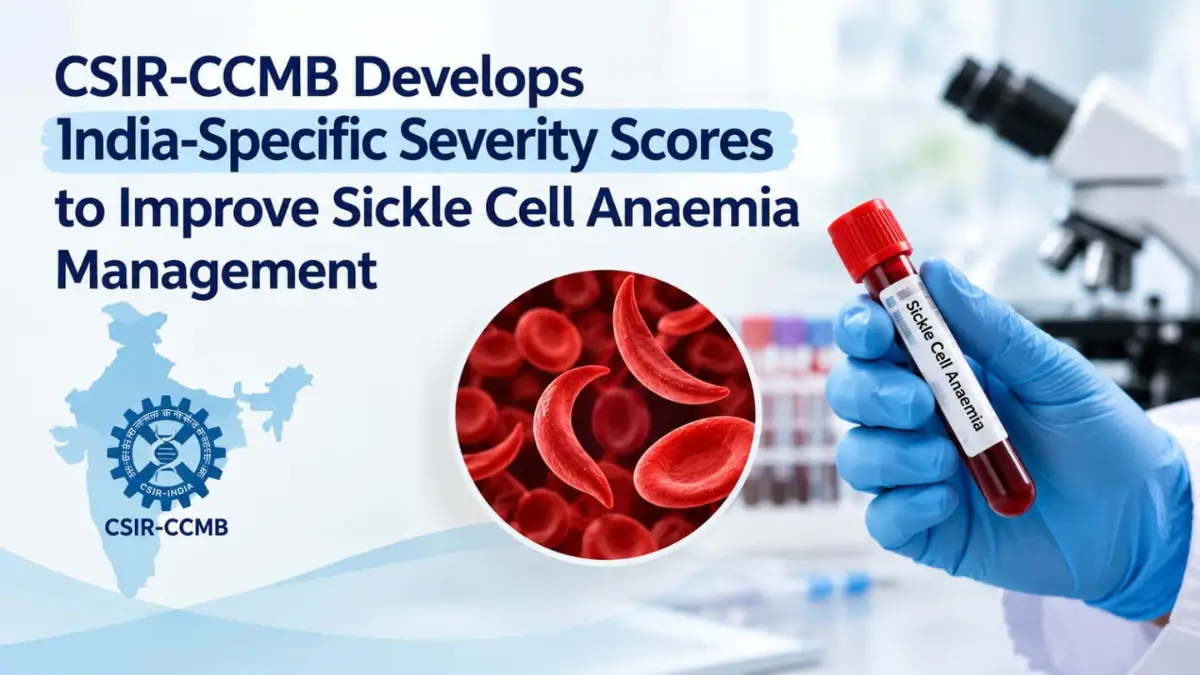
An India-specific scoring system, developed by the scientists at the Council of Scientific and Industrial Research–Centre for Cellular and Molecular Biology (CSIR-CCMB), Hyderabad, aims to improve the diagnosis, the treatment decisions and the management of the inherited blood disorder The scientists at the Council of Scientific and Industrial Research–Centre for Cellular and Molecular Biology (CSIR-CCMB), Hyderabad, have developed an India-specific severity scoring system for the sickle cell anaemia (SCA). This new tool is expected to help the doctors in assessing the severity of the disease more accurately and make the well-informed decisions regarding the treatment and the long-term patient care.
The development is significant for India, which carries a substantial burden of the sickle cell disease, as the existing international scoring systems may not accurately reflect the clinical characteristics of Indian patients. The new model, developed using the clinical data from the Indian children, seeks to address this limitation by offering a more locally relevant approach to evaluating the disease.
Understanding sickle cell anaemia
The sickle cell anaemia is an inherited blood disorder caused by a mutation in the beta-globin gene, which affects the production of haemoglobin. The haemoglobin is the protein in the red blood cells, which is responsible for carrying the oxygen throughout the body. In the people suffering from the sickle cell anaemia, the abnormal haemoglobin causes the red blood cells to become rigid and assume a crescent or a sickle shape. Unlike the normal red blood cells, which are flexible and move easily through the blood vessels, the sickle-shaped cells can obstruct the blood flow and restrict the supply of oxygen to the different parts of the body.
This can lead to the anaemia, the severe and recurring episodes of pain, the organ damage and several other complications. The severity of the condition varies from one patient to the another. While some individuals experience relatively milder symptoms, the others may suffer from frequent health crises requiring the hospitalisation and the continuous medical attention.
The assessment of the likely severity of the stage of the disease is therefore essential for determining the level of care a patient needs and also for identifying those who may require the closer monitoring and the more intensive treatment.
Why an India-specific scoring system matters?
The clinical presentation of the sickle cell anaemia differs among populations. The article reports that the Indian patients tend to have a milder disease profile than many African populations. This variation highlights the limitations of applying the same assessment model to every patient, regardless of their population or the clinical characteristics.
The international scoring systems may not adequately capture the specific patterns that are observed among the Indian patients. As a result, the doctors could face several difficulties in the accurate classification of the severity of the disease and in the selection of the appropriate management strategies.
To address this concern, the researchers at the CSIR-CCMB have developed a revised model called the India-specific Severity Score (ISS1). The tool uses the clinical information to provide a more appropriate assessment of the disease severity in the Indian patients.
According to the report, the ISS1 improved the accuracy of the clinical assessments to nearly 83 per cent. This suggests that a scoring system that has been developed using the locally relevant patient data could help the doctors in the better understanding of the likely course of the disease and can plan the treatment accordingly.
A second model simplifies clinical assessment
The researchers have also developed a second version, which is called the ISS2, and which aims to make the disease assessment more practical in the clinical settings. Unlike the approaches that depend heavily upon the laboratory measurements, the ISS2 replaces these measurements with the observable clinical indicators.
The report states that this version has achieved an overall concordance of approximately 85 per cent. The concordance refers to the degree of the agreement between the assessment made using the model and the relevant clinical classification or the evaluation.
By relying on the indicators that can be observed during the routine clinical assessment, the ISS2 could reduce the need for the multiple laboratory investigations when evaluating the severity of the disease. This may be particularly useful in the healthcare facilities where the access to the advanced diagnostic facilities is limited or where the patients face the difficulties in obtaining the repeated laboratory tests.
However, the performance of the model does not mean that the laboratory investigations can be eliminated in every case. The doctors would still need to use the clinical judgement and order the appropriate tests according to an the symptoms and medical condition of an individual.
The Research and its potential impact
The study was conducted by Giriraj R. Chandak, a physician-scientist and Sir J. C. Bose Fellow at CSIR-CCMB, along with fellow researchers Suraj S. Nongmaithem, Amitabh Biswas, Swaroop Iyer, Jandhayala Vyshnavi, Archana Wath and Dipty Jain.
The development of these scoring systems represents an effort to make the disease assessment more relevant to the Indian patients. A reliable severity score can help the healthcare professionals in identifying the differences in the disease presentation, organising the follow-up care and making the more informed treatment decisions.
The potential benefits could be particularly important for the communities with a high burden of the sickle cell disease, including the populations that face the geographical and the economic barriers to a specialised healthcare system. A clinically practical assessment tool could support the doctors in the primary and the secondary healthcare facilities, provided that it is appropriately validated and incorporated into the clinical practice.
Nevertheless, the further evaluation across the diverse Indian populations and the healthcare settings would be important to establish how consistently the scores would perform in the different age groups and the varied regions.
Conclusion
The initiative by the CSIR-CCMB, highlights the importance of developing the healthcare tools suited to the specific and peculiar medical needs of the Indian patients. By using the Indian patient data and by emphasising the clinically observable indicators, the ISS1 and the ISS2 seek to improve the assessment of the severity of the sickle cell anaemia.
If the further validation supports the effectiveness of these models, they could help the doctors to make the more informed decisions, to improve the patient monitoring and to reduce the unnecessary investigations in the appropriate cases. The broader significance of this innovation lies in adapting the medical research to the local disease patterns, making the healthcare assessment more accessible and supporting the better management of a condition that continues to affect many families across India.