
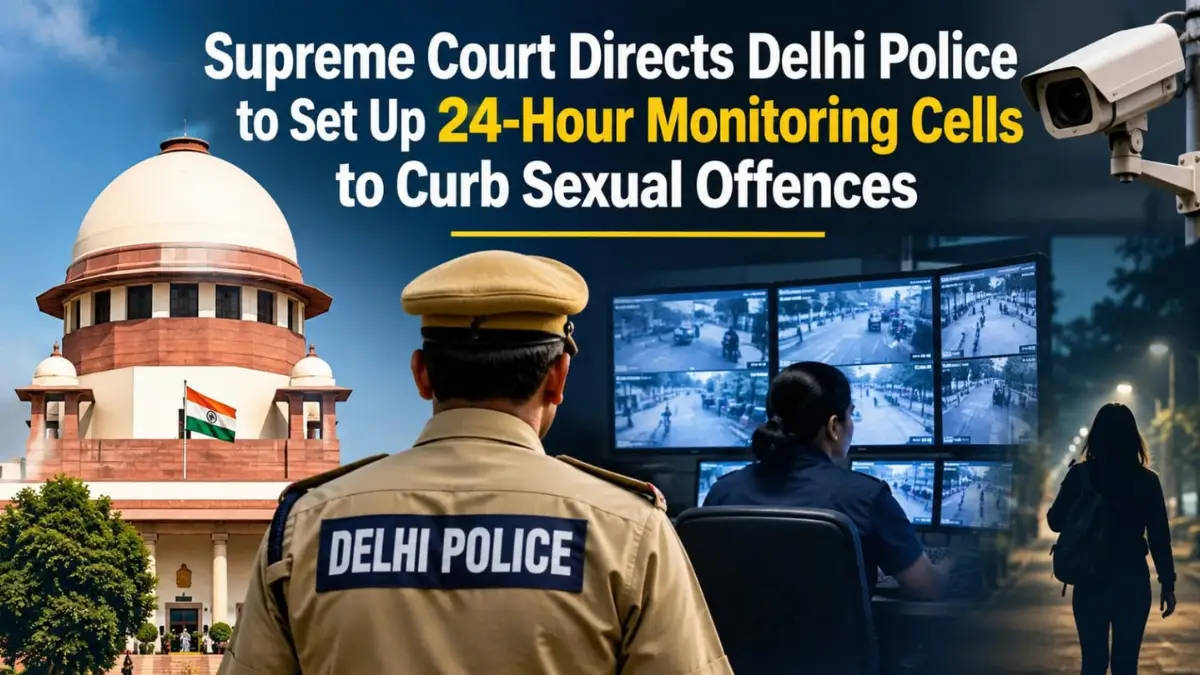
The Supreme Court has directed the Delhi Police to establish the 24-hour monitoring cells and strengthen the preventive measures to curb the sexual offences, particularly in the vulnerable areas of the national capital. The court stressed that surveillance through the CCTV cameras alone is not sufficient unless there is an effective and continuous monitoring and a quick police response.
A Bench comprising Justices J.B. Pardiwala and K. Vinod Chandran was hearing a suo motu case concerning the sexual assault incidents involving the minors and the women in the Delhi-NCR region. The court emphasised that the police must focus not only on investigating the crimes after they occur but also on preventing them through an effective surveillance, patrolling and the interaction with the local communities.
CCTV surveillance must be continuous
The Supreme Court observed that installing the CCTV cameras in the public spaces would serve little purpose if the continuous monitoring of the footage is not being done. The Bench questioned how cameras could help in the prevention of the crimes if the suspicious activities were not detected in time.
The court therefore asked the Delhi Police to create the 24-hour monitoring cells that are capable of keeping a track of developments in the vulnerable locations. Such monitoring, the court said, should help the police in the identification of the suspicious activity and in responding quickly before a crime takes place.
The Bench also called for a stronger police patrolling, particularly around the educational institutions, the colleges and the other public spaces where the women and the young students may be vulnerable.
Identify vulnerable areas and crime hotspots
The court directed the police to identify the areas where the sexual offences and the other anti-social activities are more likely to occur. It specifically referred to the locations where the groups of people harass the young women and the students, as well as the areas with illegal eateries and the establishments where the liquor is served.
The objective, according to the court, should be to identify such vulnerable pockets and ensure a visible and an effective police presence.
The Delhi Police acknowledged that there had been shortcomings in the police patrolling. The Supreme Court made it clear that preventive policing must become a priority rather than relying solely on the action after an offence has occurred.
Astha Kunj incident raises questions over police response
The Bench also referred to the reports concerning the gangrape of a 17-year-old girl at the Astha Kunj Park near the Lady Shri Ram College in New Delhi. According to the observations made in court, the residents had repeatedly raised concerns about the safety in the locality before the incident had occurred, but their complaints allegedly remained unaddressed due to the negligence of the police.
The court noted that residents had reportedly informed the police about the problems in the area, including the presence of the anti-social elements. The incident highlighted the importance of taking the public complaints seriously and acting on the information before it results in a serious crime.
Police urged to interact with society
The Supreme Court emphasised the need for the greater interaction between the police personnel and the local communities. It said that the police officers should not remain disconnected from the residents and should understand the concerns being raised by the people living in the vulnerable areas.
The Bench stressed the importance of one-to-one interaction with the society, telling the police officers that they have a responsibility to act as protectors. The regular engagement with the residents, the students and the educational institutions could help the police to identify the risks at an early stage, and also to take timely action.
Need to create deterrence
Justice J.B. Pardiwala also highlighted the importance of creating a sense of deterrence among the potential offenders. By referring to the upcoming festive season, he asked the Delhi Police to increase their vigilance activities and ensure that the incidents of sexual violence do not recur.
The court said that the law enforcement must create a genuine fear of legal consequences among the people who are inclined to commit such offences. Simply investigating crimes after they occur, the Bench suggested, is not enough.
The directions provided by the Supreme court underline a broader approach to policing in Delhi, the one that combines the 24-hour surveillance, the CCTV monitoring, the stronger patrolling, the identification of vulnerable locations and the regular community interaction. The focus is on the prevention of the sexual offences before they happen and ensuring that the complaints about the unsafe areas receive timely attention.
The directions also reinforce the principle that the public safety requires more than just the technology and an effective policing depends on the continuous monitoring, the police presence, the quick response and the sustained engagement with the communities that the law enforcement agencies are responsible for protecting.