
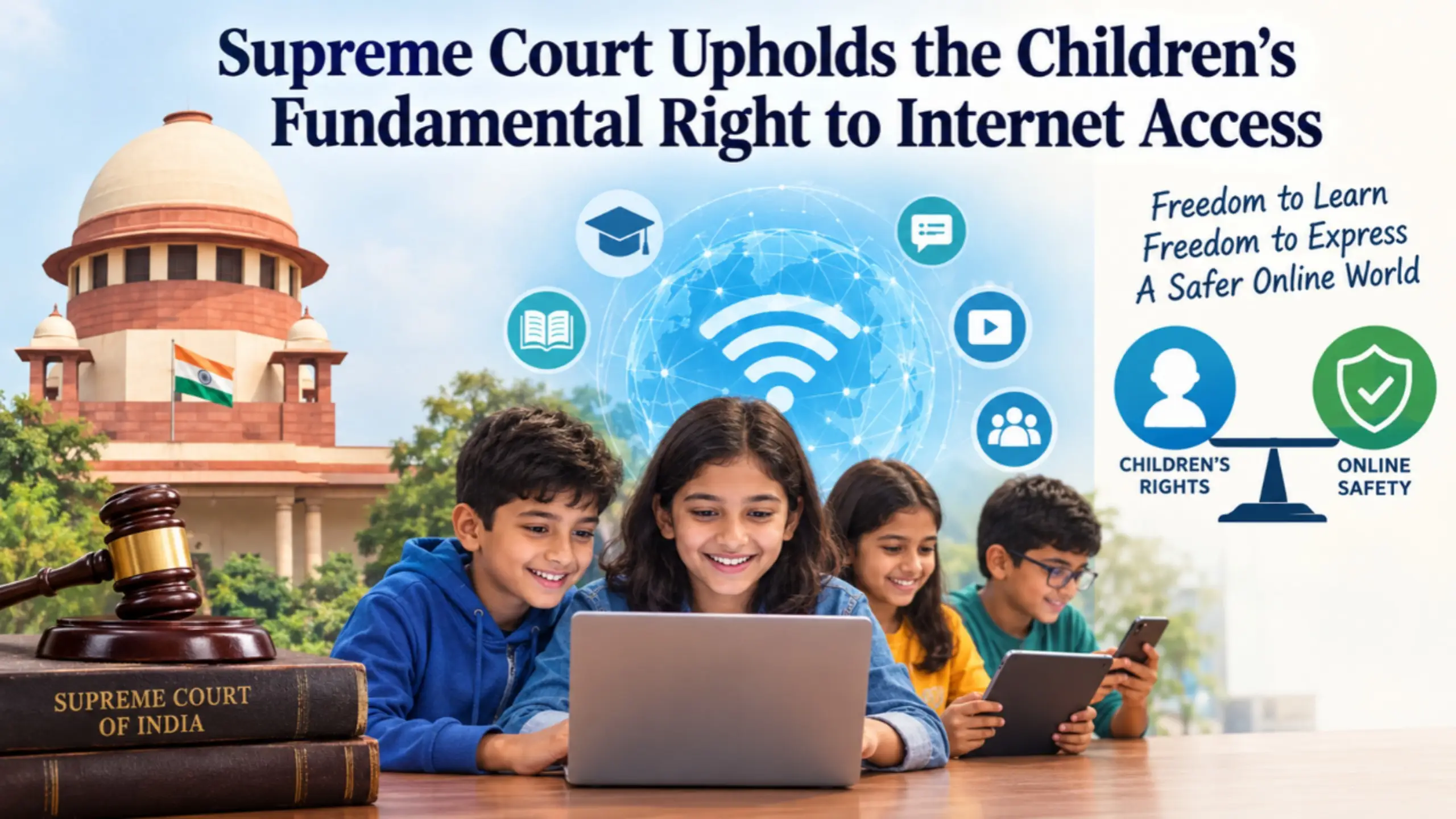
The Supreme Court of India has observed that the children, like all other individuals, have a fundamental right to access and use the Internet. The Court emphasised that the children are entitled to enjoy the same fundamental rights as the adults, including the right to freedom of speech and expression. At the same time, it highlighted the need to protect the children from the online dangers through the appropriate safeguards rather than imposing the blanket restrictions on their access to the Internet.
The Supreme Court’s Observation
A Bench that comprised of Justices J. B. Pardiwala and Vinod K. Chandran stated that the right to access and using the Internet is a fundamental right under Article 21, read with Article 19(1)(a) of the Indian Constitution.
The Article 21 of the constitution guarantees the right to life and personal liberty to a person, while the Article 19(1)(a) protects his or her freedom of speech and expression. The Court observed that denying these rights to the children merely because of their age would be unreasonable and unjustified. The children, like the adult individuals, have the right to express themselves and access the information.
The Bench stated that children are entitled to both the safety and the freedom. These twin objectives should not be treated as contradictory. Instead, the government, the parents, the educational institutions and the technology companies must work together to create a safe online environment for the children, so that they can remain safe as well as well informed.
Why Blanket Bans Are Not the Solution
The Supreme Court cautioned against imposing the blanket bans on the access of Internet by the children. According to the Court, such restrictions are unproven measures that may create more problems than they may solve.
The children continue to use the Internet even when the access is restricted by the parents or th authorities. They may turn to other platforms and websites that are unregulated and potentially more dangerous. Therefore, the strict prohibitions may push children towards the unsafe online spaces rather than protecting them.
The Court also noted that the excessive restrictions could discourage the children from reporting the incidents of online abuse. The children who are enticed, threatened or harassed online might hesitate to inform their parents or their guardians if they fear punishment for using the Internet.
Such atmosphere of fear could undermine the efforts to protect the children. Instead of encouraging the silence, the families and the authorities should create an environment in which the children can feel comfortable in reporting the online threats and seeking help if they are facing any challenges in using the online platforms.
Protecting Children from Online Dangers
Although the Court opposed the blanket bans, it acknowledged that the appropriate safeguards are necessary to ensure the online safety of the children. The increasing use of the social media and the digital platforms exposes the children to the cyberbullying, the online harassment, the inappropriate content and the other forms of exploitation.
The Court suggested that the greater emphasis should be placed on the parental consent, the guidance and the supervision. The parents should educate the children about the responsible use of the Internet, the privacy protection and the importance of avoiding the suspicious online interactions.
The Bench also recommended the introduction of a dedicated ‘child mode’ on the digital platforms, a feature could help in restrictong the access of the children to the age-inappropriate content and provide a safer online experience.
The technology companies, the law enforcement agencies, the educational institutions and the government authorities must also fulfil their responsibilities. The effective reporting mechanisms, the suitable content moderation and the awareness programmes can help in the prevention of the online abuse.
Balancing Freedom and Responsibility
The Supreme Court highlighted the importance of balancing the freedom of the children with their safety because merely protecting the children does not necessarily mean preventing them from accessing the digital technology. Instead, the focus should be on helping them in using the Internet more safely and responsibly.
The digital literacy is essential in this regard. The schools and the families should teach the children how to recognise the online risks, protect the personal information and report the harmful behaviour. The children should also understand that they can seek assistance without the fear of being blamed or punished.
Conclusion
The observations made by the Supreme Court represent an important step towards recognising the digital rights of the children in India. The Internet provides ample opportunities to the children for the education, the communication, the creativity and the personal development. The denial of these opportunities to the children through the blanket restrictions may adversely affect their growth and learning.
The need of the hour is to adopt a balanced approach that combines the freedom with an effective protection. The parental guidance, the age-appropriate safeguards, the child-friendly digital platforms and the stronger awareness programmes can help in achieving this objective.
Ultimately, the children have the right to access the Internet safely, freely and responsibly. Their protection should not come at the cost of their fundamental rights. Instead, the society must work together to ensure that the digital world becomes a safer and a more inclusive space for every child.