
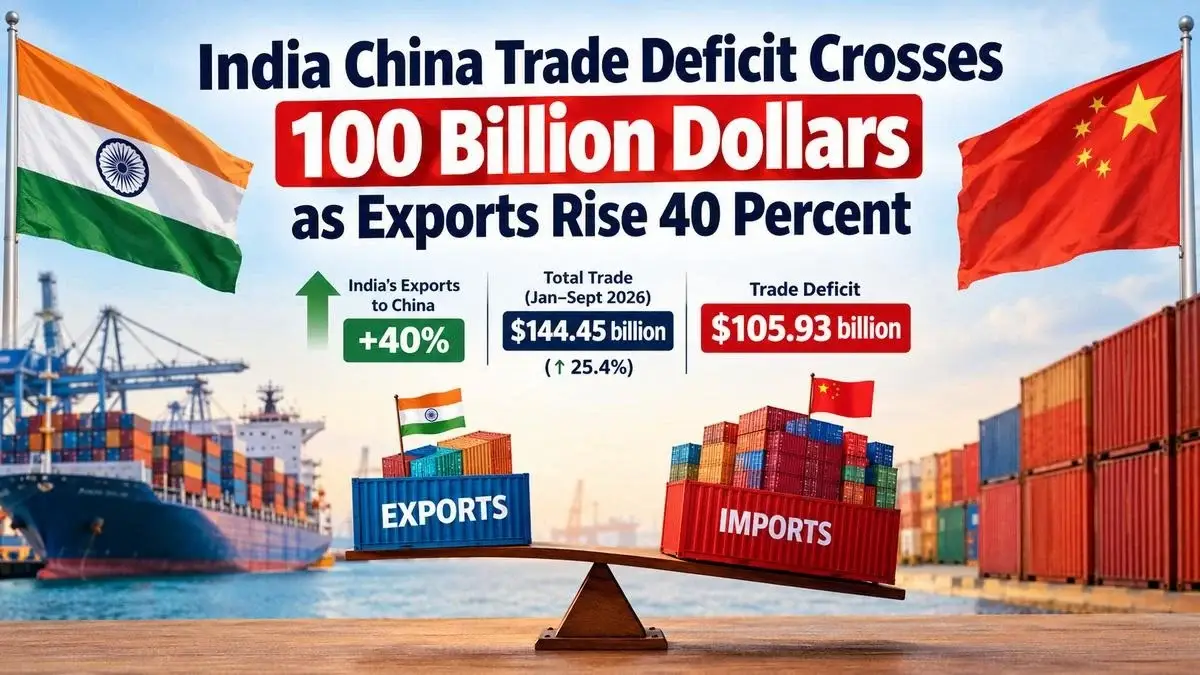
The exports of India to China have recorded strong growth during the first nine months of the year 2026, by rising approximately 40.7 per cent. However, the increase in the exports has not been sufficient to narrow the widening trade imbalance between the two countries, as the Indian trade deficit has crossed $100 billion, according to the figures reported by the Chinese General Administration of Customs.
Bilateral Trade Records Significant Growth
The two-way trade between India and China increased by 25.4 per cent on year-on-year basis to $144.45 billion between January and September 2026. During this period, the Indian exports to China have reached to $19.26 billion, while the imports from the neighbouring country have climbed by 23.3 per cent to $125.19 billion.
The difference between the imports and the exports has resulted in a trade deficit of $105.93 billion. The figure highlights the continuing imbalance in the bilateral economic relations between the two countries, despite the recent improvement in the Indian exports.
The exports of India have benefited from the increased shipments of the selected products, including the seafood, the naphtha and the printed circuit boards. Nevertheless, the overall value of the exports remains considerably lower than the imports made by India from China.
Dependence on Chinese Imports Remains a Concern
The China remains an important source of the industrial inputs, the machinery, the electronic components and the finished products for the Indian businesses. These imports support several sectors of the Indian economy, including the electronics the manufacturing, the pharmaceuticals, the renewable energy and the industrial production.
However, India has continued to depend on the Chinese goods and this dependence has raised the concerns about the supply-chain vulnerabilities and the competitiveness of the domestic manufacturing. Although importing the intermediate goods can support the local production, the substantial volume of the finished products that enter the Indian market presents significant challenges for the domestic manufacturers that seek to expand their market share.
The Reduction of this dependence does not necessarily mean the restriction on all the imports. Instead, India faces the challenge of strengthening the domestic production capacity, encouraging the technological development and diversifying its sources of essential materials.
Market Access and Trade Restrictions
Another significant concern for India is the access to the Chinese market. The Indian exporters have repeatedly sought the improved opportunities for selling their products in the Chinese market, particularly in the sectors where the Indian businesses have the competitive advantages.
At the same time, the Chinese export controls that affect certain products, including the fertilisers and the rare-earth-related materials, have highlighted the importance of the reliable supply chains. The restrictions involving the critical inputs can negatively affect and can have the consequences for the industries that heavily depend on these specialised materials for manufacturing.
Addressing these concerns will require a sustained bilateral engagement between the two governments. The better market access, the predictable trade policies and the transparent regulatory procedures could help the Indian businesses to expand the exports and to reduce some of the structural imbalances in the bilateral trade.
Diplomatic Engagement and Economic Relations
The widening trade deficit has remained an important issue in the discussions between the Indian Prime Minister Narendra Modi and the Chinese President Xi Jinping. During their recent engagement on the sidelines of the BRICS summit, both the leaders have emphasised the need to address the economic concerns and to strengthen bilateral relations.
India has highlighted the importance of correcting the structural trade imbalance, improving the market access and facilitating the predictable supply chains. China has also expressed support for addressing the economic and the trade concerns in a balanced manner.
These discussions indicate that the economic cooperation remains an important component of the broader relationship, even as both the countries navigate the strategic and the political differences between them.
The Road Ahead for India
The growth in the Indian exports to China represents a positive development, but the widening trade deficit between the two countries demonstrates that the growth in the exports alone may not be enough to correct the imbalance.
India will need to expand its export base, improve the product competitiveness, encourage the domestic manufacturing and pursue the greater access to the international markets. Supporting the exporters through better infrastructure, technological innovation and the streamlined trade procedures could also strengthen the position of India.
Ultimately, the objective is not necessarily to achieve a perfect and a balanced trade relation with China, but to establish a more sustainable economic relationship. The diversified supply chains, the stronger domestic industries and the increased export opportunities will be essential if India is to reduce the strategic vulnerabilities while continuing to benefit from the international commerce.